
Species Extinct for 6,000 Years Rediscovered Alive in New Guinea — One of the Greatest Biological Surprises of All Time
Date: March 8, 2026
Reading time: 25 minutes
Emoji: 🦘
Imagine discovering that an animal that science considered extinct for millennia is, in fact, simply living hidden in one of the most remote and inaccessible forests on the planet. That is precisely the extraordinary reality that an international team of biologists confirmed in March 2026: two species of marsupials that paleontologists believed had disappeared approximately 6,000 years ago were found alive, healthy, and actively reproducing in the remote tropical forests of the central highlands of New Guinea, in the Papua region. The discovery, published in the prestigious journal Nature Ecology & Evolution, sent shockwaves through the global scientific community and reignited fundamental debates about what "extinction" truly means, about the immense unknown biodiversity still hiding in Earth's last wild refuges, and about the desperate urgency of protecting these unique ecosystems before it is irrevocably too late.
What Are "Lazarus Species" and Why Are They So Fascinating?
From Dead to Alive: The Scientific Concept
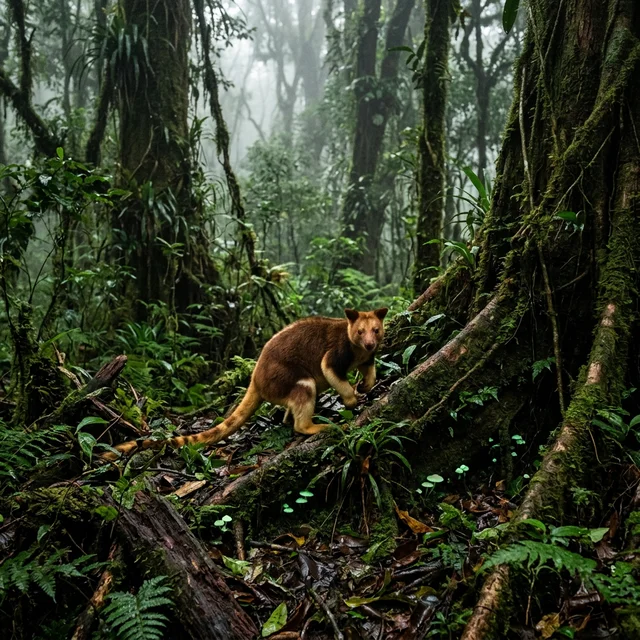
The term "Lazarus species" (Lazarus taxon) is one of the most evocative and emotionally charged in all of biology. Coined in 1983 by paleontologist Karl W. Flessa and biologist David Jablonski — in reference to the biblical character Lazarus who was raised from the dead — the term describes organisms that reappear in the fossil record or in the wild after a significant period of apparent absence, during which they were considered extinct by the scientific community.
In practice, a Lazarus species is an animal, plant, or fungus that "returns from the dead" — that is, rediscovered alive after having been officially declared extinct based on prolonged absence of scientific records. These rediscoveries profoundly challenge our assumptions about the limits and resilience of life, and frequently reveal that nature is significantly more persistent and ingenious than our scientific models had predicted.
The criteria for a species to be classified as "Lazarus" include:
- Prolonged absence: The species must have been considered extinct (or presumed extinct) for a minimum period ranging from decades to millennia, depending on the taxonomic group
- Fossil or scientific record: Prior scientific documentation must exist (fossils, museum specimens, historical records) that proves the species' previous existence
- Verifiable rediscovery: The rediscovery must be confirmed by taxonomists and published in peer-reviewed scientific journals, with irrefutable genetic and morphological evidence
- Reproductive viability: Ideally, the rediscovered population must demonstrate reproductive capacity, indicating that it is not an isolated individual but an ecologically viable population
The Most Famous Lazarus Species Cases in History
The history of biology is filled with extraordinary rediscoveries that captured the public imagination and transformed our understanding of global biodiversity:
| Species | Declared Extinct | Rediscovered | Period "Missing" |
|---|---|---|---|
| Coelacanth (Latimeria chalumnae) | ~65 million years (fossil record) | 1938 (South Africa) | 65 million years |
| Takahē (Porphyrio hochstetteri) | 1898 | 1948 (New Zealand) | 50 years |
| Lord Howe Island Stick Insect | 1920 | 2001 (Ball's Pyramid, Australia) | 81 years |
| Pygmy Tarsier (Tarsius pumilus) | 1921 | 2008 (Sulawesi, Indonesia) | 87 years |
| Kawali Rat (Paucidentomys vermidax) | Never recorded | 2012 (Sulawesi) | Entirely new species |
| New Guinea Marsupials | ~4,000 BCE | 2026 (Papua) | ~6,000 years |
The New Guinea Discovery: How It Happened
The Expedition That Changed Everything
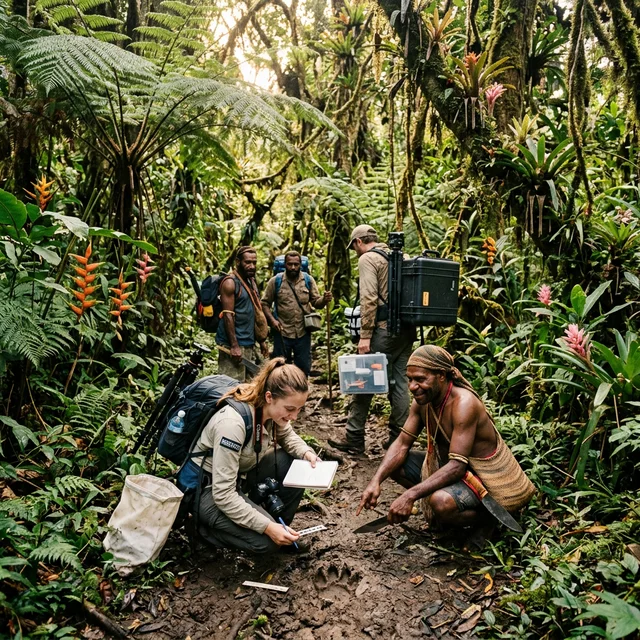
The story of the rediscovery begins in October 2024, when a multidisciplinary team of researchers from the Australian Museum, the University of Papua New Guinea, and the Max Planck Institute for Evolutionary Biology launched a biological mapping expedition into the mountainous tropical forests of New Guinea's central cordillera — a region so remote and inaccessible that some areas had never been visited by Western scientists. The expedition was part of the "Lost Species Initiative," funded by the National Geographic Society and the Australian Research Council, with the ambitious goal of cataloging the still-unknown fauna of high-altitude forests above 2,000 meters.
What the researchers found surpassed all expectations and most optimistic dreams. Using a combination of intelligent motion-sensor camera traps, environmental DNA (eDNA) analysis extracted from soil and water samples, and ultra-frequency nocturnal acoustic tracking, the team detected the presence of two marsupial species that had never been recorded alive anywhere in the world — and were known only from fossil fragments dated to approximately 6,000 years ago, found in sedimentary deposits in continental Australia and in caves throughout Papua New Guinea.
The definitive confirmation came through complete genomic sequencing carried out at the Australian Museum's genomics laboratory in Sydney. DNA analyses revealed that the captured specimens were genetically identical to the known fossils, with less than 0.3% genetic divergence — an extraordinarily low value for a temporal separation of six millennia, indicating that these populations had survived in relative genetic isolation in New Guinea's montane forests throughout this entire period.
The Two Rediscovered Species
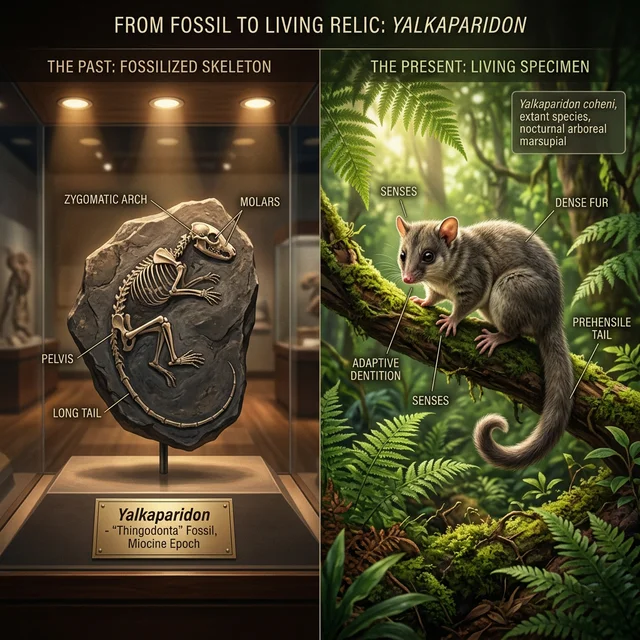
The first rediscovered species is a small nocturnal arboreal marsupial with dense golden-brown fur, enormous eyes adapted for night vision, and a prehensile tail that it uses to move between the tree canopies of high-altitude cloud forests. The animal weighs approximately 400 grams and feeds primarily on insects, fruit, and tree sap. Paleontologists knew this species only from jaw and tooth fossil fragments found in mid-Holocene deposits in the Kimberley region of northwestern Australia, and assumed it had been driven to extinction by the climatic drying that transformed much of Australia into desert between 6,000 and 4,000 years ago.
The second species is significantly larger — a terrestrial marsupial roughly the size of a European rabbit, weighing approximately 1.2 kilograms, with dark gray fur and distinctive white markings around the eyes that give it an unmistakably striking appearance. This animal inhabits the tropical forest floor, where it digs shallow burrows among the roots of giant trees and feeds on roots, tubers, worms, and soil invertebrates. Fossils of this second species were more abundant, found in at least seven archaeological sites in New Guinea and tropical Australia, suggesting that in the past it had a much wider geographic distribution.
Why Is New Guinea the Last Refuge of Lost Biodiversity?
A Natural Noah's Ark
New Guinea — the world's second-largest island, split politically between Papua New Guinea (eastern half) and the Indonesian province of Papua (western half) — is widely recognized by the scientific community as one of the last great bastions of untouched biodiversity on Earth. With more than 786,000 km² of territory, the island presents extraordinary topographical diversity: from sea-level coastal plains to glacial peaks exceeding 4,800 meters in altitude at Mount Wilhelm (Oceania's highest point), passing through mangrove forests, extensive swamps, extremely dense lowland tropical forests, and mountain cloud forests — one of the most biodiverse and least explored ecosystems on Earth.
The factors that make New Guinea a unique biological refuge include:
- Geographic isolation: New Guinea separated from continental Australia approximately 8,000 years ago, when rising sea levels after the last Ice Age flooded the land bridge connecting the two landmasses. This isolation allowed species that disappeared from the Australian continent to survive in the island's montane forests, protected from the climate changes and anthropogenic pressures that devastated the continental fauna
- Extreme topography: New Guinea's central cordillera creates a physical barrier that isolates entire valleys and drainage basins, functioning as "islands within an island" where species can evolve and survive in complete isolation for thousands of years without contact with the outside world
- Low human density: Much of the central highlands of New Guinea remains with extremely low population densities — frequently less than 2 people per km². Vast expanses of primary forest have never been cleared, mined, or converted to agriculture, maintaining intact ecosystems that date back millions of years
- Extraordinary endemic biodiversity: New Guinea harbors more than 5% of global biodiversity on just 0.5% of Earth's land surface. The island is home to more than 13,000 plant species, 800 bird species (including all 39 species of birds-of-paradise), 400 amphibian species, and an unknown number of mammals — many of which have not yet been cataloged by science
The Critical Importance of Montane Forests
The high-altitude cloud forests (between 2,000 and 3,500 meters) where the Lazarus marsupials were found are particularly unique and fragile ecosystems. These forests are permanently enveloped in mist and clouds, with average temperatures between 10°C and 18°C — significantly cooler than the tropical lowlands below. The permanent relative humidity above 90% sustains an incredible diversity of mosses, ferns, epiphytic orchids, and lichens that cover every available surface, creating a three-dimensional green world stretching from roots to canopy.
These forests function as "climate refugia" — environments where conditions have remained relatively stable over thousands of years, even as the global climate underwent dramatic changes. For species adapted to cold and humidity, these forest islands on tropical mountains represented the last viable bastion of habitat when the lowlands below became warmer and drier during the Holocene climate cycles.
Other Historic Rediscoveries: The Tradition of Lazarus Animals
The Coelacanth: The World's Most Famous Living Fossil
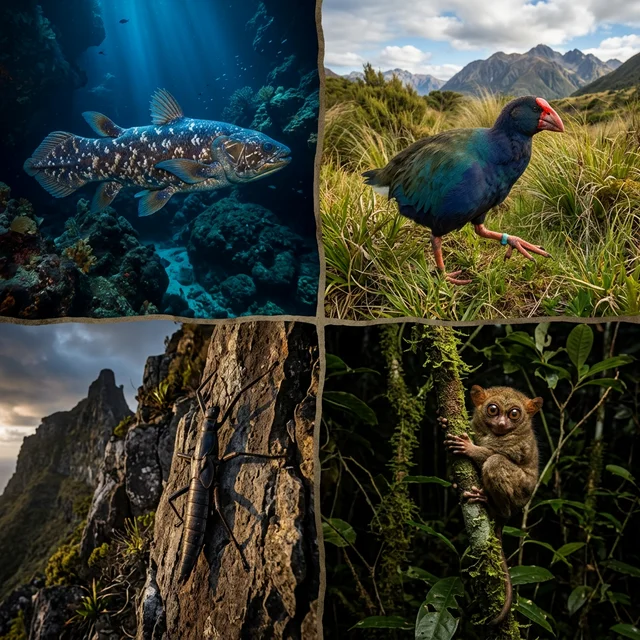
Perhaps the most celebrated and spectacular Lazarus species case in the history of science is that of the coelacanth (Latimeria chalumnae), a primitive fish that paleontologists believed had gone extinct along with the dinosaurs 65 million years ago. The coelacanth's fossil record was extensive and well-documented, showing that these fish had thrived in the oceans from the Devonian to the Cretaceous — and then vanished completely from the geological record. Science considered the coelacanth as unequivocally extinct as trilobites or pterodactyls.
In December 1938, a local museum curator in the city of East London, South Africa, named Marjorie Courtenay-Latimer, received a call from a fishing boat captain who had caught an enormous and unusual fish in his nets. When Courtenay-Latimer examined the animal — a bluish fish 1.5 meters long with lobed fins resembling limbs — she immediately realized she was looking at something extraordinary. After consulting ichthyologist J.L.B. Smith, the identification was confirmed: it was a living coelacanth, an animal that science had considered extinct for 65 million years.
The news of the coelacanth's rediscovery made headlines worldwide and revolutionized paleontology. Since then, two populations have been confirmed: Latimeria chalumnae in the deep waters of the Indian Ocean around the Comoro Islands and the coast of South Africa, and Latimeria menadoensis, a second species discovered in 1997 in Indonesian waters. Both are critically endangered, with populations estimated at only a few hundred individuals.
New Zealand's Takahē
Another emblematic case is the takahē (Porphyrio hochstetteri), a large bird from New Zealand that was declared extinct in 1898 after the last known specimen was captured. The takahē was a flightless bird with iridescent blue-green plumage and a bright red beak. Fifty years later, in 1948, physician and naturalist Geoffrey Orbell led an expedition to the remote Murchison Mountains on New Zealand's South Island and found a small colony of takahēs living in isolated highland valleys. The population was extremely small — only about 250 individuals — but it was actively reproducing. Since then, intensive conservation programs have raised the population to more than 500 birds.
Lord Howe Island's Stick Insect
The Lord Howe Island stick insect (Dryococelus australis), also known as the "tree lobster," was declared extinct in 1920 following the accidental introduction of black rats to the small Australian island of Lord Howe. These invasive rodents devastated the entire insect population within a few years. However, in 2001, climbers discovered a tiny colony of just 24 individuals surviving precariously on a single bush on the steep face of Ball's Pyramid — an isolated volcanic pinnacle 23 km from the main island, essentially a needle of rock emerging from the ocean. A captive breeding program at Melbourne Zoo saved the species from definitive extinction using only two founding pairs.
What Science Doesn't Know: The Taxonomic Darkness
The Problem of "Unknown Numbers"
The rediscovery of New Guinea's marsupials exposes a fundamental and deeply troubling problem in contemporary biology: we simply have no idea how many species exist on the planet. Scientific estimates vary enormously — from 8.7 million to over 1 trillion species, depending on whether microorganisms are included. Of what we call "macrolife" (animals, plants, and fungi visible to the naked eye), conservative estimates suggest we know only between 15% and 20% of existing species.
This "taxonomic darkness" means that species are going extinct before being discovered by science — a phenomenon biologists call "centrifugal extinction," where species disappear from records from the outside in, from the most remote peripheries to the most studied biodiversity centers. Each year, an estimated 10,000 to 100,000 species are permanently lost, most without ever having been given a scientific name.
Implications for Global Conservation
The rediscovery of New Guinea's marsupials has profound and immediate implications for global conservation policy:
- Reassess extinction lists: If species declared extinct 6,000 years ago can be found alive, how many species declared extinct in the past 200 years might actually still survive in undiscovered remote populations? The IUCN (International Union for Conservation of Nature) has announced it will review extinction classification criteria in light of this discovery
- Prioritize exploration of remote areas: The planet's last unexplored ecosystems — New Guinea's montane forests, isolated valleys of the Amazon, underground caves of Southeast Asia — must receive maximum priority for biological mapping expeditions before deforestation and climate change destroy these critical refuges
- Protect the last refuges: New Guinea's montane forests are under growing threat from mining, agricultural expansion, and climate change. If these forests are destroyed, species that survived 6,000 years of "extinction" will finally be lost forever
- Value indigenous knowledge: The indigenous communities of New Guinea always knew about these animals — they simply had not been listened to by Western science. This case reinforces the critical importance of integrating traditional indigenous knowledge into biological research and conservation programs
The Future: Protection or Definitive Extinction?
Growing Threats to the Last Refuges
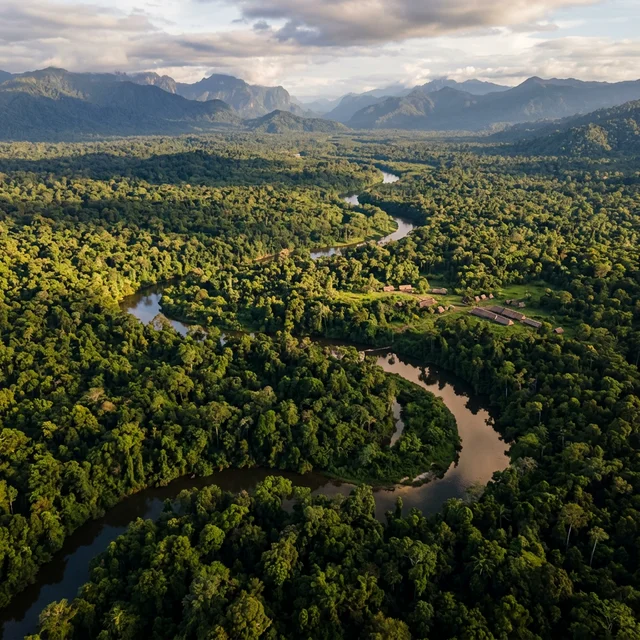
Despite the euphoria of the rediscovery, the biologists involved express urgent and justified concern. The same forests that protected these marsupials for millennia now face unprecedented threats advancing at an ever-increasing pace:
- Mining: Papua New Guinea possesses vast reserves of gold, copper, nickel, and natural gas. Large-scale mining projects are expanding into increasingly remote areas, destroying primary forests and polluting rivers with heavy metals and toxic sediments
- Climate change: Global warming is pushing temperature zones to ever-higher altitudes. Cloud forests — which depend on cool temperatures and constant humidity — are literally being "pushed uphill" as temperatures rise, progressively reducing the available habitat area for cold-adapted species
- Illegal logging: Timber companies, many operating illegally or with dubious concessions, are felling high-biological-value primary forests at an accelerating pace, frequently with little or no government oversight
- Population growth: Papua New Guinea has one of the highest population growth rates in the Pacific, generating constant pressure to convert forests into agricultural land to feed a growing population
Urgent Conservation Actions
In response to the rediscovery, international conservation organizations have launched a coordinated effort to protect the forests where the marsupials were found:
The National Geographic Society announced a $2 million emergency fund to finance community-based forest protection patrols and establish a permanent research station in the region. The government of Papua New Guinea declared a temporary moratorium on mining and logging in the rediscovery area, though the duration and effectiveness of this protection remain uncertain. The Australian Museum has initiated a long-term genetic monitoring program to assess the size and genetic diversity of the rediscovered populations, essential information for developing conservation strategies based on solid scientific evidence.
Conclusion: Nature Still Has Secrets
The rediscovery of living marsupials after 6,000 years of "extinction" is more than a scientific curiosity — it is a powerful and humbling reminder of how little we truly know about the diversity of life on Earth. In an era of satellites mapping every square meter of the Earth's surface, drones flying over inaccessible forests, and artificial intelligence processing images from remote cameras, vast expanses of the planet still exist where wildlife thrives completely beyond the reach of human knowledge and our capacity for observation.
But this rediscovery is also an urgent and desperate warning. The wild refuges that protected these species for millennia are disappearing at an alarming rate. If we do not act now — with significant investments in conservation, protection of indigenous lands, and combating climate change — species that elegantly survived 6,000 years of "extinction" may finally succumb in mere decades to the destruction caused by unchecked human activity.
As Dr. Kristofer Helgen, the Australian Museum mammalogist who led the expedition, has said: "These species survived everything nature threw at them for millennia — ice ages, droughts, volcanoes. The question is whether they will survive us."
Sources and References
- Australian Museum — Lost Species Initiative — Species rediscovery program
- Nature Ecology & Evolution — Original scientific publication
- IUCN Red List — Threatened species red list
- National Geographic — New Guinea Biodiversity — New Guinea biodiversity
- Max Planck Institute — Evolutionary Biology — Evolutionary genomics
- Conservation International — Papua New Guinea — Conservation in PNG


