Have you ever caught yourself repeating the exact same mistakes you swore you'd never make? Have you entered the same kind of destructive relationship for the third time? Have you sabotaged an achievement at the very moment everything was going right? If you answered "yes" to any of these questions, there's an explanation — and it's not in your present. It's in the generations that came before you. The ebook "Echo of the Ancestors: Breaking Free from Invisible Choices", by Loester Silva, unravels this mechanism with an approach no self-help book offers: the analytical mind of a programmer with 30+ years of experience dissecting bugs — only this time, the bugs are emotional.
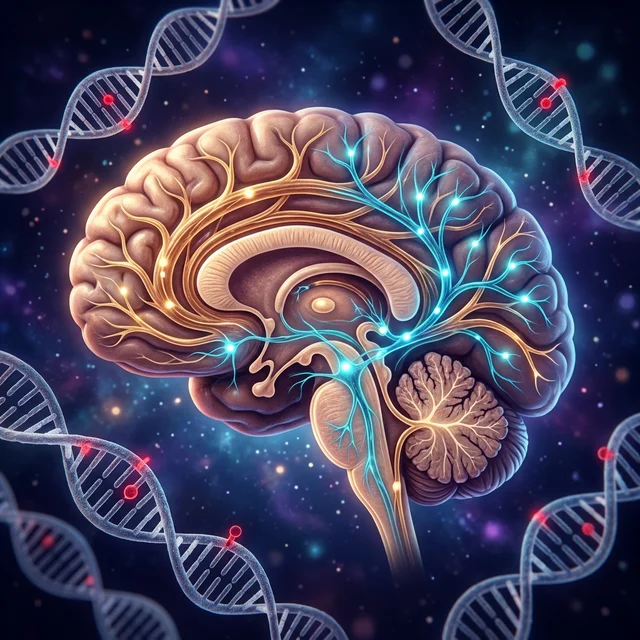
The Science That Proves It: You're Not as Free as You Think
Before dismissing this as "just another self-help book," consider this: science has already proven that traumas are transmitted genetically.
Researchers at Emory University (USA) conditioned mice to fear a specific smell. The offspring and grandchildren of those mice — who were never exposed to the conditioning — were already born with a fear of that same smell. The trauma had been inscribed in the DNA.
If this happens in mice, imagine what three, four, five generations of fears, guilt, and beliefs do to you.
| Scientific Discovery | What It Means for You |
|---|---|
| Epigenetics — experiences activate/deactivate genes | Your grandmother's fears may be coded in your DNA |
| ACE Study (17,000 adults) — childhood traumas cause diseases | Each childhood trauma reduces life expectancy by up to 20 years |
| Polyvagal Theory (Stephen Porges) | Your nervous system operates in survival mode without you knowing |
| Theta waves (Bruce Lipton) | Until age 7, your brain was in hypnosis — absorbing EVERYTHING |
"Until you make the unconscious conscious, it will direct your life and you will call it fate." — Carl Jung

What the Book Reveals: 9 Chapters That Change How You See Yourself
The ebook is divided into three parts that work as an archaeological dig into your psyche:
🔍 Part 1 — Understanding (Chapters 1-3)
You'll discover how the first 7 years of your life installed "programs" that still run today — without your consent. Real stories like Marina's, who went through three failed marriages before discovering that three generations of women in her family had been abandoned. She didn't have "bad luck in love." She had emotional software programmed for rejection.
🔎 Part 2 — Identification (Chapters 4-5)
Practical tools to identify invisible patterns: the Three-Column Diary, the Emotional Genogram, the Pattern Audit. Here you stop guessing and start seeing.
🌱 Part 3 — Healing and Transformation (Chapters 6-9)
The 4 Pillars of Healing (Safety, Awareness, Compassion, Consistent Action) + a 30-Day Plan to begin transformation. It's not magic. It's neuroplasticity — the proven ability of the adult brain to create new neural pathways at any age.

Quick Test: How Many Patterns Do You Carry?
Answer honestly:
- Do you repeat the same type of conflict in different relationships?
- Do you feel anxiety without apparent cause?
- Do you sabotage achievements when you're close to success?
- Do you struggle to express affection — or express it excessively?
- Do you handle money the same way (chaotic or restrictive) as your family?
- Are your children showing patterns you recognize from your parents?
If you checked 2 or more, this book was written for you. Not as comfort — as a map.
5 Lessons Every Parent Should Know (Straight from the Book)
"I am not my patterns." They pass through me, but they are not my self. They are software, not hardware. And software can be updated.
"Awareness is the first step." I can't change what I can't see. But what I bring to consciousness loses its power to control me.
"Compassion is not weakness." Treating yourself with kindness creates the neurological conditions for genuine change.
"The cycle can stop with me." I am the link that can transform the chain. What I heal, my children won't need to carry.
"It's never too late." Neuroplasticity exists at any age. Healing has no expiration date.
"Every code can be refactored. Every pattern can be rewritten. Including yours." — Loester Silva
Therapies Recommended by the Book (With Clear Guidance)
| Therapy | Focus | For Whom |
|---|---|---|
| EMDR | Memory reprocessing | Traumas with flashbacks |
| Cognitive-Behavioral Therapy | Thought patterns | Distorted beliefs |
| Somatic Therapy | Trauma stored in the body | Chronic pain without cause |
| Schema Therapy | Deep emotional patterns | Repetitive relationships |
| Family Constellation | Transgenerational dynamics | Cyclical family patterns |
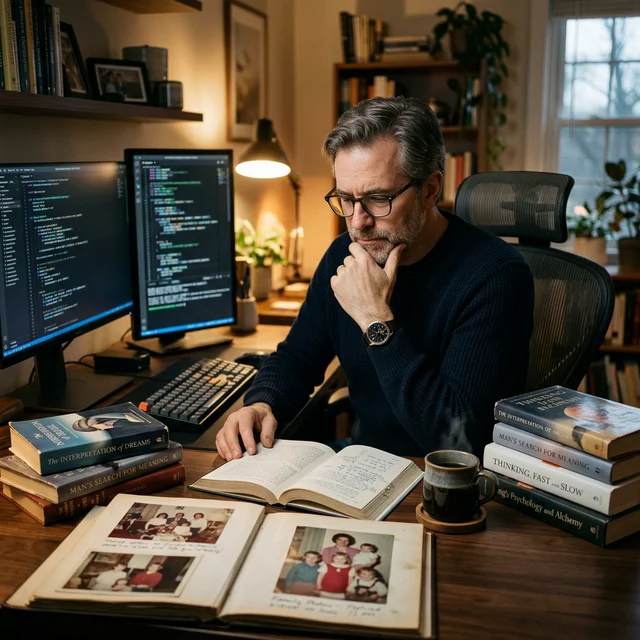

🎤 Chat with the Author: Loester Silva
Mundo Incrível: A programmer writing about psychology and trauma — how did that happen?
Loester Silva: I spent over 30 years doing debugging — finding flaws in complex systems. At some point, I realized my own life had recurring bugs. The same conflicts, the same frustrations, the same loops. When I started looking at the origin of those patterns, I discovered the source code had been written before I had a choice. It was written in childhood, by my parents, who inherited it from their parents.
MI: What was the moment that made you think "I need to write about this"?
LS: When I realized I was reproducing in my own relationships the exact same patterns I criticized in my parents. It's a brutal shock. You look in the mirror and recognize the gestures of someone you swore you'd never imitate. That's when I understood this wasn't my weakness — it was inherited code. And code can be rewritten.
MI: What did programming teach you about the human mind?
LS: That every system has a root cause. In programming, when an error repeats, you don't blame the program — you go to the source code. With emotions, it's the same. If the same pattern appears in your relationships, finances, health — the bug isn't on the surface. It's in the first years of life, in the first lines of code written without your consent.
MI: What do you hope the reader takes from this book?
LS: One thing: that they are not what they inherited. We are the temporary result of patterns that can be modified. Neuroscience has proven it. The book is the debugging manual. But the programmer is the reader. Literally seeking to awaken, day by day.
MI: This is your first book. How does it feel?
LS: It's like deploying the first version of software you know will need updates. But version 1.0 needs to ship — because someone might be stuck in a loop right now, not knowing there's a way out. If this book helps one person see the pattern and break it, every line I wrote was worth it.
About the Author
Loester Silva is a programmer with over 30 years of experience, with a career marked by the pursuit of understanding systems — both digital and human. A financial markets and blockchain technology enthusiast, he is currently developing his own blockchain focused on eliminating scams in the crypto world.
"Echo of the Ancestors" was born from the conviction that the same debugging principles he applied for decades to fix system failures can be applied to the emotional patterns we inherit without choice.
"Literally seeking to awaken day by day." — That's how Loester describes his journey.
This is his first book.
Where to Read the Ebook
📖 The full ebook is available for free. [Link coming soon]
Frequently Asked Questions
Do I need psychology knowledge to understand this book?
No. The book was written for anyone, using technology metaphors and accessible language. Scientific references are there for support, but the writing is conversational and direct.
Does the book replace therapy?
No. The author is emphatic: for severe trauma, seeking professional help is essential. The book is a self-knowledge tool and a map — not a clinical treatment.
How soon will I see results?
The book includes a 30-Day Plan to start the process. Results vary, but awareness — once awakened — is already irreversible. As a Chinese proverb cited in the book states: "The best time to plant a tree was twenty years ago. The second best time is now."
Why trust a programmer to talk about emotions?
Precisely because the perspective is different. The analytical debugging approach applied to emotional patterns offers a lens that traditional self-help books don't have. Moreover, all claims are backed by research from neuroscientists like Bessel van der Kolk, Bruce Lipton, Gabor Maté, and Stephen Porges.
Is the book too heavy to read?
There are intense moments, yes — because truths about ourselves tend to hurt. But there are practical exercises in each chapter, real stories that create connection, and the author's tone is that of a fellow traveler, not a guru.
📖 Get the Ebook
Want to dive deeper and start your emotional liberation journey? The ebook "Echo of the Ancestors: Breaking Free from Invisible Choices" is available on Amazon:
- 🇺🇸 English Version: Buy on Amazon US
- 🇧🇷 Versão em Português: Buy on Amazon Brazil
- 🇪🇸 Versión en Español: Buy on Amazon Spain
Read Also
Sources: Emory University (epigenetic study in rodents), ACE Study — Kaiser Permanente/CDC (Felitti & Anda, 1998), Dr. Bessel van der Kolk — "The Body Keeps the Score", Dr. Bruce Lipton — "The Biology of Belief", Gabor Maté — "When the Body Says No", Stephen Porges — Polyvagal Theory, Kristin Neff — Self-Compassion Research, John Bowlby — Attachment Theory.