
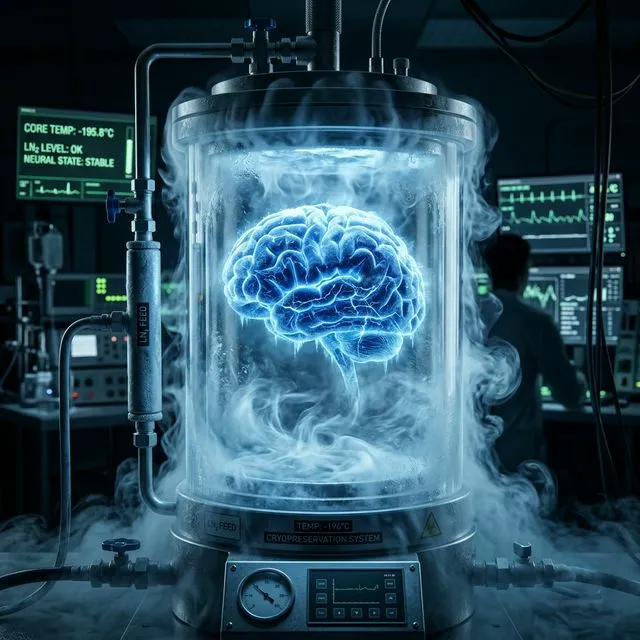
In a laboratory at Fudan University in Shanghai, something that exclusively belonged to the universe of science fiction just became experimental reality. For the first time in the history of neuroscience, researchers froze rat brain tissue at -196°C — the temperature of liquid nitrogen — and then successfully thawed it, observing the restoration of synaptic activity and neural function. The study, published in Cell Reports Methods in February 2026, represents a qualitative leap for cryobiology and reignites the debate about the feasibility of human cryogenics.
We're not talking about freezing an entire body and "waking it up" decades later — at least, not yet. But what this team led by Dr. Zhicheng Shao demonstrated is that neurons can survive the cryogenic vitrification process and resume their electrical activity when rewarmed. For a field that accumulated decades of failures and skepticism, this is equivalent to proving that, in principle, the brain can be preserved and reactivated.
What Exactly the Scientists Did
The experiment followed an approach known as vitrification — a process that radically differs from conventional freezing. When water freezes normally, it forms ice crystals that pierce cell membranes like thousands of microscopic needles. That's why, historically, freezing biological tissue meant destroying it.
Vitrification solves this problem by replacing water with cryoprotectants — chemical substances that prevent crystal formation. The Fudan team developed a specific cocktail called MEDY, composed of methylcellulose, ethylene glycol, DMSO, and Y27632 (a ROCK inhibitor). When applied to brain tissue before cooling, MEDY transforms intracellular liquid into a vitreous state — like liquid glass — without forming ice.
The experimental protocol:
| Step | Procedure | Duration |
|---|---|---|
| 1. Extraction | Brain organoids extracted from rats | ~2 hours |
| 2. Incubation | Tissue immersed in MEDY solution | 30 minutes |
| 3. Vitrification | Cooling to -196°C in liquid nitrogen | Instantaneous |
| 4. Storage | Maintained in liquid nitrogen | 24h to 18 months |
| 5. Thawing | Controlled gradual rewarming | ~15 minutes |
| 6. Assessment | Viability and neural activity tests | 48-72 hours |
The results were unequivocal: 80% of neurons in vitrified organoids survived the process, compared to less than 10% in controls frozen without the MEDY cocktail. More importantly, surviving neurons weren't merely alive — they fired action potentials, formed new synapses, and exhibited electrical activity patterns indistinguishable from fresh tissue that was never frozen.
Why This Is Different from Everything Before
Cryobiology isn't new. Since the 1960s, companies like the Alcor Life Extension Foundation have offered post-death "preservation" services, charging between $80,000 and $200,000 to vitrify the entire body or just the head of people hoping to be "resurrected" by future technology. Currently, about 500 people are cryopreserved worldwide, with another 4,000 on waiting lists.
The problem was that, until now, no one had demonstrated that complex neural tissue could survive the freeze-thaw cycle with its functions intact. There were successful studies with embryos, eggs, and even small worms (C. elegans), but the brain — with its extraordinarily complex architecture of trillions of synapses — was considered impossible.
What changes with this study:
- Proof of concept: for the first time, there's experimental evidence that neural activity can survive vitrification
- Extended period: tests showed tissue stored for 18 months had results as good as tissue stored for 24 hours
- New cryoprotectant: the MEDY cocktail is more effective than any previously tested solution for neural tissue
- Human organoids: the team also successfully tested with organoids derived from human cells, not just rats

The Path to Human Cryosleep
Before any premature enthusiasm, it's essential to understand the distance between freezing a few-millimeter organoid and a 1.4 kg human brain. The remaining challenges are formidable:
Scale: Human brain organoids used in the study were a few millimeters in diameter. An adult human brain has billions of neurons distributed in a volume roughly 100,000 times larger.
Toxicity: Cryoprotectants, including DMSO and ethylene glycol in MEDY, are toxic at high concentrations. In small organoids, the necessary concentration is tolerable. In a whole organ, the dosage needed could damage the cells it intends to preserve.
Uniform Rewarming: Perhaps the greatest technical challenge. If different brain regions rewarm at different speeds — which is inevitable in a large organ — mechanical and thermal stresses can rupture synaptic connections.
Consciousness and Identity: Even with perfect structural preservation, a philosophical question remains: would consciousness survive? Would the "self" before freezing be the same "self" that awakens?
More Immediate Applications
While science fiction cryosleep remains distant, practical applications are much closer:
- Neural tissue banks: hospitals could maintain cryopreserved brain organoid banks for transplant in patients with traumatic brain injuries, stroke, or neurodegenerative diseases
- Pharmaceutical research: cryopreserved human brain organoids could replace animal models for neurological drug testing
- Long-duration space travel: NASA considers cryosleep a critical technology for crewed Mars missions (6-9 month journey)
- Emergency preservation: in severe trauma scenarios, rapid brain vitrification could "pause" neural degradation until appropriate treatment is available

The Commercial Cryogenics Race
The competitive landscape is heating up. Alcor reported a 340% increase in inquiries after the Fudan study. Tomorrow Biostasis (Berlin) raised €40 million and is building a 4,000-body facility. Cradle (San Francisco) received $67 million from a16z and works directly with the Fudan team.
| Company | Country | Price | Patients | Approach |
|---|---|---|---|---|
| Alcor | USA | $200k (body) / $80k (head) | 232 | Full-body vitrification |
| Tomorrow Bio | Germany | €200k+ | 12 | Full-body vitrification |
| Cradle | USA | In development | — | Brain vitrification (MEDY) |
| Nectome | USA | $10k (deposit) | — | Aldehyde + digitization |
FAQ
Is human cryosleep possible now?
No. The study demonstrated viability in brain organoids (structures of a few millimeters). Freezing and thawing an entire human brain with preserved functions is still decades away.
How much does cryopreservation cost today?
Between $28,000 (head only, Cryonics Institute) and $200,000 (full body, Alcor).
Can cryopreserved people currently be resurrected?
Not with current technology. The promise is that future advances may make this possible, but there's no guarantee.
What's the difference between freezing and vitrification?
Conventional freezing forms ice crystals that destroy cells. Vitrification uses cryoprotectants to transform liquid into a vitreous state (like glass), avoiding crystals and preserving cellular structure.
Sources and References
- Shao, Z. et al. (2026). "Cryopreservation of human brain organoids with resumed neuronal activity." Cell Reports Methods
- Alcor Life Extension Foundation — Annual Report 2025
- NASA Torpor Inducing Transfer Research — Johnson Space Center (2025)
- Magalhães, J.P. de (2026). Commentary: "A watershed moment for cryobiology." Nature Neuroscience


