400-Year-Old Giant Black Coral Discovered in New Zealand
Deep within the silent and dark fjords of Fiordland, New Zealand, stands a living monument of Earth's history. In a scientific expedition completed in June 2026, marine biology researchers discovered a colossal black coral colony (Antipatharia) measuring an impressive 4 meters in height and 4.5 meters in width. Detailed analysis of the structure revealed that the organism is approximately 400 years old, having begun its slow growth in the early 17th century, long before the arrival of the first European settlers in the region. This finding is an invaluable scientific milestone for studying historical ocean changes and highlights the unique ecological importance of the Fiordland marine ecosystem.
What Happened
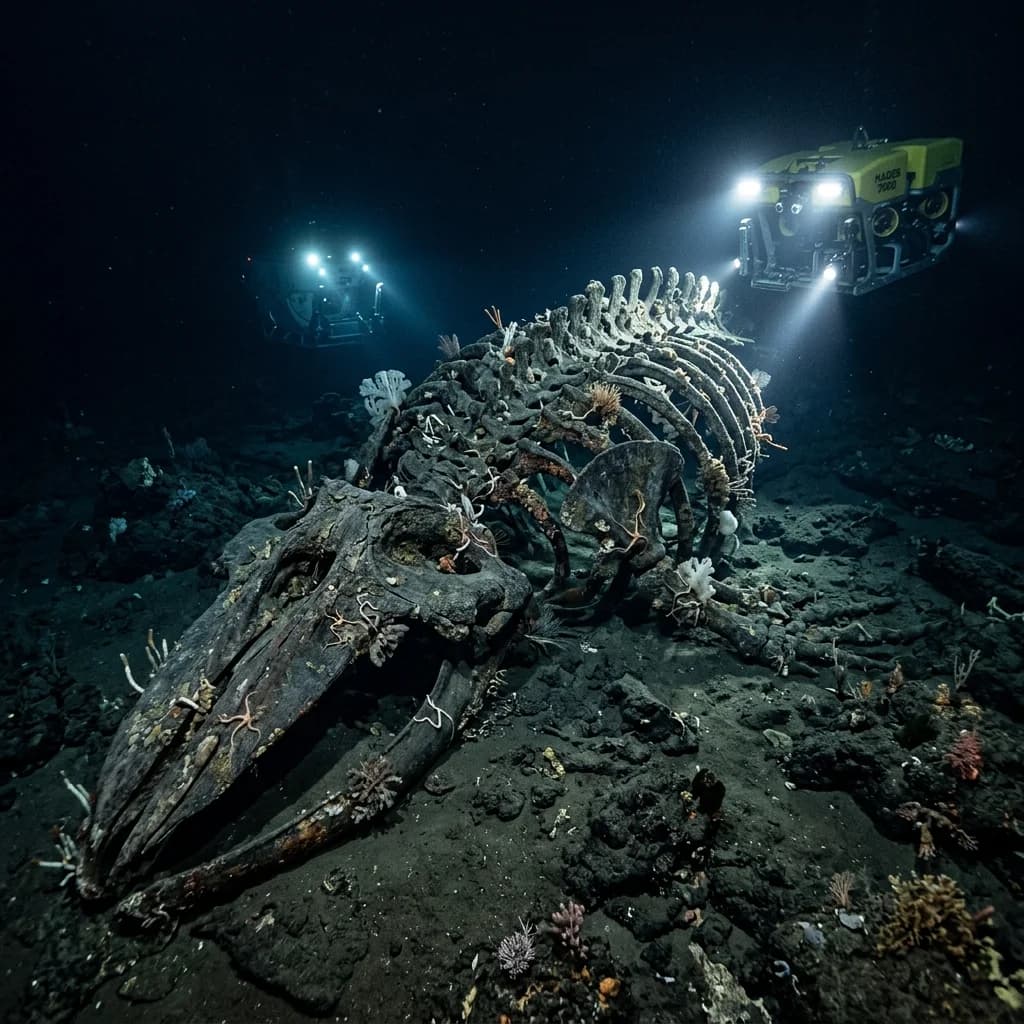
During a research mission focused on mapping vulnerable deep-marine habitats, scientists from NIWA (National Institute of Water and Atmospheric Research) and the New Zealand Department of Conservation utilized advanced remotely operated vehicles (ROVs). While navigating the dark and cold waters of a protected fjord in Fiordland, the ROVs' high-definition cameras revealed the giant, branched structure of a black coral colony.
Following the discovery, scientists performed non-invasive physical sampling of small dead branches at the base of the coral. Laboratory radiocarbon analysis and microscopic study of the concentric growth rings in the coral's skeleton — which develop similarly to the growth rings of tree trunks — confirmed an estimated age of 400 years. The giant colony is in an excellent state of preservation, harboring hundreds of other marine species that depend on its physical structure for shelter and food.
Context and History
Black corals belong to the order Antipatharia, and contrary to what their popular name suggests, their living tissues present bright colors such as white, yellow, or orange. The name "black coral" is due to the dark color of its rigid, branched skeleton, which is composed of chitin and resistant proteins. This type of coral is characterized by extremely slow growth, often advancing by only a few micrometers or fractions of a millimeter per year, making large colonies incredibly vulnerable to any physical or environmental disturbance.
The Fiordland region, located in the southwest of New Zealand's South Island, is globally famous for hosting a rare ecological phenomenon called "deep-sea emergence." Due to heavy and frequent rainfall in the adjacent temperate rainforest, a layer of cold freshwater permanently floats on top of the denser saltwater of the ocean. This upper freshwater layer carries large amounts of forest organic matter (tannins), which act as a natural filter, staining the water dark and blocking sunlight penetration. This dark, cold environment at shallow depths simulates deep-ocean conditions, allowing species like black corals, which normally only grow at depths exceeding 200 or 500 meters, to inhabit shallow, accessible depths of just 10 or 15 meters.
Impact on the Population
The discovery of this centuries-old black coral colony has a direct impact on the development of public policies for environmental conservation and the scientific study of global climate change in New Zealand. Because the black coral skeleton grows continuously over centuries, recording the chemical composition of seawater in its concentric chitin rings, scientists can read these rings as historical climate archives. The samples help reconstruct ocean temperatures and marine currents over the last 400 years, providing valuable data for modeling future climate trends.
For local communities and sustainable ecotourism on the South Island, the discovery reinforces the value and importance of maintaining strict restrictions against commercial bottom trawling and unregulated activities in the fjords. The preservation of these marine giants ensures the sustenance of local marine biodiversity, which is one of the main drivers of ecotourism in New Zealand.
The table below compares the characteristics of the giant black coral of Fiordland in relation to other known long-lived marine organisms:
| Species / Organism | Main Location | Estimated Age | Typical Dimensions | Habitat Depth | Ecological / Scientific Importance |
|---|---|---|---|---|---|
| Fiordland Black Coral | Fiordland, New Zealand | 400 years | 4.0m height x 4.5m width | 10 to 80 meters (fjords) | Climate archive, biodiversity shelter |
| Hawaiian Black Coral | Hawaiian Archipelago | 1,000 to 4,000 years | Usually under 2 meters | 300 to 3,000 meters | Protected against jewelry harvesting |
| Glass Sponge | Antarctica & N. Pacific | Up to 10,000 years | Varied (several meters) | Above 500 meters | Deep-water filtration |
| Cold-Water Coral (Lophelia) | North Atlantic | 200 to 1,000 years | Large-scale reefs | 200 to 1,200 meters | Builder of vulnerable deep reefs |
What Those Involved Say
NIWA researchers and conservationists highlighted the rarity and vulnerability of the discovery. In a joint statement from NIWA, Dr. Amanda O'Connell, the marine biologist who led the underwater expedition, commented: "Finding an organism that began growing around the time Galileo was pointing his first telescopes at the sky is thrilling. This giant coral is a living relic, a silent witness to ocean currents and our planet's climate over four centuries."
On the government side, a representative from the New Zealand Department of Conservation emphasized the responsibility of protection: "This 4-meter black coral reminds us that there are ancient, majestic marine forests beneath the dark waters of Fiordland that deserve the same level of protection we give to our terrestrial forests of ancient kauri trees. Heavy commercial fishing and unregulated boat anchoring represent direct threats that we cannot allow in this protected region."
Next Steps
The next steps of the scientific mission involve continuous monitoring of water temperature and acidity in the fjord where the giant coral was located. Automatic temperature sensors have been installed near the colony to record anomalies caused by global warming and the El Niño climate phenomenon.
Biologists plan to perform detailed paleoclimatological analyses on chitin samples from the skeleton to map historical chemical variations in the ocean. Furthermore, the Department of Conservation will review local navigation charts to establish an anchor exclusion zone around the exact site of the discovery, ensuring that the giant black coral continues to grow free from physical damage caused by tourist and recreational boat anchors.
Closing
The extraordinary discovery of the 400-year-old giant black coral in the depths of Fiordland in 2026 invites us to reflect on the beauty of the ocean and the fragility of life. By revealing a marine giant that has silently survived for four centuries in the protected waters of New Zealand, science reminds us that marine conservation is not only an ecological obligation but also a moral commitment to the future. Protecting these hidden forests ensures that these living fossils continue to guard the climate secrets of the past and sustain the rich web of marine life that makes Fiordland one of the planet's most precious sanctuaries.