The Whale Graveyard in the Diamantina Trench
The darkness in the Diamantina Fracture Zone, seven thousand meters deep in the southeastern Indian Ocean, is absolute, pierced only by the bright artificial light beams projected by the searchlights of the Chinese crewed deep-sea submersible Fendouzhe. What the crew members saw through the reinforced quartz viewports was not the usual abyssal desert of mud and volcanic rocks, but a ghostly landscape dominated by hundreds of gigantic ribs, massive skulls, and vertebrae covered in dark mineral crusts. Along a 1,200-kilometer corridor, researchers had just mapped the largest and deepest marine necropolis ever documented on the planet, accumulated over more than five million years of evolutionary history.
O Que Aconteceu
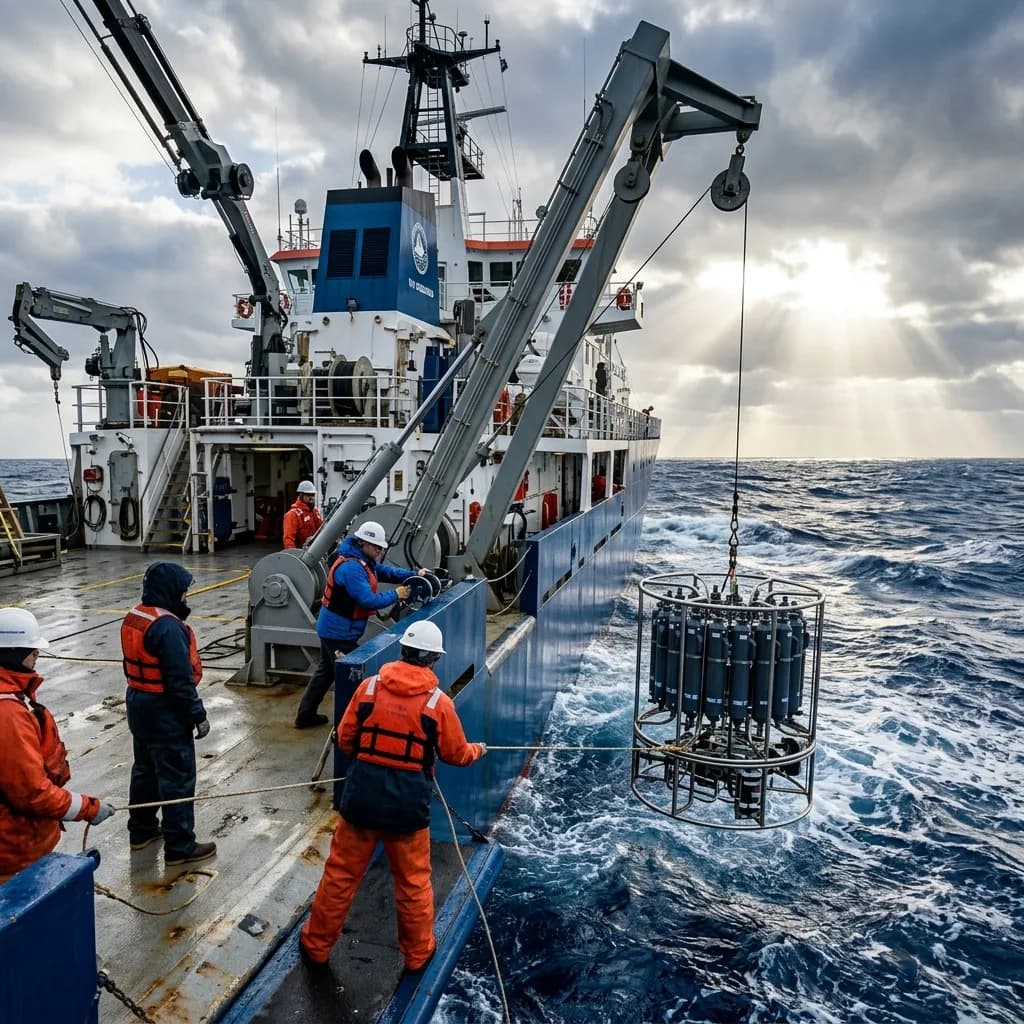
On June 10, 2026, an international team of scientists coordinated by the renowned Institute of Deep-Sea Science and Engineering (IDSSE) of the Chinese Academy of Sciences, in partnership with researchers from the University of Pisa in Italy and geosciences institutes in New Zealand, revealed the discoveries of this exploration in the scientific journal Nature. The study, based on 32 deep dives conducted by the crewed submersible Fendouzhe and the research vessel Tan Suo Yi Hao, mapped a total of 485 sites of biological and geological interest at the base of the Diamantina Fracture Zone.
Of this total, 476 correspond to fossilized deposits composed of skeletal remains of whales, while five other sites harbor active, modern "whale-fall" ecosystems, serving as vibrant oasis-like communities in the deep dark. The most remarkable scientific aspect of the expedition was the recovery of bone samples fossilized from a previously unknown species of prehistoric cetacean. This is an extinct beaked whale, named Pterocetus diamantinae, which directly honors the rugged marine fracture zone where its remains rested for millions of years.
To collect these ancient samples at extreme depths, the submersible Fendouzhe utilized its dual hydraulic manipulator arms, equipped with high-precision force-feedback sensors that allowed operators to delicate lift fragile, mineralized bones without crushing them. The retrieved bones were then stored in insulated titanium bio-boxes to protect their delicate structure from pressure and temperature shocks during the long ascent.
Isotopic dating and biogeochemical analyses applied to the recovered bones revealed that the graveyard has operated continuously as a biological sink since the early Pliocene epoch, approximately 5.3 million years ago. The slow mineralization process in the Diamantina Fracture Zone, driven by an environment of freezing temperatures and exceptionally low sediment accumulation rates, allowed the molecular structure of the bones to remain surprisingly intact. The ferromanganese and phosphate crusts covering most of the fossils acted as protective shields against the acidic dissolution typical of ultra-deep waters, creating an unprecedented historical record of extinct cetaceans from remote epochs, including the genera Pterocetus benguelae and Izikoziphius rossi.
Contexto e Histórico
To comprehend the scientific magnitude of this marine find, it is necessary to analyze the biological phenomenon known in modern oceanography as a "whale fall." The deep ocean floor is an environment of extreme scarcity of energy and organic matter, operating almost entirely on the basis of "marine snow," which consists of microscopic detritus drifting slowly down from the sunlit upper layers. The sudden sink of a thirty-ton whale carcass represents an input of organic carbon and nutrients equivalent to what an abyssal plain region would normally receive over a period of up to two decades of accumulated marine snow.
Historically, oceanographers divide the ecological life cycle of a whale fall into four well-documented stages:
- The Mobile Scavenger Stage: During the first few months following the sinking of the carcass, large carnivorous animals such as sleeper sharks, hagfish, spider crabs, and deep-sea amphipods devour almost all of the soft tissues and external flesh.
- The Opportunistic Stage: Small crustaceans, gastropod mollusks, and annelids colonize the enriched sediment around the remains and the partially exposed skeleton, consuming the remaining cartilage and smaller organic fragments.
- The Sulfophilic Stage: Specialized anaerobic bacteria decompose the abundant lipids present within the cetacean bone marrow. This process generates a continuous flow of hydrogen sulfide, a substance that feeds autotrophic microbes. These microorganisms serve as food for entire communities of clams, deep-sea mussels, and giant tubeworms similar to those found at hydrothermal vents.
- The Reef Stage: Once all the organic matter and internal oils have been fully metabolized by the bacterial colonies, the remaining mineral structures of the vertebrae and ribs serve as hard artificial substrates for the attachment of deep-sea corals, anemones, glass sponges, and sea lilies.
The family Ziphiidae, commonly known as beaked whales, is particularly interesting in this context. Modern beaked whales are the champions of deep diving among marine mammals, routinely descending to depths of 2,000 to 3,000 meters to hunt squid using echolocation. To withstand the extreme pressures and avoid decompression sickness, they have evolved highly specialized physiological adaptations, such as a collapsible rib cage (controlled pulmonary atelectasis) and high concentrations of myoglobin in their muscles to store oxygen. The discovery of Pterocetus diamantinae shows that these deep-diving adaptations were already well-developed millions of years ago, allowing these ancient cetaceans to forage in the deep trenches where their bones eventually accumulated.
The fundamental mystery that intrigued researchers was why the Diamantina Fracture Zone hosted such a dense concentration of these skeletons, stretching linearly for hundreds of kilometers. Oceanographic investigations pointed to a unique combination of hydrodynamics and underwater topography. Cold ocean currents flowing from Antarctica toward the north meet warmer water masses from the Indian Ocean exactly above the Diamantina Fracture Zone. This thermal convergence acts as a barrier that affects the migration path of whales and attracts schools of predators and prey. When the whales died, deep currents pushed their carcasses toward the tectonic gorges of the trench, preventing the bodies from being dispersed across the flat, featureless abyssal plains.
Impacto Para a População
The impact of this discovery on the population and the global scientific community does not lie in direct industrial applications or immediate economic gains, but in the profound reconfiguration of our understanding of the ecological resilience of deep-sea ecosystems and our planet's carbon dynamics. In practical terms, this new deep graveyard constitutes a massive biogeochemical archive registering 5.3 million years of temperature and acidity fluctuations in Earth's oceans, serving as an irreplaceable tool for calibrating climate change models.
The table below summarizes the scientific understanding before and after the discoveries published in June 2026:
| Aspecto | Antes de Junho de 2026 | Depois de Junho de 2026 | Impacto Científico e Educativo |
|---|---|---|---|
| Depth Limit for Fossils | It was believed that skeletal remains dissolved below 4,000 meters due to carbonate undersaturation. | Proof of perfect skeletal preservation at 7,002 meters due to special ferromanganese mineralization. | Expands the geographic and depth range where paleontologists can search for preserved marine fossils. |
| Beaked Whale Fossil Diversity | The fossil record was extremely fragmented and scarce for deep-diving species (family Ziphiidae). | Cataloging of dozens of skulls of Pterocetus diamantinae and other rare prehistoric species. | Allows for the highly precise reconstruction of the evolutionary tree of Pliocene deep-diving cetaceans. |
| Maximum Age of Bone Deposits | Whale falls were documented as transient ecological phenomena lasting at most 100 years. | Identification of linear deposits operating as active ecosystems for 5.3 million years. | Demonstrates that these deep skeletal structures constitute permanent ecological habitats on a geological scale. |
| Abyssal Carbon Dynamics | Modeling of deep-ocean carbon retention was based almost solely on microscopic marine snow. | Inclusion of cetacean bone megadeposts as major permanent sinks for deep carbon on the seafloor. | Enhances the accuracy of global carbon balance calculations for the abyssal marine ecosystem. |
Additionally, the identification of new chemotrophic unicellular organisms and specialized bacterial enzymes capable of breaking down complex lipids under extreme pressures has opened new opportunities for industrial biotechnology. Partner laboratories have already begun testing enzymes extracted from the bones of the abyssal graveyard to evaluate their utility in developing biodegradable detergents, bioremediation of deep-sea oil spills, and novel pharmacological processes.
O Que Dizem os Envolvidos
The researchers and biologists who joined the missions aboard the Tan Suo Yi Hao expressed awe at the revelations and the clarity of the data collected during the operations of the submersible Fendouzhe. Dr. Liang Zhao, chief marine geologist at IDSSE and lead author of the study, shared the excitement of the historic dives:
"We spent decades believing that the abyssal seafloor was composed largely of monotonous plains of gray mud, with few visible signs of ancient complex life beyond small blind crabs and amphipods. When the exploration robot illuminated the first complete skull of Pterocetus diamantinae, we realized we were navigating over a lost geological library. Every single bone collected there carries chemical signatures of water temperature, oxygen content, and surface biological productivity from millions of years ago. It is a physical time machine that allows us to reconstruct the marine ecological dynamics of the early Pliocene epoch with details we never imagined achieving."
Similarly, Dr. Francesca Rossi, a paleontologist and professor of evolutionary biology at the University of Pisa, emphasized the anatomical features of the newly identified species:
"The anatomy of Pterocetus diamantinae is truly exceptional and resolves several evolutionary puzzles regarding beaked whales of the family Ziphiidae. This extinct species presented severe osteological modifications in the nasal region and echolocation pathways that indicate a level of specialization for deep diving far superior to other species of the same period. The cranial bones are extremely dense, a direct response to tolerate crushing physical pressures exceeding 700 times the normal atmospheric pressure at Earth's surface. The discovery proves that beaked whales successfully colonized deep submarine canyons much earlier than theoretical genetic models estimated. We are looking at an animal that was perfectly adapted to one of the most hostile environments on Earth."
Finally, Dr. Alistair Grant, a deep-sea ecology expert from Earth Sciences New Zealand, highlighted the environmental importance and the need to protect this extraordinary area:
"This immense marine fracture zone acts as a true biological oasis in the dark. The fact that we located five active whale falls surrounded by hundreds of ancient bone deposits confirms that deep-sea life depends intrinsically on phenomena occurring at the surface. We must act urgently to declare the Diamantina Fracture Zone an International Marine Protected Area, preventing any future deep-sea mining of polymetallic nodules in the region. Destroying this geological and biological sanctuary would erase irreplaceable pages of the evolutionary history of life on our planet before we can even read them."
Próximos Passos
The results of the 2026 expedition paved the way for a series of new interdisciplinary scientific projects. For the years 2027 and 2028, IDSSE and its international partners plan to launch a new long-term monitoring expedition to the Diamantina Fracture Zone. The plan includes installing autonomous flow sensors and time-lapse cameras near the active whale falls, allowing scientists to track biological colonization and the ecological succession of abyssal species in real time over the next five years.
Another major research focus will involve the computer-based three-dimensional reconstruction of all the fossil skeletons spotted by the submersible's cameras. Using AI algorithms applied to high-definition video feeds, paleontologists aim to create a complete digital 3D map of the entire graveyard corridor. This interactive map will be hosted on open academic platforms, allowing researchers and students worldwide to conduct virtual scientific dives and study the spatial distribution of the carcasses without the need for expensive physical expeditions.
Lastly, microbiologists are focused on isolating and sequencing the genetic material of new extremophilic bacterial taxa found living on the mineral crusts of the fossilized bones. These microbes are expected to reveal new ecological metabolic pathways based entirely on the consumption of exotic mineral compounds and ancient lipids, expanding the known limits for biological survival on Earth and offering new concepts for the search for life on icy moons harboring deep oceans in our Solar System, such as Europa and Enceladus.
Fechamento
The historic discovery of the whale graveyard in the Diamantina Fracture Zone and the characterization of the new extinct species Pterocetus diamantinae represent much more than a technical victory for deep-sea engineering. It reminds us, with deep scientific sobriety, that Earth's oceans harbor entire geological archives untouched by human hands. By illuminating the skeletons that have rested seven thousand meters deep for millions of years, science has taken a decisive step toward understanding that the cycles of life and death on our world's surface are intimately linked to the deepest, darkest mysteries of the ocean depths.
Fontes e Referências
- Nature Journal - Discovery of the Diamantina Deep-Sea Cetacean Necropolis
- Institute of Deep-Sea Science and Engineering (IDSSE) - Expedition Report Tan Suo Yi Hao
- University of Pisa - Evolutionary Biology and Beaked Whale Palaeontology Research Group
- Smithsonian Magazine - Deep-Time Archives of Whale Falls in the Indian Ocean