
Solar Cell with 130% Quantum Efficiency Breaks Physical Barrier Deemed Impossible
A single photon of light enters an experimental solar cell. On the other side, two energy carriers emerge. Not one — two. This shouldn't be possible, according to classical thermodynamics. But on March 25, 2026, researchers from Kyushu University (Japan) and Johannes Gutenberg University Mainz (Germany) proved that quantum physics not only allows this — it can be engineered to do it with 130% quantum yield.
The study, published in the prestigious Journal of the American Chemical Society (DOI: 10.1021/jacs.5c20500), demonstrates for the first time that a phenomenon called singlet fission can be efficiently captured using a "spin-flip" emitter based on molybdenum — an abundant and cheap metal. The result shatters the so-called Shockley-Queisser limit, a theoretical barrier that since 1961 defined the maximum efficiency ceiling for conventional solar cells at approximately 33%.
In plain terms: solar technology, which many considered stagnant, just found its turbocharger.
The Limit That "Couldn't Be Broken"
To understand the magnitude of this discovery, we need to go back to 1961, when two physicists — William Shockley and Hans-Joachim Queisser — published a paper that would become one of the most cited in the history of semiconductor physics.
The Shockley-Queisser limit establishes that, in a single-junction solar cell (the most common type), at most 33.7% of sunlight energy can be converted into electricity. The rest is lost as heat or as photons with insufficient energy to excite electrons.
This 33.7% figure isn't an engineering limitation — it's a law of thermodynamics. For 65 years, the entire solar industry operated within this prison.
How does the limitation work?
When a photon hits a conventional solar cell, three things can happen:
| Scenario | What happens | Result |
|---|---|---|
| Photon with very low energy | Cannot excite electron | Lost as heat |
| Photon with "ideal" energy | Excites exactly 1 electron | 1 energy carrier generated |
| Photon with very high energy | Excites 1 electron, excess energy becomes heat | Thermal waste |
The third scenario is the most frustrating: ultraviolet and blue photons (highly energetic) generate the same amount of electricity as red photons (less energetic), wasting the excess as heat. It's like paying $100 for a $30 product and receiving the $70 change in ashes.
Singlet Fission: The Quantum Trick That Changes Everything
The Japan-Germany team used a quantum phenomenon called singlet fission to circumvent this fundamental limitation.
What is singlet fission?
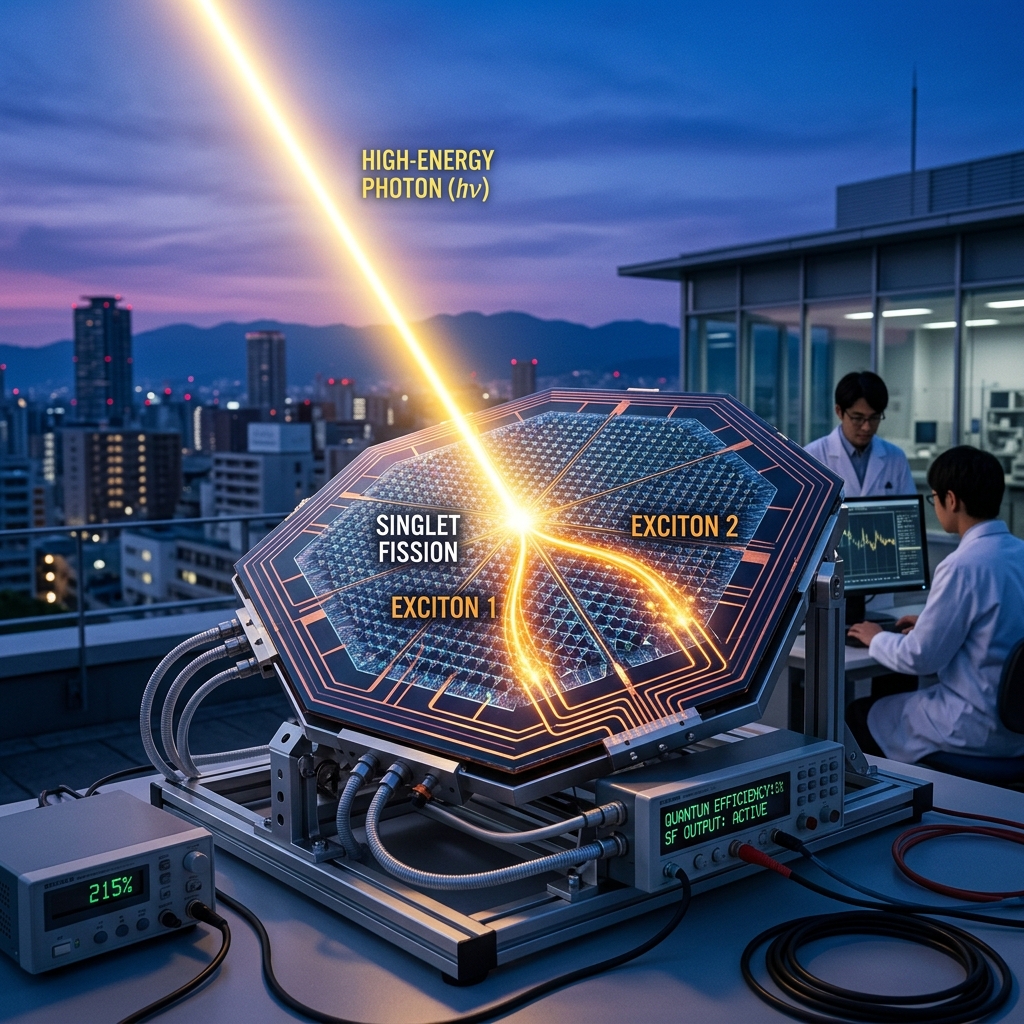
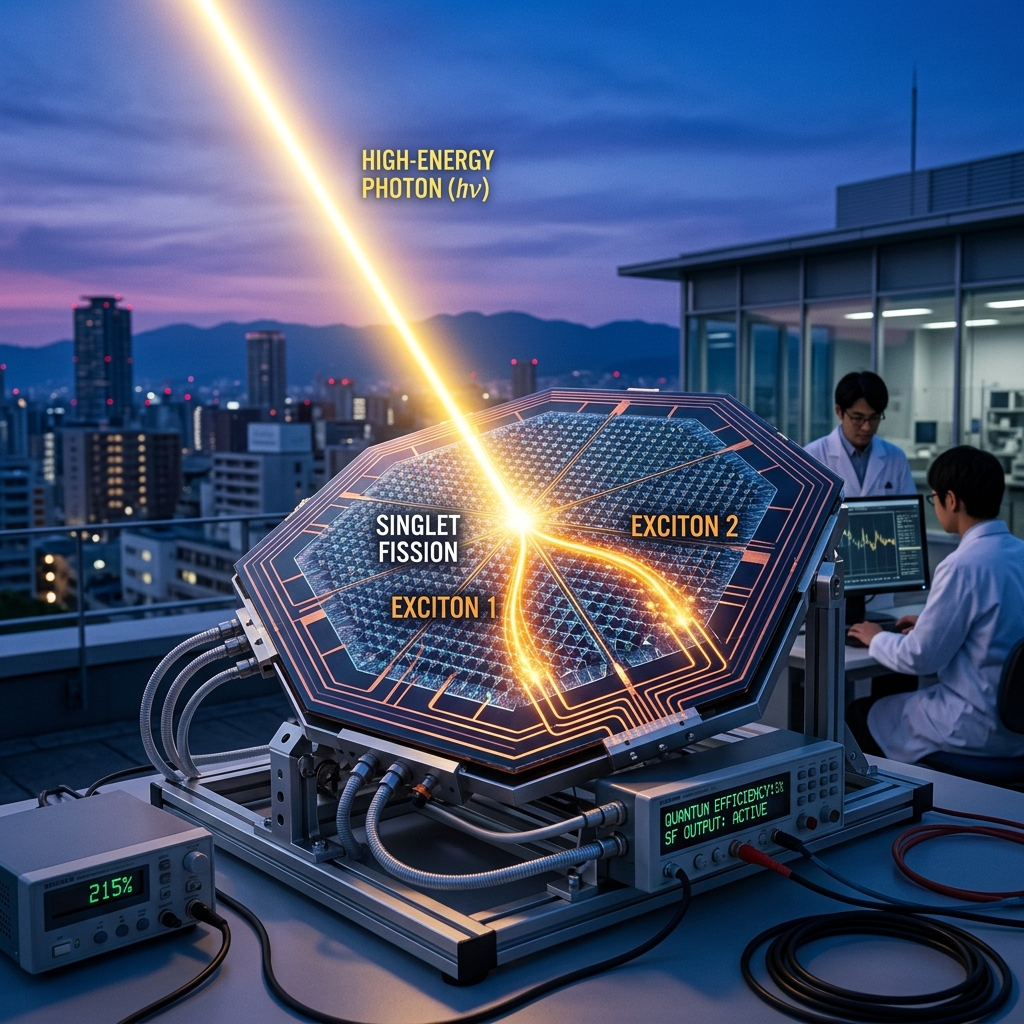
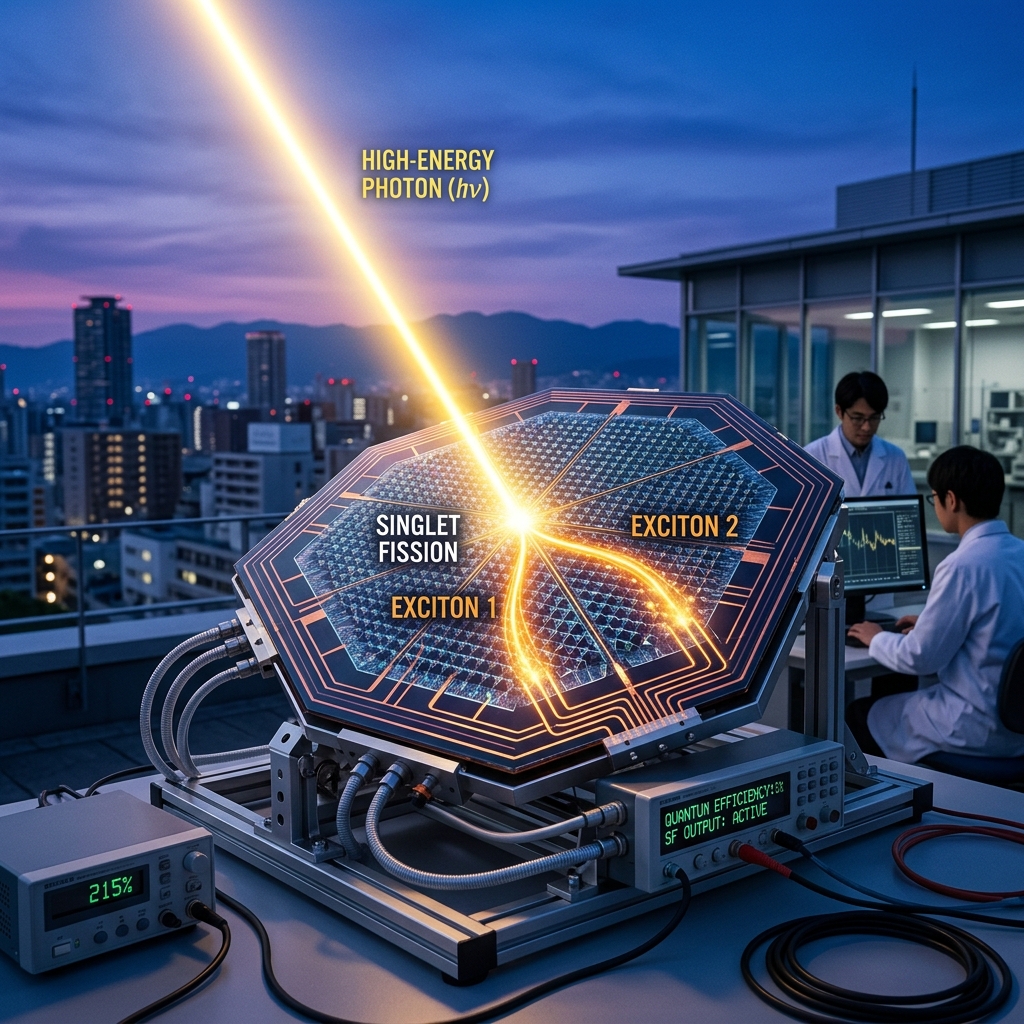
When a high-energy photon is absorbed by certain organic materials, it creates an excited state called a singlet. Normally, this singlet would deactivate, losing energy as heat. But in specially designed materials, the singlet can split — literally "fission" — into two excited states called triplets.
Each triplet carries approximately half the energy of the original singlet. The net result: 1 photon → 2 energy carriers.
This means the quantum efficiency (ratio of energy carriers generated to photons absorbed) can exceed 100%. It doesn't violate thermodynamics — it's efficient redistribution of energy within the rules of quantum mechanics.
The problem nobody could solve
The concept of singlet fission has been known since the 1960s. But there was a devastating problem: the triplets generated by fission are extremely unstable and are quickly reabsorbed or lost through a process called FRET (Förster Resonance Energy Transfer).
In simple terms: the fission worked, but the "children" (triplets) were kidnapped before they could generate electricity. Like printing money that evaporates before reaching your wallet.
The Solution: The Molybdenum "Spin-Flip" Emitter
Kyushu's team developed a molybdenum metal complex that functions as a selective triplet receptor. The mechanism is elegant:
- Base material: Tetracene (an aromatic organic hydrocarbon) absorbs high-energy photons
- Singlet fission: Tetracene generates two triplets from one singlet
- Selective capture: The molybdenum complex, strategically positioned, captures the triplets before FRET can destroy them
- Near-infrared emission: Molybdenum converts triplet energy into near-infrared emission, which can be recaptured by conventional silicon solar cells
The trick is the "spin-flip" mechanism — a quantum property of the molybdenum complex that allows it to distinguish between the spin states of triplets. This means the material "chooses" to capture only singlet fission triplets, ignoring other parasitic processes.
Why molybdenum?
The choice wasn't random. Unlike rare metals like iridium or platinum (used in previous experiments), molybdenum is:
- Abundant: 42nd most common element in Earth's crust
- Cheap: ~$25/kg (vs. $150,000/kg for iridium)
- Stable: Doesn't degrade under solar operating conditions
- Processable: Can be synthesized in solution at room temperature
The numbers that matter
| Metric | Kyushu result | Previous record | Improvement |
|---|---|---|---|
| Quantum yield | ~130% | ~105% (MIT, 2019) | +24% |
| Metal used | Molybdenum (abundant) | Iridium (rare) | Cost -99% |
| Operating temperature | Ambient (~25°C) | Cryogenic (-196°C) | Practical |
| Publication | JACS, 03/25/2026 | Nature Chemistry | Top-tier |
What This Means for the Future of Solar Energy
Current landscape: where we stand
The current record efficiency for commercial solar cells is approximately 26.8% (monocrystalline silicon, Longi Green Energy, 2024). In laboratories, perovskite-silicon tandem cells have reached 33.9% (KAUST/Helmholtz Berlin, 2025).
These numbers operate within the Shockley-Queisser limit. Singlet fission offers a path to go beyond.
Theoretical projections
If singlet fission is successfully integrated into silicon solar cells, the maximum theoretical efficiency jumps from 33.7% to ~45%. In tandem cells (perovskite + silicon + singlet fission), the theoretical ceiling reaches ~50%.
What's needed to get this out of the lab?
Kyushu's research is a proof of concept in solution (liquid). To reach real solar panels, the team identifies three challenges:
- Solid-state integration: Transfer the system from a liquid solution to a solid thin film
- Long-term stability: Ensure the molybdenum complex functions for 25+ years outdoors
- Silicon coupling: Optimize near-infrared emission capture by standard silicon cells
Professor Nobuo Kimizuka, group leader at Kyushu, stated that the next step is building a solid-state device within the next 18-24 months.
The Economic Impact: Impressive Numbers
The global solar energy market moved $401 billion in 2025 (BloombergNEF). Global installed capacity surpassed 2.2 terawatts — enough to power 1 billion homes.
But even with the 99% drop in cost of panels since 1976, efficiency remained the bottleneck. An increase from 33% to 45% efficiency would mean:
- 30% fewer panels needed for the same generation
- 30% less area for installation (critical for space-constrained countries like Japan and the Netherlands)
- $120 billion per year in solar infrastructure savings (IEA estimate)
- Acceleration of grid parity in developing countries
The Global Solar Race in 2026
Kyushu's discovery doesn't happen in a vacuum. The year 2026 is shaping up as the most transformative in the history of solar energy:
- China: Installed more solar capacity in 2025 (280 GW) than the total accumulation of the US
- USA: The Inflation Reduction Act (IRA) injected $369 billion in clean-tech incentives since 2022
- India: Reached 200 GW of solar capacity in March 2026, two years ahead of its original target
- Europe: The EU banned panels below 20% efficiency in new installations starting 2027
Strategic importance
With oil at $134/barrel (March 2026), solar energy is no longer an environmental issue — it's a matter of national and economic security. Countries that master next-generation solar technology will have strategic advantage comparable to oil in the 20th century.
Competing Technologies: Who Else Is in This Race?
Singlet fission isn't the only approach to break the Shockley-Queisser limit. At least four other technologies compete for the same prize:
Perovskite-Silicon Tandem Cells
The technology closest to commercialization. Uses two layers of different materials, each capturing different ranges of the solar spectrum. Current record: 33.9% (KAUST/Helmholtz Berlin, 2025). Companies like Oxford PV and CubicPV already sell tandem panels in pilot scale. Advantage: already works in solid state. Disadvantage: perovskites degrade rapidly and contain lead.
Multi-Junction Cells (III-V)
Used in satellites and spacecraft, stacking three or more semiconductor layers. Record efficiency: 47.6% (Fraunhofer ISE/NREL, 2022). Problem: costs are so astronomical they're only viable in space, where every gram matters more than every dollar.
Comparative Table
| Technology | Record efficiency | Relative cost | Maturity | Main barrier |
|---|---|---|---|---|
| Singlet fission (Kyushu) | 130% QY (concept) | Low (molybdenum) | Laboratory | Solid state |
| Perovskite-tandem | 33.9% | Medium | Commercial pilot | Degradation/lead |
| III-V multi-junction | 47.6% | Very high | Spaceflight | Prohibitive cost |
| LSC (solar windows) | 5-7% | Low | Laboratory | Low efficiency |
| TPV (thermophotovoltaic) | 40% | High | Laboratory | Integration |
The History of Solar Efficiency: From 1% to 130%
The journey has been remarkable:
- 1839: Edmond Becquerel observes the photovoltaic effect for the first time
- 1954: Bell Labs creates the first practical silicon cell — 6% efficiency
- 1961: Shockley and Queisser publish the 33.7% theoretical limit
- 2000: First experimental demonstration of singlet fission in pentacene
- 2019: MIT demonstrates quantum yield of ~105% (using iridium at -196°C)
- 2022: LONGi Green Energy sets record of 26.81% for monocrystalline silicon
- 2025: KAUST/Helmholtz Berlin reach 33.9% with perovskite-silicon tandem
- 2026: Kyushu University achieves ~130% quantum yield using molybdenum at room temperature
The progression is revealing: it took 31 years to go from 6% to 20%. Then another 37 years from 20% to 26.8%. Singlet fission doesn't improve the linear percentage — it changes the entire game's rules.
FAQ — Frequently Asked Questions
How is it possible to have more than 100% efficiency? Doesn't this violate physics?
No, it doesn't violate energy conservation. The 130% quantum yield means that for every 100 photons absorbed, approximately 130 energy carriers (excitons) are generated. The total energy of the 130 carriers does not exceed the total energy of the 100 photons — only the energy of each individual photon is distributed more efficiently between two smaller carriers. It's like exchanging a $100 bill for two $50 bills — the total value is the same, but now you have two units to work with, which allows capturing more energy in subsequent processes.
When will this technology reach the market?
The Kyushu team estimates that a functional solid-state device will be demonstrated in 18-24 months (late 2027 or early 2028). Large-scale commercialization depends on manufacturers like LONGi, JinkoSolar, or First Solar integrating the process into their production lines, which would take another 3-5 years. Optimistic projection: commercial panels with singlet fission by 2031-2033.
Will this replace current solar panels?
Probably not replace, but complement them. Singlet fission works best with high-energy photons (blue and ultraviolet). The idea is to create an additional layer over existing silicon cells that captures the energy normally wasted as heat. Your current panels would continue working normally — the new technology would add an extra layer of efficiency.
Is molybdenum toxic or dangerous?
Molybdenum is an essential element for life — it's present in plant and animal enzymes. In its metallic form or in complexes like those used in this research, it's considered low toxicity by the WHO. It's significantly less toxic than lead (used in perovskite solar) and cadmium (used in CdTe panels).
Are other groups worldwide working on this?
Yes. MIT in the US, University of Cambridge in the UK, and the Max Planck Institute in Germany have active singlet fission research programs. However, Kyushu's result is the most impressive to date in terms of measurable quantum yield and use of abundant materials. The race for the first functional solid-state device is wide open.
Sources and References
- Kyushu University — "Exploring Spin-State Selective Harvesting Pathways from Singlet Fission Dimers to a Near-Infrared-Emissive Spin-Flip Emitter" — JACS, March 25, 2026
- SciTechDaily — "Breakthrough Solar Tech Achieves Over 130% Quantum Efficiency" — March 2026
- ScienceDaily — "Solar cell technology demonstrates ~130% efficiency using spin-flip metal complex" — March 2026
- BloombergNEF — "Global Solar Market Outlook 2026" — February 2026
- International Energy Agency (IEA) — "World Energy Outlook 2026" — March 2026


