
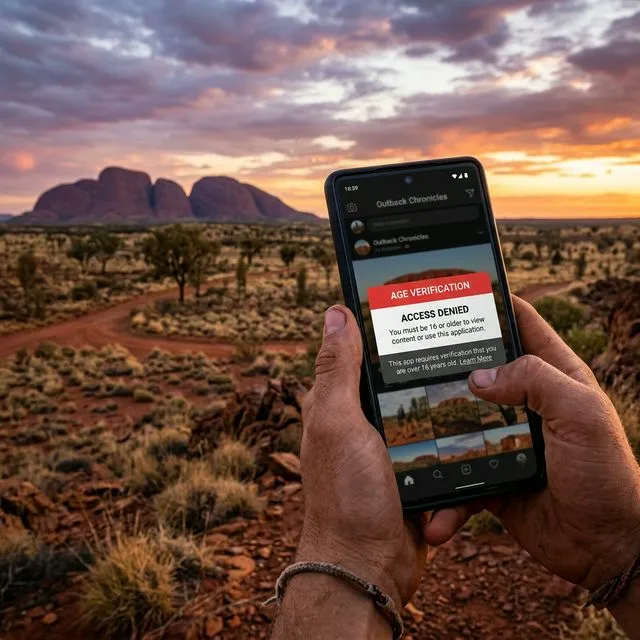
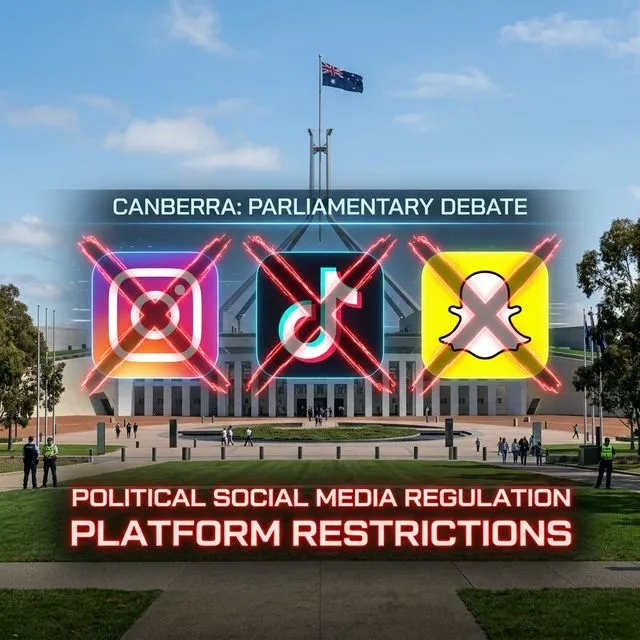
On the morning of November 28, 2025, the Australian Parliament passed the most radical legislation on the planet regarding social media: starting March 2026, children and teenagers under 16 years old are completely banned from creating accounts on Instagram, TikTok, Facebook, Snapchat, X (Twitter), Reddit, and any other social media platform with a recommendation algorithm. No exceptions. No parental consent as an alternative. No "kids mode" as a loophole.
The law establishes that the responsibility for age verification lies with the platforms, not parents or children. Companies that fail to prevent minors' access face fines of up to 49.5 million Australian dollars (approximately $32 million USD). No country in the world has ever gone this far in the digital protection of minors.
The measure has divided Australia — and the world — right down the middle. Supporters celebrate the decision as a historic milestone in protecting children's mental health. Critics warn of the danger of pushing teenagers toward unregulated and even more dangerous online spaces.
Why Australia Made This Decision
An Unprecedented Mental Health Crisis
The Australian Parliament's decision wasn't made in a vacuum. It came after years of alarming data on social media's impact on children and adolescents' mental health:
Australian data (Australian Bureau of Statistics, 2025):
- Suicide is the leading cause of death among Australians aged 15-24
- Self-harm among girls aged 10-14 increased 189% between 2010 and 2025
- 1 in 4 Australian teenagers reports symptoms of severe anxiety
- Average daily screen time for teenagers is 7 hours and 22 minutes
- 43% of teenagers report experiences of cyberbullying
Global data that reinforced the decision:
- Internal Meta documents (leaked in 2021 by Frances Haugen) showed the company knew Instagram was worsening eating disorders in 32% of teenage girls
- University of Oxford study (2025) found a 25% increase in depression diagnoses among intensive TikTok-using adolescents
- The US Surgeon General classified social media as a "public health hazard" for youth in 2023
The Report That Changed Everything
The direct catalyst was the report from the Parliamentary Joint Committee on Social Media and Children, published in September 2025. The 247-page document heard 450 affected families, 28 pediatric mental health specialists, 12 former Big Tech employees (whistleblowers), and the CEOs of Meta, TikTok, X, and Snapchat.
The committee's conclusion was unequivocal: "Scientific evidence demonstrates that social media, in its current format, causes significant and predictable harm to children's mental health and development. Industry self-regulation has completely failed."
How the Law Works in Practice
Age Verification Mechanisms
The law — officially the Online Safety Amendment (Social Media Minimum Age) Act 2025 — is technically ambitious. It requires platforms to implement "robust and reliable" age verification but deliberately doesn't specify the method.
Methods being tested include:
| Method | How It Works | Accuracy |
|---|---|---|
| AI facial age estimation | Camera analyzes face and estimates age | 96-98% |
| Document verification | Upload of ID/passport | 99%+ |
| Carrier verification | Mobile carrier confirms age of line holder | 95% |
| Government verification | MyGov ID (Australian digital identity) | 99.9% |
| Behavioral analysis | AI analyzes usage patterns | 87% |
Platforms Included
Banned platforms: Instagram, TikTok, Facebook, Snapchat, X (Twitter), Reddit, Pinterest, Tumblr, BeReal, Threads
Exempt platforms: YouTube (classified as "streaming service"), WhatsApp and Messenger (classified as "private messengers"), Gmail, gaming apps, educational platforms
Penalties
| Violation | Fine |
|---|---|
| Systemic failure to verify age | Up to AU$49.5 million |
| Deliberate maintenance of minor's account | AU$782,500 per account |
| Repeated non-compliance | Service blocked in Australia |
Global Reactions
Big Tech: Resistance and Adaptation
Mark Zuckerberg called the law "extreme and poorly calibrated." However, Meta announced it will implement age verification globally by 2027. Elon Musk posted: "Australia is banning free speech for teenagers. What's next — banning books?" Snap Inc. was the only company to publicly support the law.
Countries Following the Example
| Country | Status (March 2026) |
|---|---|
| Australia 🇦🇺 | Law in effect (March 2026) |
| Norway 🇳🇴 | Bill passed (minimum age: 15) |
| France 🇫🇷 | Bill in progress (minimum age: 15) |
| Spain 🇪🇸 | Public consultation (minimum age: 16) |
| UK 🇬🇧 | Parliamentary debate (minimum age: 16) |
| Italy 🇮🇹 | Proposal announced (minimum age: 14) |
| Brazil 🇧🇷 | Bill introduced (minimum age: 14) |
| USA 🇺🇸 | KOSA Act in progress (no fixed minimum age) |
Arguments For and Against
In Favor of the Ban
Mental health: Scientific evidence is robust — multiple longitudinal studies connect intensive social media use to depression, anxiety, and self-harm in adolescents.
Brain development protection: The prefrontal cortex (responsible for impulse control and decision-making) doesn't fully mature until age 25. Recommendation algorithms are designed to exploit exactly this vulnerability.
Regulatory precedent: We prohibit minors from driving, drinking alcohol, and gambling. Social media with addictive algorithms deserves the same logic.
Against the Ban
Questionable effectiveness: Teenagers will find ways to circumvent age verification (VPNs, borrowed accounts, fake documents).
Unregulated spaces: Pushed out of Instagram and TikTok, minors may migrate to platforms like Telegram, Discord, or anonymous forums — spaces with less moderation and more risks.
Freedom of expression: Organizations like the Electronic Frontier Foundation argue that access to information is a right.
Social isolation: For LGBTQIA+, neurodivergent, and rural teenagers, social media is often the only way to find community and support.

First Results (March 2026)
Three weeks after the law took effect:
- 68% of Australian teens with social media accounts were automatically blocked
- 22% found ways to circumvent verification (mainly VPNs and parents' accounts)
- 10% never had accounts or had already deactivated them
- BeReal downloads surged 340%
- Messaging app downloads (Discord, Telegram) rose 127% among under-16s
A Sydney Morning Herald survey of 2,000 Australian teens found 34% support the law, 29% are neutral, 37% oppose it, 58% say they're spending more time gaming as a substitute, and 23% reported improved sleep quality in the first 3 weeks.
FAQ — Frequently Asked Questions
Does the law apply to all under-16s without exception?
Yes. The Australian law provides no exceptions for parental consent, educational needs, or any other reason. The age of 16 is absolute.
What if a teenager uses a VPN to circumvent verification?
The law holds platforms responsible, not users. If a teenager bypasses verification, the legal fault lies with the platform for verification mechanism failure.
Was YouTube also banned for minors?
No. YouTube was classified as a "content streaming service" rather than a "social network."
Will other countries follow Australia's example?
Several countries have introduced similar legislation. Norway has already passed a bill with a minimum age of 15. France, Spain, the UK, Italy, Brazil, and the US all have proposals at various stages.
Sources and References
- Australian Government. "Online Safety Amendment (Social Media Minimum Age) Act 2025." November 2025.
- Australian Bureau of Statistics. "National Study of Mental Health and Wellbeing, 2025." 2025.
- Parliamentary Joint Committee on Social Media and Children. "Final Report." September 2025.
- Sydney Morning Herald. "Inside Australia's Social Media Ban: The First Three Weeks." March 2026.
- Electronic Frontier Foundation. "Australia's Social Media Ban: Good Intentions, Bad Implementation." January 2026.


