
Electron Spin Filmed in Real Time for the First Time: 140 Trillionths of a Second
140 femtoseconds. That's 0.000000000000140 seconds — or 140 trillionths of a second. In this unimaginably small time interval, scientists at the University of Tokyo captured the first real-time image of an electron spin flip happening inside a magnetic crystal. The result, published in Nature Physics on March 30, 2026, is a landmark in experimental physics and opens new frontiers for spintronics — the technology that could replace conventional electronics with devices that manipulate electrons' magnetic spin instead of their electrical charge.
To put into perspective how fast 140 femtoseconds is: in that time, light — the fastest thing in the universe — travels only 42 micrometers, less than the thickness of a human hair. It's the equivalent of "filming" a process that occurs in a period so short that, if we expanded one second to the age of the universe (13.8 billion years), 140 femtoseconds would be equivalent to about 48 hours — two days in 13.8 billion years.
What Is Electron Spin?
The little quantum magnet
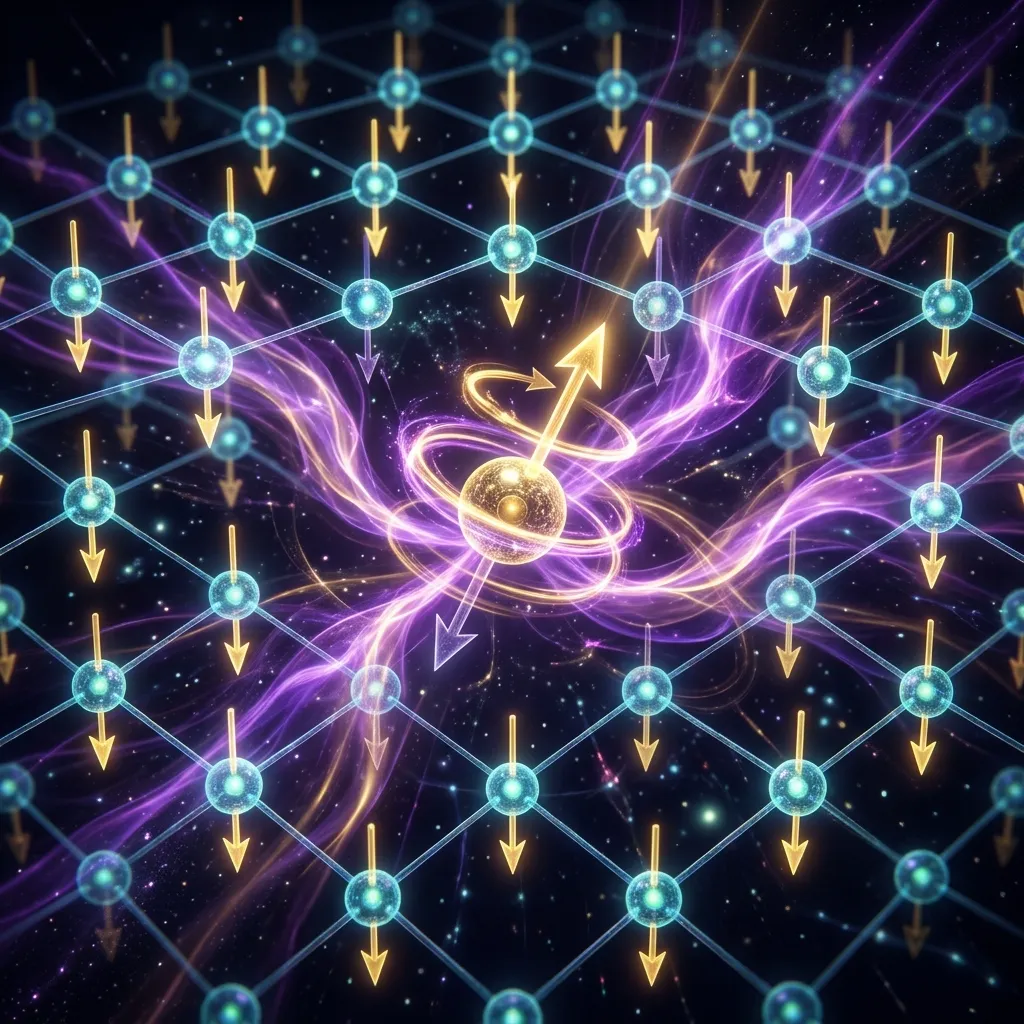
Every electron in the universe possesses an intrinsic property called spin — a form of quantum angular momentum that makes the electron behave as if it were a tiny spinning magnet, with an imaginary north pole and south pole. The spin can be "up" (↑) or "down" (↓), and it's this binary property that forms the basis of spintronics.
Spin is one of the most fundamental properties of matter. Without spin, atoms wouldn't form stable bonds, metals wouldn't be magnetic, MRI wouldn't work, and the Sun wouldn't produce energy through nuclear fusion.
Understanding spin through analogy
The spin is quantum — it has no perfect macroscopic analogy. But to understand its behavior, imagine a coin spinning on a table:
- The coin can be "heads" (↑, spin up) or "tails" (↓, spin down)
- While spinning, it's in a superposition of both states (quantum aspect)
- When it stops (measurement), it "chooses" one state definitively
- In a magnetic material, millions of coin-electrons spin aligned — all "heads" or all "tails" — creating macroscopic magnetism
What Tokyo's team did was, essentially, film in ultra-slow-motion the exact moment when a "spinning coin" flips from heads to tails — a process that lasts only 140 femtoseconds.
How the Experiment Was Done
The material: GdFeCo
The team used a crystal of GdFeCo (Gadolinium-Iron-Cobalt), an alloy known in spintronics for exhibiting extremely fast spin dynamics. GdFeCo has a unique property: its gadolinium and iron/cobalt sublattices have opposing spin orientations (ferrimagnetism), with a compensation point where sublattice magnetizations exactly cancel out. Near this point, spin flips are maximally fast.
The setup
| Component | Specification |
|---|---|
| Pump laser | Titanium:sapphire, 35 fs pulses, 800 nm |
| Probe | X-ray free-electron laser (XFEL) via SACLA |
| Temporal resolution | 140 fs |
| Spatial resolution | 15 nm |
| Temperature | 300 K (room temperature) |
| Magnetic field | 0.5 Tesla |
The experiment used a pump-probe technique:
- Pump: An ultrashort laser pulse hits the crystal, exciting electrons and initiating the spin flip
- Probe: At precise femtosecond intervals after the pump, an X-ray pulse "photographs" the magnetic state of the crystal
- Repetition: The process is repeated thousands of times with varying time intervals, building a molecular-level "stop-motion movie"
What they saw
The sequence revealed that the spin flip occurs in three distinct stages:
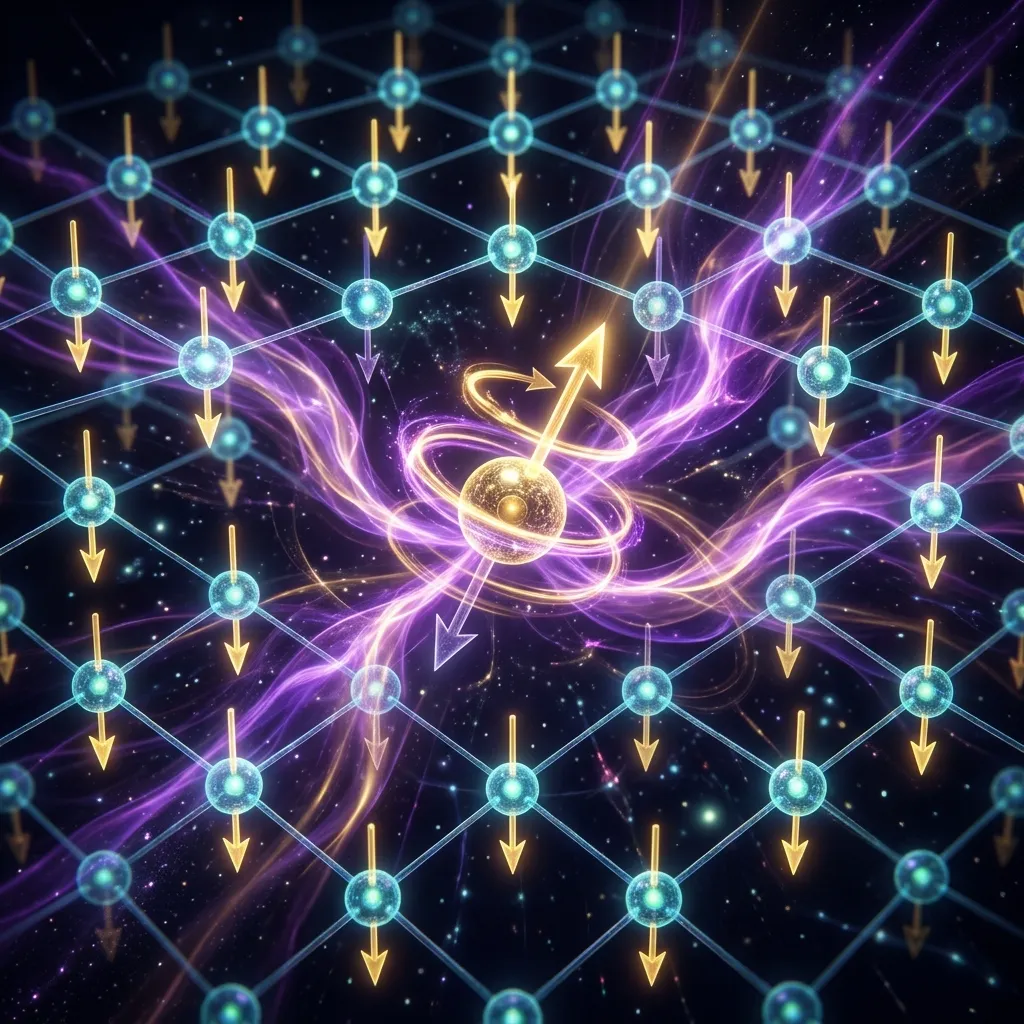
Phase 1 (0-50 fs): The pump laser transfers energy to electrons, which begin to lose their original spin orientation. Iron spins start decohering — like a formation of ballerinas that begins to lose synchrony.
Phase 2 (50-100 fs): Iron sublattice spins collapse completely. Gadolinium sublattice, initially opposed, temporarily dominates the magnetization. This creates an ephemeral state with transient magnetization — something never before visualized.
Phase 3 (100-140 fs): Both sublattices simultaneously realign in the new direction. The "magnetic reset" is complete. The crystal's magnetic orientation has been reversed.
Why This Matters: Practical Applications
MRAM: The eternal memory
MRAM (Magnetoresistive Random Access Memory) is a technology that stores data using electron spin states (↑ = 0, ↓ = 1). Advantages over conventional memories:
| Feature | DRAM (current RAM) | Flash (SSD) | MRAM |
|---|---|---|---|
| Speed | 10-50 ns | 25-100 μs | 3-10 ns |
| Non-volatile | ❌ | ✅ | ✅ |
| Durability | Unlimited | 3,000-100,000 cycles | Unlimited |
| Energy (write) | ~5 pJ/bit | ~10 nJ/bit | ~0.1 pJ/bit |
| Data retention | Loses with power off | 10+ years | Forever |
MRAM combines DRAM's speed with Flash's non-volatility and consumes 50× less energy for writing. A computer with MRAM would start instantly (no booting), never lose data from power failures, and consume dramatically less energy.
Currently, flip speed limits MRAM clock rate. Knowing the spin reversal process lasts 140 fs means MRAM could theoretically operate at 7 terahertz (7 trillion operations per second) — 1,000× faster than current DDR5 RAM at 6.4 GHz.
Quantum computing
Spins are candidates for qubits in spin-based quantum computers. Precisely understanding the dynamics of the flip — including transient intermediate states discovered in Tokyo — could enable ultrafast quantum gates: single-qubit operations in femtoseconds, compared to nanoseconds in current superconducting systems.
The Future of Femtoscience
This breakthrough opens doors for a new era called femtoscience — the science of processes occurring at femtosecond scales. Coming next:
1. Filming charge transfer in semiconductors: When sunlight hits a solar cell, understanding how electrons "get lost" could boost solar panel efficiency by 10-15 percentage points.
2. Mapping chemical reactions in real time: Chemical reactions are fundamentally atoms exchanging electrons in femtoseconds. Filming them would enable designing catalysts with atomic precision.
3. Visualizing ultrafast biological processes: Photosynthesis involves quantum energy transfer between chlorophyll molecules in ~300 femtoseconds. Why do plants achieve near-perfect efficiency (97%) while artificial solar panels reach 25%?
Industry impact
Samsung and SK Hynix — the world's two largest memory manufacturers — maintain spintronics research programs with combined investment exceeding $800 million annually. The global MRAM market reached $1.2 billion in 2025 and is projected to grow to $8.4 billion by 2032.
What Experts Say
Dr. Chiara Ciccarelli (University of Cambridge): "This is the most detailed real-time visualization of electron spin dynamics ever obtained. The three-phase flip model suggests our theoretical models were incomplete."
Prof. Stuart Parkin (Max Planck Institute, Nobel candidate): "If we can control spin flips with the precision demonstrated in Tokyo, we're looking at a new era of spintronic devices that operate at frequencies currently reserved for optics."
Also Read
- CERN Discovers Doubly Charmed Baryon
- Phonon Laser Revolutionizes Quantum Measurement
- 130% Efficiency Solar Cell
FAQ — Frequently Asked Questions
Why is it so important to "film" a spin flip?
Because until March 2026, all knowledge about spin flip dynamics came from THEORETICAL models and INDIRECT measurements. No one had ever directly observed the intermediate stages of the process. Tokyo's experiment revealed that the flip occurs in three distinct phases, with a transient intermediate state that wasn't predicted by dominant theoretical models. This means our simulated models of spin behavior — which we use to design technologies like MRAM — were incomplete.
Will this make my computer faster?
Not immediately, but in the medium term (5-15 years), yes. Understanding the spin flip at the femtosecond level enables engineering MRAM memories that operate at terahertz frequencies — 1,000× faster than current DDR5. A computer with terahertz MRAM would start instantly, never lose data from power failures, and consume dramatically less energy.
How can something be faster than light?
It can't. The spin flip isn't "faster than light" — what's fast is the PROCESS duration (140 fs). Light doesn't stop; in 140 fs it travels 42 micrometers. The experiment used X-ray free-electron laser (XFEL) pulses at the SACLA facility — one of only 5 facilities worldwide capable of producing coherent X-ray pulses short enough to "photograph" processes at this temporal scale.
Sources and References
- Nature Physics — "Real-time imaging of ultrafast spin reversal in GdFeCo" — University of Tokyo, March 30, 2026
- SACLA/RIKEN — "XFEL-based pump-probe study of femtosecond magnetic dynamics" — technical report, March 2026
- Nature Reviews Materials — "Spintronics: from fundamentals to applications" — review, January 2026
- Journal of Applied Physics — "Current status of STT-MRAM" — review, February 2026
- Science — "Attosecond to femtosecond: the new frontier of ultrafast science" — perspective, March 2026


