
Phonon Laser Revolutionizes Quantum Measurement and Could Retire GPS
On March 31, 2026, a team of physicists from the University of Rochester and the Rochester Institute of Technology published in the journal Physical Review Letters what could become one of the decade's most disruptive technologies: a phonon laser capable of measuring vibrations at the quantum level with precision 1,000 times greater than the best commercially available sensors. The most immediate implication? Ultra-high-precision navigation without relying on GPS satellites — something militaries, submarines, aviation, and even autonomous vehicles have pursued for decades.
To put this in perspective: the American GPS system, consisting of 31 satellites orbiting at 20,200 km altitude, has accuracy of 3 to 5 meters for civilians and 30 centimeters for military use. The phonon laser, in initial laboratory tests, demonstrated potential to achieve millimeter accuracy — without needing any signal from space.
What Is a Phonon and Why Does It Matter?
The particle that isn't a particle
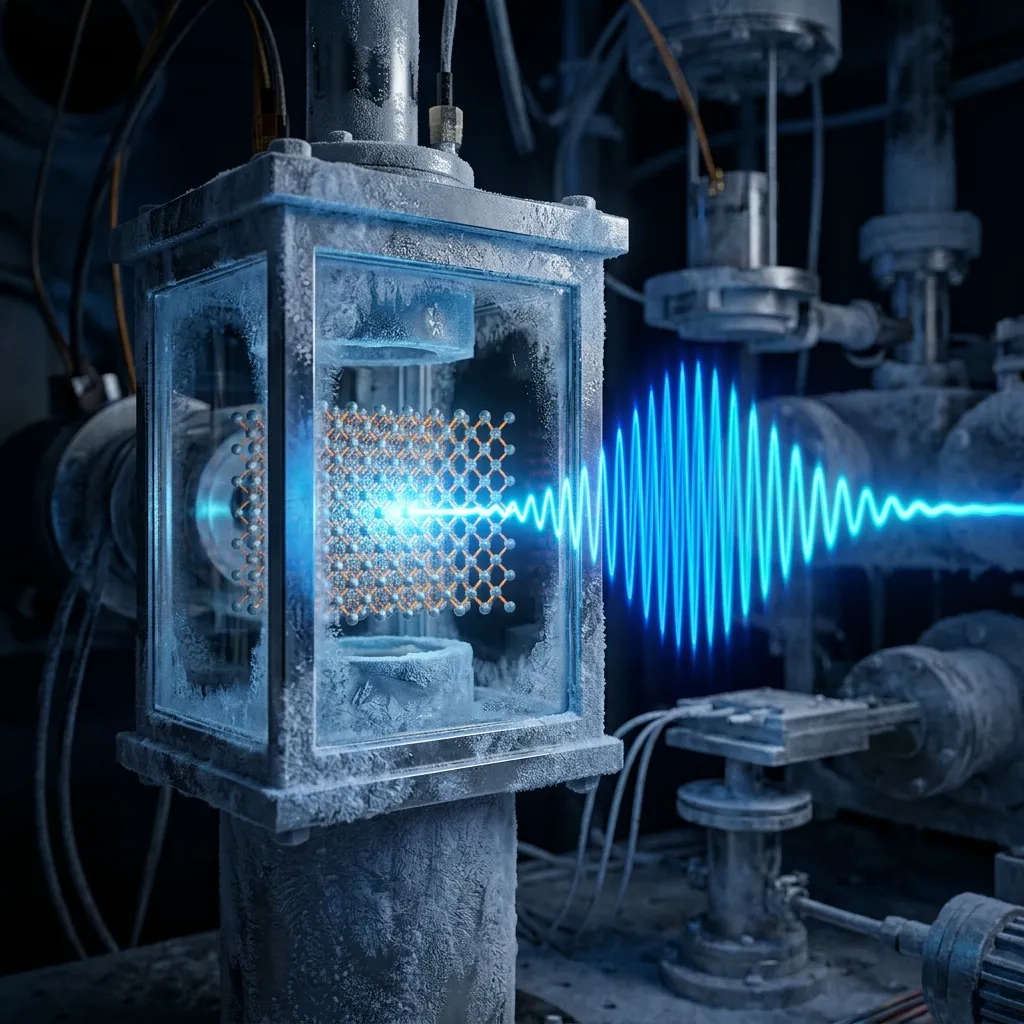
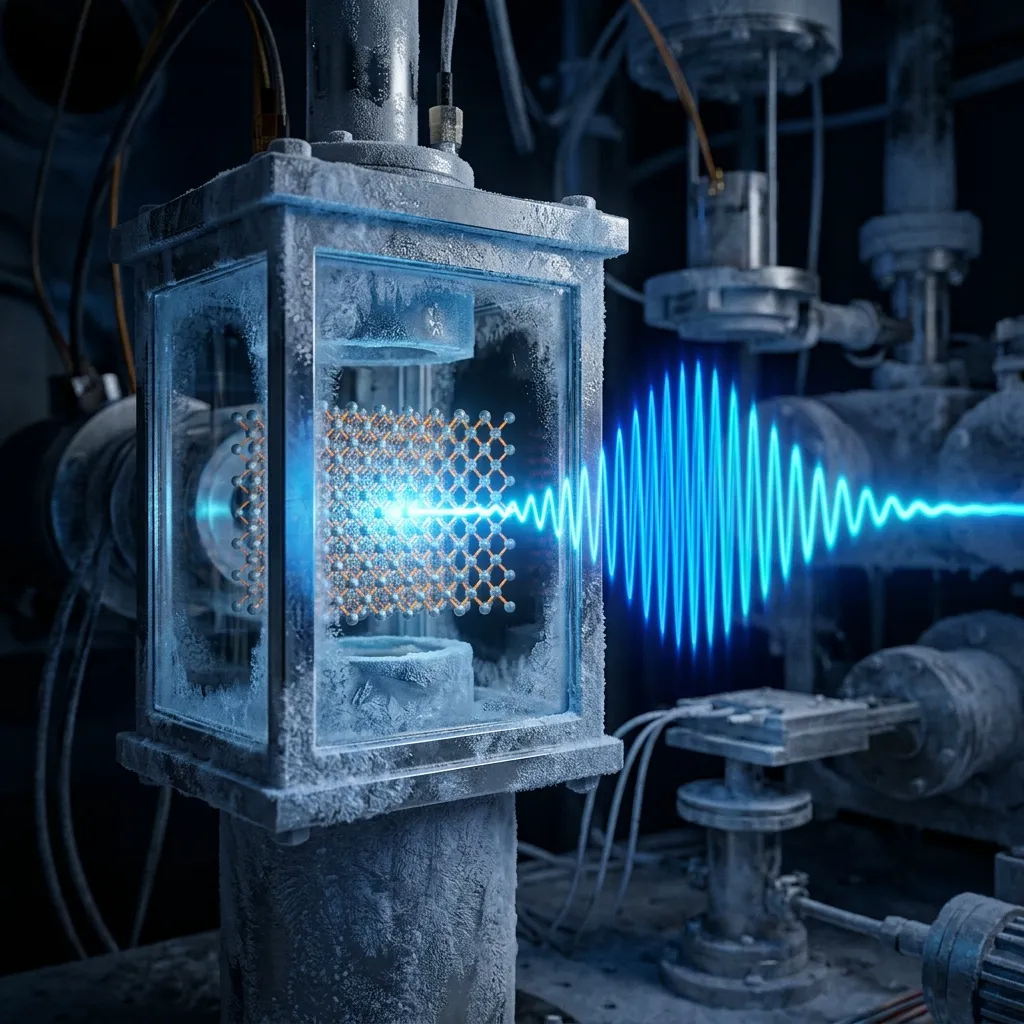
In solid-state physics, a phonon is a quasiparticle — it doesn't exist as an individual physical object but is the mathematical representation of a collective vibration of atoms in a solid material. Imagine a crystal lattice of atoms (like carbon atoms in a diamond) vibrating as a wave. Each "packet" of this vibration is a phonon.
Just as a photon is the quantum of light energy, a phonon is the quantum of mechanical vibrational energy. And just as photons can be organized into coherent beams (a light laser), phonons can — in theory — be organized into coherent vibration beams. That's the phonon laser.
The stadium analogy
Think of a soccer stadium with 60,000 fans. Normally, each person talks, shouts, and moves in an uncoordinated fashion — that's thermal noise, the vibrational equivalent of random background noise. Now imagine all 60,000 fans begin clapping in perfect synchrony, at the same rhythm, the same amplitude. This transition from chaos to coherence is what the phonon laser does with atomic vibrations.
How the Rochester Phonon Laser Works
The quantum noise problem
The greatest obstacle to measuring vibrations at the quantum scale has always been noise — thermal, electromagnetic, and even quantum disturbances that mask the signals scientists are trying to detect. In classical measurements, noise limits precision. In quantum measurements, it can completely destroy information.
The Rochester team solved this with a triple approach:
- Cryogenic cooling to 15 millikelvin (0.015°C above absolute zero) — eliminating thermal noise
- Optomechanical cavity of 200 nanometers — confining phonons in a space smaller than a virus
- Active quantum feedback — using real-time measurements to suppress remaining fluctuations
The impressive numbers
| Parameter | Commercial sensor | Rochester phonon laser |
|---|---|---|
| Force sensitivity | 10⁻¹² N/√Hz | 10⁻¹⁵ N/√Hz |
| Operating temperature | Ambient (300K) | 15 mK |
| Sensor size | ~10 cm | ~200 nm |
| Positional accuracy | Micrometers | Sub-nanometers |
| Frequency range | 1 Hz – 10 kHz | 1 MHz – 10 GHz |
The sensitivity difference of three orders of magnitude (1,000x) isn't an incremental improvement — it's a paradigm shift. For context: it's the difference between being able to hear a conversation in a quiet room and being able to hear an ant's heartbeat.
GPS-Free Navigation: The Military Holy Grail
Why GPS is vulnerable
GPS is a brilliant technology — and dangerously fragile. GPS satellite signals reach Earth with power of approximately -160 dBW — weaker than the receiver's own background noise. This makes GPS vulnerable to:
- Jamming: Broadcasting noise on the same frequency. A $30 jammer from the internet can block GPS within a 50-meter radius. Russian military jammers can block areas of 300+ km²
- Spoofing: Transmitting fake GPS signals that deceive receivers. Iran captured an American RQ-170 drone in 2011 using GPS spoofing
- Physical destruction: Anti-satellite missiles (ASAT) can destroy GPS satellites. China, Russia, India, and the US have demonstrated ASAT capability
In March 2026, with Operation Epic Fury in the Middle East underway, Iran intensified GPS jamming throughout the Persian Gulf, affecting civilian aviation and American military operations. The need for satellite-independent navigation systems has never been more urgent.
Quantum inertial navigation
Inertial navigation systems (INS) work by measuring acceleration and rotation to calculate position without external signals. Nuclear submarines already use INS, but accuracy degrades over time — an error of 0.1 degree/hour in a gyroscope means deviation of 1.8 km after 1 hour of submersion.
The phonon laser promises quantum gyroscopes with drift of less than 0.001 degree/hour — reducing navigation error to meters after hours of operation without any external signal. This would enable:
- Submarines navigating months without GPS with metric precision
- Military aircraft operating in intense jamming environments
- Cruise missiles maintaining accuracy even under electronic warfare
- Autonomous cars navigating through tunnels, garages, and urban canyons
The Global Race for Quantum Navigation
What each country is doing
The Rochester phonon laser doesn't emerge in a vacuum. Quantum navigation is a field of intense geopolitical competition:
- United States: DARPA operates the A-PNT (Assured Positioning, Navigation and Timing) program since 2019, with estimated budget of $200 million annually. The Rochester phonon laser received partial funding from the program
- China: The ZiQuan (自泉, "Own Source") program from the Chinese Academy of Sciences has worked on atomic gyroscopes since 2017. In 2025, China demonstrated a quantum inertial navigation prototype with drift of 0.01 degree/hour in 72-hour tests
- United Kingdom: The UK Quantum Navigation Hub, with £31 million from the British government, developed the first commercial quantum accelerometer in 2023, already tested on Royal Navy ships
- Russia: Limited information, but intelligence reports suggest the Landau Institute in Moscow is working on Bose-Einstein condensate-based sensors
Comparative table: major global programs
| Country | Program | Start | Investment | Status (Mar 2026) |
|---|---|---|---|---|
| USA | DARPA A-PNT + Rochester | 2019 | ~$200M/yr | Lab prototype 1000x more precise |
| China | ZiQuan (CAS) | 2017 | ~$150M/yr | Prototype tested 72h |
| UK | Quantum Nav Hub | 2020 | £31M total | Accelerometer on ship |
| France | IOGS/Thales | 2021 | €45M total | Atomic gyroscope lab |
| Japan | MEXT QST | 2022 | ¥8B total | Fundamental research |
Beyond Navigation: Other Applications
Gravitational wave detection
LIGO (Laser Interferometer Gravitational-Wave Observatory), which detected gravitational waves for the first time in 2015, uses 40 kg mirrors suspended in laser beams to measure space-time distortions. LIGO's current precision is 10⁻¹⁹ meters — smaller than a proton's diameter.
If phonon laser-based sensors are integrated into future detectors like the Einstein Telescope (planned for 2035 in Europe), sensitivity could increase 10 to 100 times, enabling detection of gravitational waves from less energetic events — like smaller neutron star mergers or even primordial Big Bang signals.
Local gravity studies
The phonon laser could revolutionize gravimetry — the precise measurement of local gravitational fields. Applications include:
- Detection of underground cavities without drilling (tunnels, mines, bunkers)
- Volcano monitoring by detecting changes in underground magma
- Mineral exploration identifying metal deposits without exploratory mining
- Archaeology finding hidden chambers in pyramids and ancient temples
Quantum processing
Coherent phonons can serve as mechanical qubits in hybrid quantum computers. The advantage of phononic qubits is their relative stability: while superconducting qubits lose coherence in microseconds, coherent phonons in crystalline cavities can maintain coherence for milliseconds — a thousand times longer.
Challenges: From Laboratory to Real World
Temperature
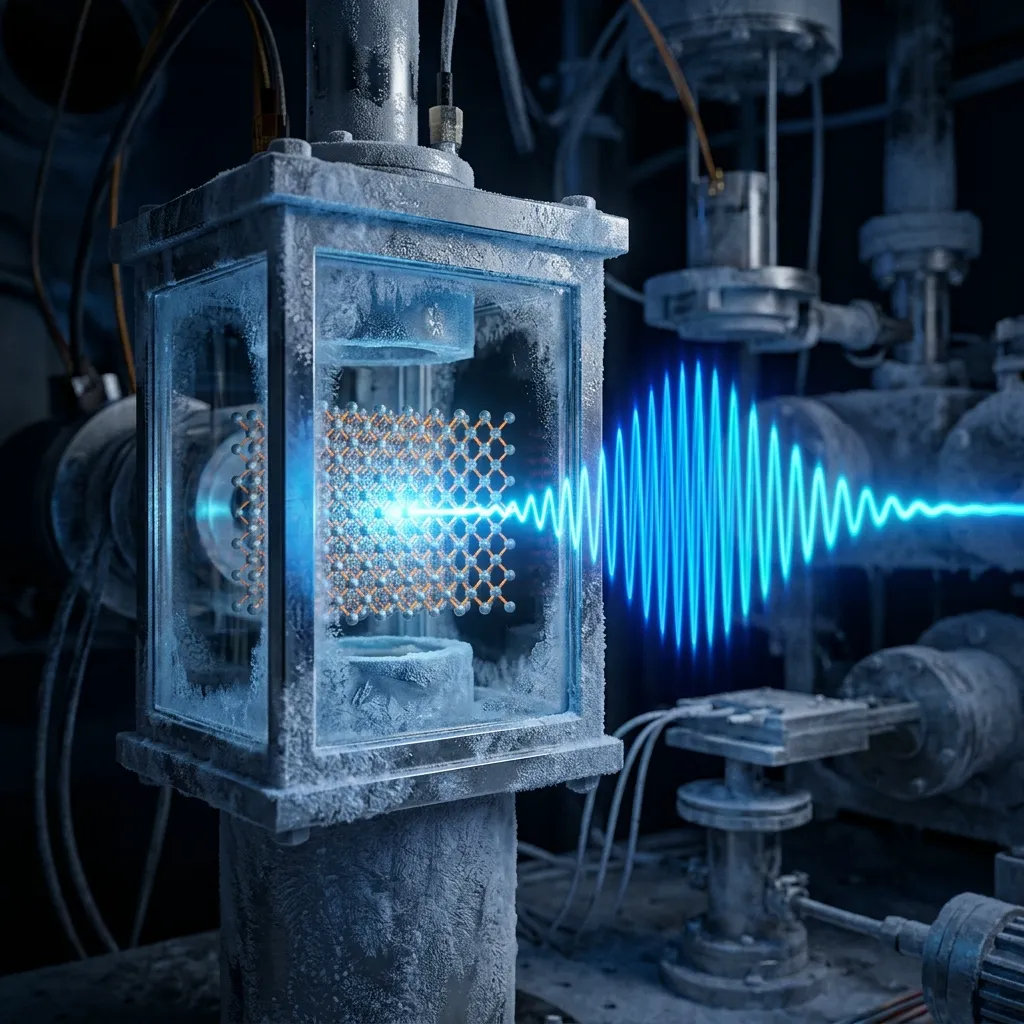
The phonon laser operates at 15 millikelvin — colder than outer space (2.7 K). Maintaining this temperature requires dilution refrigerators costing $500,000 to $2 million and consuming kilowatts of power. For submarine or aircraft applications, compact and robust cryogenic systems would need to be developed — something current technology doesn't offer.
Miniaturization
The optomechanical cavity is nanometric, but the complete system (cryostat + control electronics + pump laser) occupies an entire room. Rochester's goal is to reduce it to the size of a shoebox by 2032, but this depends on advances in compact cooling.
Cost
Current prototypes cost $3-5 million. Mass production would reduce this to $50,000-100,000 — expensive for civilian use but acceptable for military and large-scale navigation applications.
Impact on Everyday Life
When will it reach consumers?
If the history of other quantum technologies serves as a guide, the likely timeline is:
- 2028-2030: Military prototypes in testing (submarines, aviation)
- 2030-2032: Industrial systems (mineral exploration, seismic monitoring)
- 2032-2035: Commercial navigation systems (ships, civil aviation)
- 2035-2040: Integration in compact devices (autonomous cars, drones)
For the average citizen, the most immediate impact would be autonomous cars that work in tunnels and garages without GPS, and smartphones with indoor navigation accurate to 10 centimeters — enabling navigation inside hospitals, malls, and airports.
What Experts Say
Dr. Florian Marquardt, Director of the Max Planck Institute for the Science of Light in Germany, who was not involved in the study, told Nature Physics: "The Rochester work represents the first convincing demonstration that coherent phonons can surpass classical sensors by a margin sufficient to justify the additional complexity. This was theoretical two years ago — now it's experimental."
Prof. Aashish Clerk, co-lead author and Professor of Physics at the University of Rochester: "We reduced quantum noise below the standard quantum limit for the first time in a phononic system. This opens the door to phononic metrology — precision measurement using vibrations, just as photon lasers revolutionized optical metrology."
Geopolitical Context: Why Now?
The publication of Rochester's work in March 2026 is no coincidence. With the US-Iran conflict at high intensity during Operation Epic Fury, the Pentagon is accelerating investments in technologies that reduce satellite dependency. Iran has demonstrated GPS jamming capability across the entire Persian Gulf, and China has been testing anti-satellite weapons that could disable the American GPS constellation.
The phonon laser represents a technological shortcut that could give decisive strategic advantage to the first country that manages to miniaturize it for military use.
Also Read
FAQ — Frequently Asked Questions
Will the phonon laser replace GPS on my phone?
Not in the short term. Current technology requires extreme cryogenic cooling (15 millikelvin, colder than space) and room-sized equipment. Miniaturization for portable devices is projected for 2035-2040. What will likely happen first is a hybrid system: GPS works normally when signals are available, and a compact quantum inertial sensor takes over when GPS fails — in tunnels, underground garages, or areas with interference. The current prototype costs $3-5 million, which needs to drop at least 100-fold for consumer electronics viability.
What's the difference between a photon laser and a phonon laser?
A photon laser (the conventional laser we know) produces a coherent beam of light — particles of electromagnetic energy traveling in the same direction, frequency, and phase. A phonon laser produces coherent mechanical vibrations — atoms in a crystal lattice oscillating in perfect synchrony. The similarity is conceptual: both amplify a form of energy (luminous or vibrational) through stimulated emission. The practical difference is that phonons don't travel through space like photons — they are internal vibrations of solid materials, making them ideal for measuring local forces and accelerations, but useless for long-distance communications.
Why is GPS-free navigation so important for the military?
Because GPS is surprisingly easy to disable. A portable $30 jammer can block GPS within a 50-meter radius. Russian military jammers like the Krasukha-4 can block areas of hundreds of square kilometers. Iran captured an American RQ-170 drone in 2011 using GPS spoofing — transmitting fake signals that made the drone "think" it was over American territory. In 2026, during Operation Epic Fury, Iranian GPS jamming affects civilian aviation in the Persian Gulf. Submarines need to stay submerged for months without surfacing to capture GPS. Quantum inertial navigation would eliminate all these vulnerabilities.
Sources and References
- Physical Review Letters — "Phonon Lasing and Quantum-Limited Mechanical Measurement in an Optomechanical Cavity" — University of Rochester & RIT, March 31, 2026
- ScienceDaily — "New phonon laser manipulates tiny vibrations at quantum level" — March 31, 2026
- Nature Physics — Editorial comment: "Phonon coherence crosses the threshold" — March 2026
- DARPA — A-PNT Program: Assured Positioning, Navigation and Timing — Annual Report 2025
- UK Quantum Technology Hub for Sensors and Timing — "First sea trials of quantum accelerometer" — Report 2023-2025


