🌍 Your knowledge portal
ciencia-natureza

Scientists Discover Bizarre New State of Matter Inside Uranus and Neptune

📅 2026-04-21⏱️ 5 min read📝

Quick Summary

Researchers at Carnegie Institution for Science simulated the interior of Uranus and Neptune and discovered that carbon and hydrogen form an unprecedented 'superionic' state — solid and liquid simultaneously — explaining these planets' irregular magnetic fields.

Scientists Discover Bizarre New State of Matter Inside Uranus and Neptune

A research team at the Carnegie Institution for Science has discovered something that shouldn't be possible according to classical physics: a state of matter that is simultaneously solid and liquid, existing in the interiors of Uranus and Neptune under conditions of extreme pressure and temperature. The findings, published in Nature Communications in April 2026, don't just describe a novel form of matter — they may finally explain one of planetary science's longest-standing mysteries: why the ice giants have such bizarre magnetic fields.

The Planets Nobody Knows #

Uranus and Neptune are, in many ways, the solar system's forgotten giants. Jupiter and Saturn dominate popular science coverage due to their visual drama — the Great Red Spot, Saturn's rings, the sheer scale of their cloud bands. The ice giants — colder, smaller, bluer — receive comparatively little attention.

But they are deeply strange. Their magnetic fields are unlike those of any other planet in the solar system — or any planet we've yet detected beyond it. Earth's magnetic field is roughly aligned with its rotation axis, with the magnetic north pole relatively close to the geographic north pole. Jupiter and Saturn also have magnetic fields broadly aligned with their axes.

Uranus's magnetic field is tilted approximately 60 degrees from its rotation axis and offset from the planet's center by about one-third of the planet's radius. Neptune's is similarly bizarre — tilted 47 degrees and offset. The fields are also asymmetric, meaning the north and south magnetic poles have significantly different strengths.

This doesn't match any existing model of planetary magnetic field generation. For decades, planetary scientists have known the standard convective dynamo model — the mechanism that generates Earth's magnetic field through fluid motion in a conducting outer core — doesn't adequately explain what we observe at Uranus and Neptune.

The Discovery: A New Form of Matter #

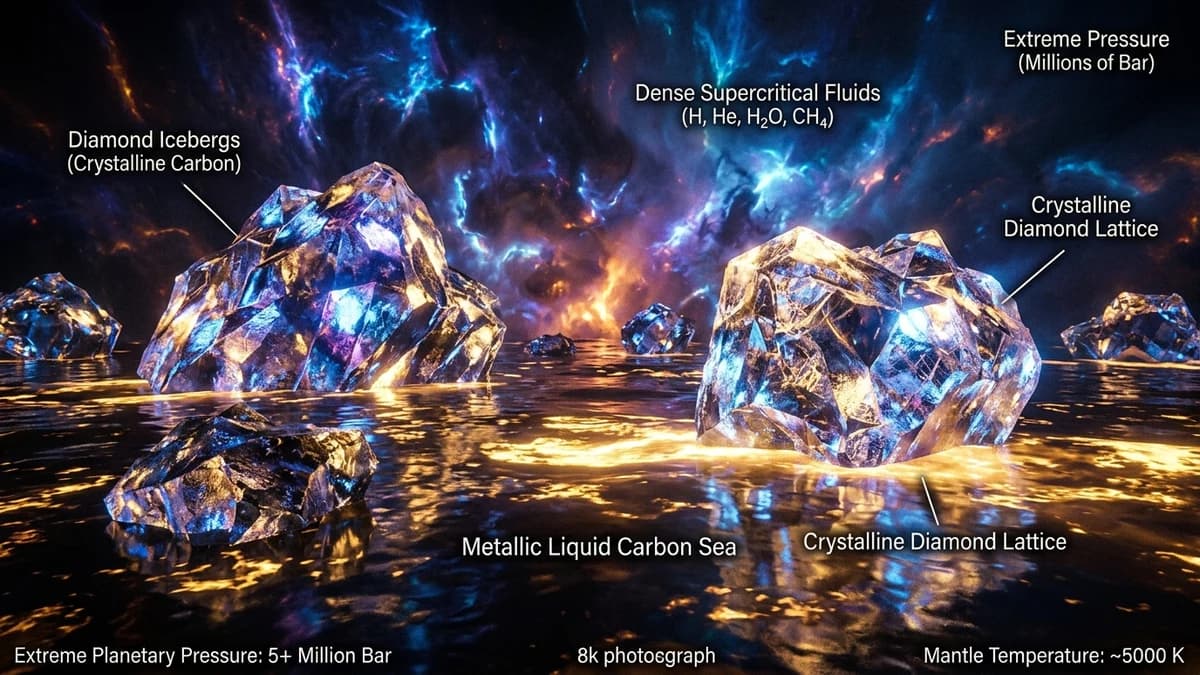
The Carnegie team, led by geophysicist Rajkrishna Mishra, used quantum mechanical molecular dynamics simulations to model what happens to mixtures of carbon and hydrogen at the pressures and temperatures found in ice giant interiors — roughly 100-400 gigapascals of pressure and temperatures of 5,000 to 10,000 Kelvin.

What they found exceeded expectations. At certain pressure-temperature combinations, the carbon-hydrogen mixture doesn't behave like a normal solid or a normal liquid. Instead, it enters what physicists call a superionic state — but with a specific geometry never previously described.

In standard superionic materials (which have been created in laboratories and modeled theoretically), the ionic lattice is fixed while ions flow through it omnidirectionally. In the carbon-hydrogen system inside ice giants, the geometry is more constrained: hydrogen ions flow not in all directions but along specific helical pathways within the carbon diamond-like lattice structure.

The team named this the quasi-one-dimensional superionic state — a phase of matter in which ion flow is geometrically constrained to specific directional channels within an otherwise rigid crystalline framework. It had never been predicted or observed before.

Why This Explains the Magnetic Fields #

Magnetic fields in planets are generated by the movement of electrically conducting material — this is the dynamo effect. Different types of conducting material, moving in different geometries, produce magnetic fields with different characteristics.

The quasi-one-dimensional superionic carbon-hydrogen phase is electrically conducting — the flowing hydrogen ions carry charge, generating electrical currents, which generate magnetic fields. But the constrained, helical geometry of that ion flow produces magnetic fields fundamentally different from those generated by an isotropic (direction-independent) fluid conductor.

Multiple layers of this superionic material, at different depths, temperatures, and pressures, each with slightly different ion flow geometries, would naturally produce magnetic fields that:

  • Are offset from the rotation axis (because the conducting layers are asymmetrically distributed)
  • Are asymmetric between poles (because the ion flow geometry differs by depth and hemisphere)
  • Are unstable over geological timescales (because the superionic layers can shift as the planet cools)

This matches, for the first time in a coherent physical model, the actual observed magnetic field characteristics of Uranus and Neptune.

What This Means Beyond Planetary Science #

The discovery has implications that extend beyond understanding Uranus and Neptune.

Exoplanet characterization: Ice giant-sized planets are among the most common types identified in exoplanet surveys. Many of these may be larger versions of Uranus and Neptune — "super-Neptunes" or "sub-Saturns." The quasi-one-dimensional superionic phase may be present in millions of worlds, generating magnetic fields that will be detectable by future space observatories.

Planetary magnetic field diversity: The discovery suggests that planetary magnetic fields can be generated by mechanisms far more varied than previously thought. The range of possible magnetic field geometries — and thus the range of magnetosphere configurations that affect habitability and atmospheric retention — is broader than existing models capture.

Fundamental physics: A state of matter with constrained, directional ion flow within a crystalline lattice is interesting independently of its astrophysical context. The discovery opens questions about what other geometrically constrained superionic states might exist in other material systems.

How We Study Conditions We Can Never Visit #

No spacecraft has ever come close to Uranus or Neptune. Voyager 2, the only probe to conduct flybys, photographed both planets in the late 1980s — providing the basic data on magnetic field structure that this research now helps explain. No dedicated mission to either planet has yet been approved, though NASA has identified an Uranus orbiter as a top priority in its planetary science decadal survey.

The Carnegie team's work was done entirely through computational simulation — modeling the quantum behavior of carbon and hydrogen atoms at conditions achievable only in the deep interior of ice giants or, briefly, in laboratory settings with diamond anvil cells and high-powered lasers.

The fact that computational physics can discover states of matter that neither laboratory experiments nor spacecraft observations have accessed is itself significant — a demonstration of the explanatory power of quantum mechanical modeling when applied to extreme conditions.

Impact Table #

Discovery Details
New matter state Quasi-one-dimensional superionic
Materials Carbon + hydrogen
Conditions 100-400 GPa, 5,000-10,000 K
Published Nature Communications, April 2026
Institution Carnegie Institution for Science
Mystery explained Uranus/Neptune magnetic field asymmetry

Sources #

📢 Gostou deste artigo?

Compartilhe com seus amigos e nos conte o que você achou nos comentários!

Receba novidades!

Cadastre seu email e receba as melhores curiosidades toda semana.

Sem spam. Cancele quando quiser.

💬 Comentários (0)

Seja o primeiro a comentar! 👋

📚Read Also

Artemis II Delayed 18 Months: The Crisis Threatening America's Return to the Moonciencia-natureza

Artemis II Delayed 18 Months: The Crisis Threatening America's Return to the Moon

NASA announced on April 24, 2026 the delay of Artemis II to September 2027. A 24% budget cut and Orion technical failures are the causes.

⏱️1 minLer mais →
FDA Approves Otarmeni: The Gene Therapy That Gives Hearing to Children Born Deafciencia-natureza

FDA Approves Otarmeni: The Gene Therapy That Gives Hearing to Children Born Deaf

Regeneron's Otarmeni became the first FDA-approved gene therapy for hereditary hearing loss caused by OTOF gene mutations in April 2026, restoring hearing in children who were profoundly deaf from bir

⏱️5 minLer mais →
Toxic Leak in West Virginia: Hydrogen Sulfide Kills 2, Hospitalizes 19 at Silver Refineryciencia-natureza

Toxic Leak in West Virginia: Hydrogen Sulfide Kills 2, Hospitalizes 19 at Silver Refinery

On April 22, 2026, the accidental mixing of nitric acid and M2000A at the Ames Goldsmith silver refinery in Institute, West Virginia, released toxic hydrogen sulfide gas, killing 2 workers and sending

⏱️9 minLer mais →
ANVISA Approves Polylaminin: Brazil's Breakthrough Treatment for Spinal Cord Injuryciencia-natureza

ANVISA Approves Polylaminin: Brazil's Breakthrough Treatment for Spinal Cord Injury

ANVISA granted landmark approval for polylaminin-based therapy for spinal cord injury in April 2026, offering the first disease-modifying treatment for paralysis patients in Brazil.

⏱️2 minLer mais →
Curiosity Detects Unprecedented Organic Compounds on Mars — Including a DNA Precursorciencia-natureza

Curiosity Detects Unprecedented Organic Compounds on Mars — Including a DNA Precursor

NASA's Curiosity rover detected organic molecules in Mars's Gale Crater, including a nitrogen compound similar to DNA precursors. The discovery reignites debate about past life on the Red Planet.

⏱️4 minLer mais →
Georgia and Florida on Fire: The Southeast's Worst Wildfire Crisis in Decadesciencia-natureza

Georgia and Florida on Fire: The Southeast's Worst Wildfire Crisis in Decades

Driven by severe drought, low humidity, and high winds, fast-moving wildfires ripped through Georgia and Florida on April 21–23, 2026, destroying more than 50 homes and forcing thousands of residents

⏱️9 minLer mais →