Curiosity Detects Unprecedented Organic Compounds on Mars — Including a DNA Precursor
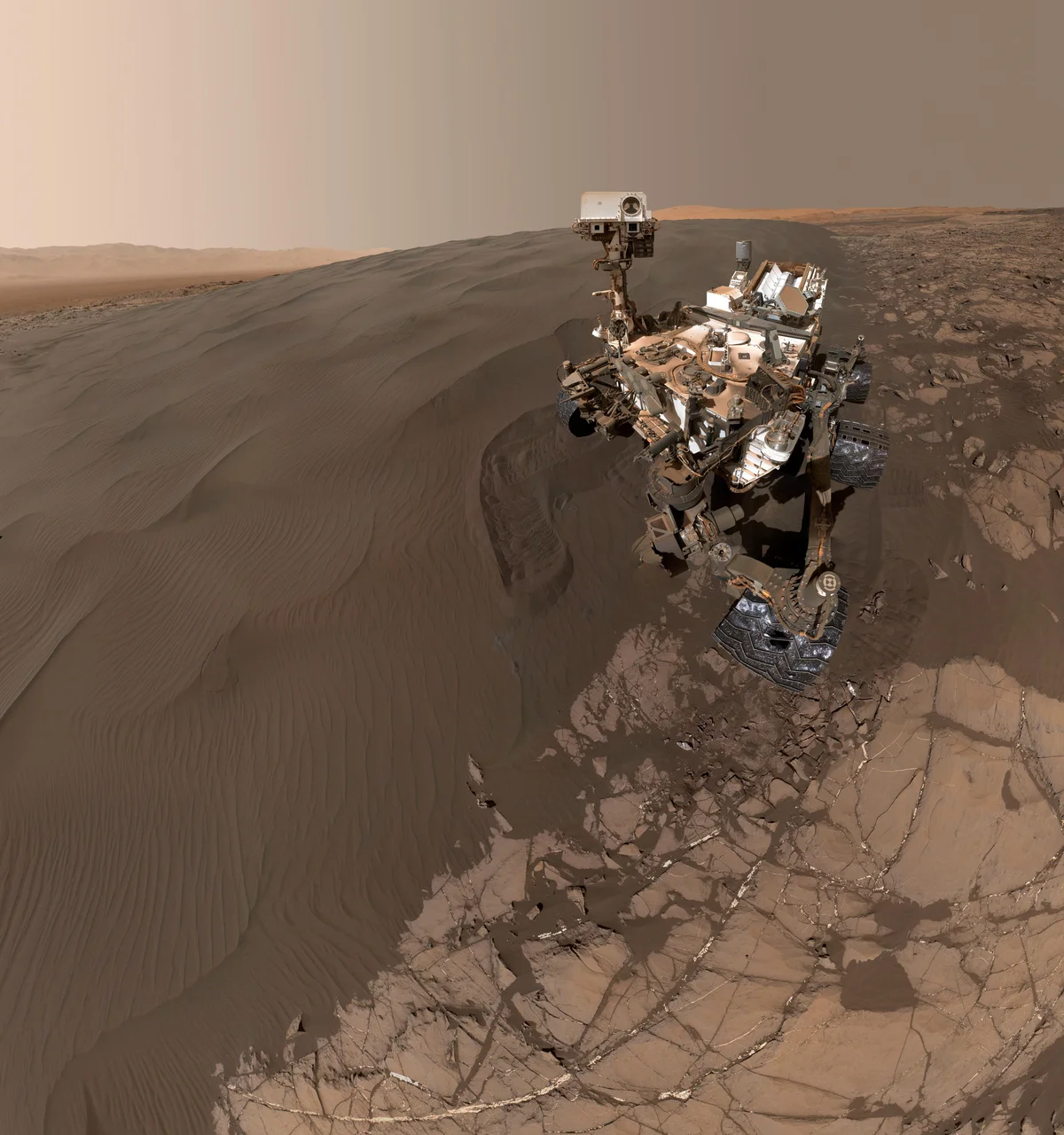
In April 2026, NASA announced that its Curiosity rover had detected a suite of organic molecules in Mars's Gale Crater that includes compounds never previously found on the Red Planet — among them, a nitrogen-containing organic molecule with structural similarities to DNA nucleotide precursors. The discovery, published simultaneously in Nature Astronomy and announced at a NASA press conference, represents the most chemically significant finding from Mars surface exploration since Curiosity's own detection of organic molecules in 2018.
Gale Crater: Mars's Chemical Archive
Gale Crater is a 154-kilometer-wide impact crater that formed approximately 3.8 billion years ago. Billions of years of geological history are preserved in its layered sedimentary rocks — rocks that accumulated when Mars was a wetter, warmer world. These sediments contain chemical records of ancient martian environments that may have been habitable.
Curiosity has been exploring Gale Crater since its landing in 2012. The rover's SAM (Sample Analysis at Mars) instrument, which heats rock samples and analyzes the gases released, has over thirteen years of operation accumulated an unparalleled chemical database of martian surface and subsurface chemistry.
The April 2026 discovery came from samples drilled at a location called "Pontours," in an area of the crater where orbital spectroscopy had suggested elevated concentrations of sulfate minerals — indicators of past aqueous activity.
What Was Found: The Organic Chemistry
The SAM instrument detected multiple classes of organic compounds in the Pontours samples:
Aliphatic hydrocarbons — chains of carbon and hydrogen atoms, the simplest organic compounds. These have been found before on Mars and can be produced by both biological and abiological processes.
Aromatic compounds — ring-shaped carbon structures. These are more interesting because they are structural components of DNA, RNA, and many biological molecules.
Sulfur-containing organics — organic molecules incorporating sulfur atoms. These are particularly relevant because sulfur plays important roles in prebiotic chemistry — the chemistry that precedes and enables life.
The nitrogen compound — the discovery that generated the most excitement. SAM detected a compound containing carbon, nitrogen, and hydrogen in a configuration that structurally resembles purine nucleobases — the building blocks of DNA (adenine, guanine) and RNA (adenine, guanine). On Earth, purines are synthesized by biological organisms as the foundation of genetic material.
The compound is not identical to any known DNA nucleobase — it appears to be a nitrogen heterocycle, a class of molecules that includes purines as a subset. But its structural similarity, found in combination with other organics in ancient sedimentary rock, is precisely what astrobiologists have been looking for as evidence of prebiotic chemistry.
Why This Is Significant
The significance of the April 2026 finding is best understood in context.
Organic molecules have been found on Mars before. Methane has been detected in the atmosphere. Simple organics have been found in rocks. But previous discoveries left open fundamental questions about origin and preservation.
What makes the Pontours discovery different is threefold:
Molecular complexity: The suite of compounds found together — aliphatic, aromatic, sulfur-bearing, and nitrogen-containing — represents a level of chemical complexity that is more consistent with sustained prebiotic chemistry than with simple abiotic synthesis.
Structural specificity: The nitrogen heterocycle compound's structural similarity to DNA precursors is specific enough to be meaningful. Random abiotic synthesis tends to produce random mixtures; the finding of compounds structurally related to biologically important molecules is statistically significant.
Preservation context: Gale Crater's sulfate-rich sedimentary environment is known to be favorable for organic preservation. The detection in ancient rock layers suggests these compounds have survived for potentially billions of years — which constrains hypotheses about their origin.
What It Doesn't Mean (And Why That Matters)
The NASA announcement was careful, and the scientific community appropriately cautious. Detecting nitrogen-containing organics on Mars does not mean life existed on Mars.
Organic synthesis is possible through abiotic pathways: meteorite delivery (meteorites, including carbonaceous chondrites, contain amino acids and purines), UV-driven chemistry in the atmosphere, hydrothermal synthesis in subsurface water-rock interactions, and Strecker synthesis in evaporating saline environments.
The critical test — whether these specific compounds have a biological or abiological origin — cannot be definitively resolved by rover instruments. SAM is extraordinarily sensitive, but it cannot sequence a molecule, determine isotopic fractionation with the precision needed for biosignature confirmation, or distinguish between closely related organic structures at the level required for definitive conclusions.
This is why Mars Sample Return matters. The samples Curiosity and Perseverance have collected — preserved in the rover's sample tubes on the Martian surface — could, when returned to Earth and analyzed in advanced mass spectrometers, definitively answer whether the organic chemistry of Gale Crater is biogenic.
The Broader Context: Mars as a Living Question
The April 2026 discovery adds to a growing body of evidence suggesting that early Mars was more chemically complex, and more potentially habitable, than the dead desert world it appears today.
Curiosity and Perseverance have together documented: ancient lake environments in Gale Crater and Jezero Crater; cycles of wet and dry conditions preserved in sedimentary rock chemistry; evidence of subsurface liquid water in recent martian geological history; complex organic chemistry including sulfur-bearing organics and now nitrogen heterocycles.
None of this proves life. All of it is consistent with the possibility that life, if it ever arose on Mars, would have had environments in which to persist. The question remains open — more open, after April 2026, than it was before.
Impact Table
| Compound type | Biological relevance | Novel? |
|---|---|---|
| Aliphatic hydrocarbons | Low | No |
| Aromatic compounds | Medium | No |
| Sulfur organics | Medium-high | Partial |
| Nitrogen heterocycle | Very high | Yes — first detection |