
A team of physicists has just achieved what many considered impossible: superconductivity at 151 Kelvin (−122.15 °C) under normal atmospheric pressure. The feat, published on March 9, 2026, in the Proceedings of the National Academy of Sciences, surpasses a record that had stood since 1993 and reignites the race for room-temperature superconductors — the "Holy Grail" of modern physics. If confirmed in all its nuances, this breakthrough could redefine entire industries, from quantum computing to lossless electrical power transmission.
In this article, we'll explain in detail what superconductors are, how the record was broken, the revolutionary pressure quenching technique used by the team, the practical implications for the real world, and what to expect in the coming years.
What Are Superconductors and Why Do They Matter
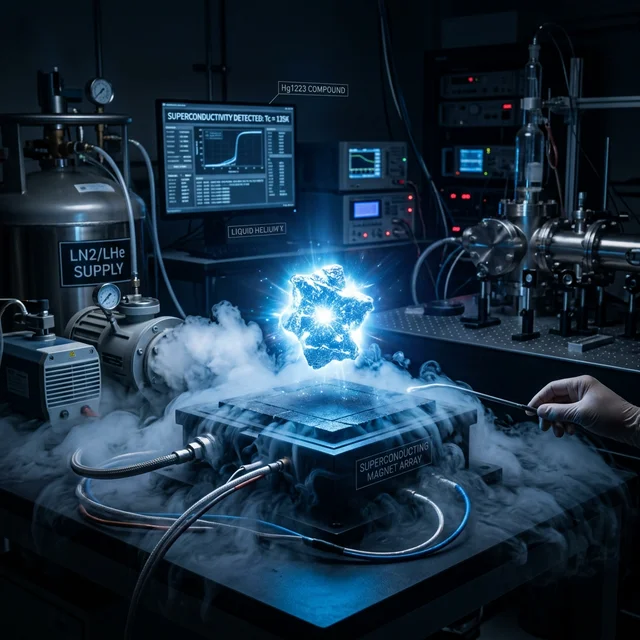
Superconductivity is a quantum phenomenon in which certain materials lose all electrical resistance when cooled below a critical temperature. In practical terms, this means that electrical current can flow through these materials indefinitely, without losing energy as heat. It's as if water could flow through a pipe with zero friction — forever.
The phenomenon was discovered in 1911 by Dutch physicist Heike Kamerlingh Onnes, who observed that pure mercury lost all its electrical resistance when cooled to 4.2 Kelvin (−268.95 °C). Since then, scientists worldwide have been searching for materials that achieve this state at increasingly higher temperatures. The ultimate goal is a superconductor that works at room temperature (about 293 K or 20 °C), which would eliminate the need for expensive and complex cooling systems.
Why Temperature Matters So Much
The most commonly used superconductors today — such as niobium-titanium (NbTi) and niobium-tin (Nb₃Sn) — only work at extremely low temperatures, near absolute zero. Maintaining these temperatures requires liquid helium, an expensive and finite resource. Each additional Kelvin in a superconductor's critical temperature represents a dramatic reduction in cooling costs and a step closer to large-scale practical applications.
| Superconductor Type | Critical Temperature | Cooling Required | Relative Cost |
|---|---|---|---|
| NbTi (conventional) | 9.3 K (−263.9 °C) | Liquid helium | ★★★★★ (very high) |
| Nb₃Sn (conventional) | 18.3 K (−254.9 °C) | Liquid helium | ★★★★★ |
| YBCO (ceramic) | 93 K (−180 °C) | Liquid nitrogen | ★★★ (moderate) |
| Hg-1223 (1993) | 133 K (−140 °C) | Liquid nitrogen | ★★★ |
| Hg-1223 PQ (2026) | 151 K (−122 °C) | Liquid nitrogen | ★★ (lower) |
| LaH₁₀ (high pressure) | 260 K (−13 °C) | Extreme pressure + cold | ★★★★★ (impractical) |
How the 151 Kelvin Record Was Achieved
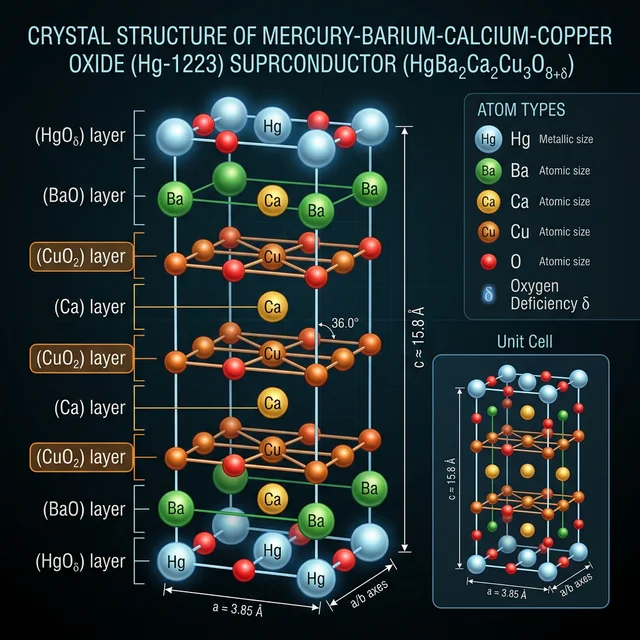
The star material of this discovery is Hg-1223, or HgBa₂Ca₂Cu₃O₈₊δ — a mercury-based cuprate that already held the previous record of 133 K since 1993. The team led by renowned physicist Paul Chu, from the University of Houston, used an ingenious technique called pressure quenching to raise the critical temperature by an impressive 18 degrees.
The Pressure Quenching Technique
The process works in three fundamental steps:
Extreme compression: Samples of Hg-1223 were subjected to colossal pressures of 10 to 30 gigapascals — equivalent to 100,000 to 300,000 times Earth's atmospheric pressure. For context, this pressure is comparable to what exists at the center of the Earth.
Structural reorganization: Under this tremendous pressure, the crystal structure of the material reorganizes in ways that wouldn't occur naturally. The copper, calcium, barium and mercury atoms are forced into more compact and efficient arrangements for conducting Cooper pairs — the electron pairs responsible for superconductivity.
Rapid decompression (quenching): The key to the discovery lies in rapid decompression. Instead of releasing the pressure gradually (which would allow the material to return to its original structure), the team performed an ultrafast decompression. This caused the material to retain its high-pressure structure even under ambient conditions.
The result? The pressure-quenched Hg-1223 maintained its enhanced superconducting properties at normal atmospheric pressure, achieving a critical temperature of 151 Kelvin (−122.15 °C). Even more impressive: the material maintained this superconductivity for at least three days when stored in liquid nitrogen.
Verification and Scientific Caution
Despite the excitement, the scientific community urges caution. For superconductivity to be fully confirmed, it must be demonstrated that electrical resistance drops completely to zero — not just approximately zero. Paul Chu's team observed a dramatic drop in resistivity, but additional verifications using techniques such as measuring the Meissner effect (complete expulsion of the magnetic field) are still underway.
This prudence is justified by the field's history: in 2020, an article in Nature announced superconductivity at 288 K in carbonaceous sulfur hydride, but was subsequently retracted due to data integrity issues. Healthy skepticism is essential in science.
What This Means for Future Technology

If the breakthrough is confirmed and can be replicated at industrial scale, the implications are vast and transformative. Here are the main areas that would be impacted:
More Accessible Quantum Computing
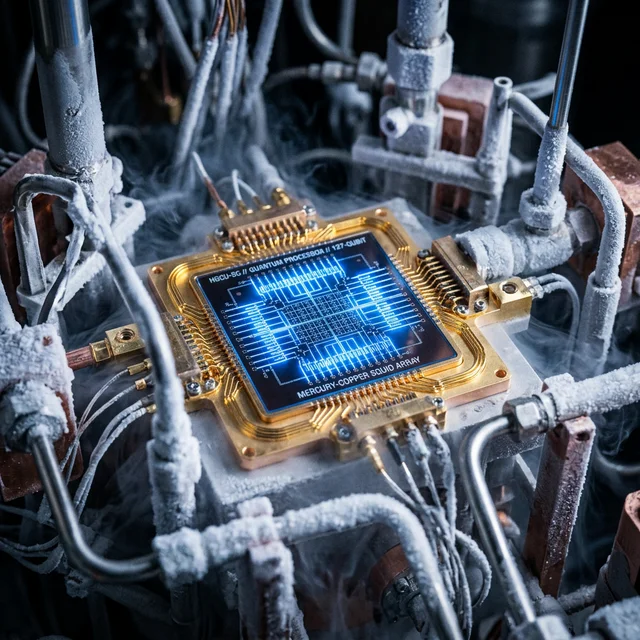
The world's most advanced quantum computers — like those from IBM, Google and Rigetti — rely on superconducting circuits cooled to millikelvins (thousandths of a degree above absolute zero). This extreme cold requirement is the main limiting factor for quantum system scalability.
A superconductor that works at 151 K is still far from room temperature, but −122 °C is significantly easier to achieve and maintain than −273 °C. Cooling with liquid nitrogen (boiling point: 77 K or −196 °C) is about 50 times cheaper than cooling with liquid helium. This could:
- Reduce quantum data center costs by 70% or more
- Make small, portable quantum computers a reality
- Accelerate research in pharmacology (molecular simulation), cryptography and artificial intelligence
Lossless Energy Transmission
Currently, about 8 to 15% of all electricity generated worldwide is lost during transmission through conventional cables. Superconductors eliminate these losses completely. With a superconductor operating at 151 K:
- Underground transmission cables in urban areas could use liquid nitrogen to maintain temperature
- Global power grid efficiency would increase dramatically
- Estimates indicate savings of $150 to $400 billion annually in wasted energy
Magnetic Levitation Transportation (Maglev)
The world's fastest maglev trains — like Japan's SCMaglev (603 km/h) and China's CRRC (600 km/h) — already use superconductors for magnetic levitation. With a material that superconducts at −122 °C instead of −269 °C, operating costs would drop dramatically, making maglev transport competitive with regional airlines.
Magnetic Resonance Imaging (MRI) Systems
The nuclear magnetic resonance machines found in every modern hospital rely on superconducting magnets cooled with liquid helium — a resource that is becoming increasingly scarce and expensive. High-temperature superconductors like the new Hg-1223 could:
- Reduce the cost of an MRI machine from $2 million to $500,000
- Eliminate dependence on liquid helium
- Make magnetic resonance imaging accessible in hospitals across developing countries
The Race for Room-Temperature Superconductors
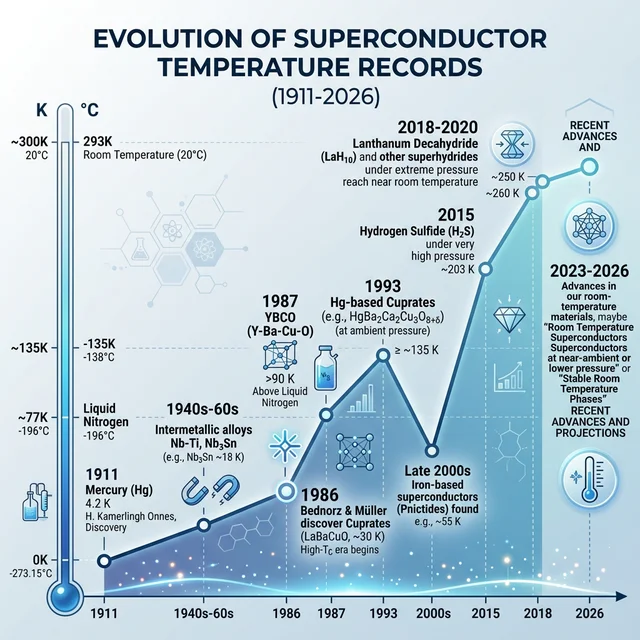
The history of superconductivity is a story of broken records — and each new record seemed impossible just a few years before. The 2026 discovery fits into a fascinating trajectory:
The Record Timeline
- 1911 (4.2 K): Heike Kamerlingh Onnes discovers superconductivity in mercury
- 1913 (7.2 K): Lead superconductor
- 1941 (16 K): Niobium-nitrogen alloy
- 1973 (23 K): Nb₃Ge — record that held for 13 years
- 1986 (35 K): Georg Bednorz and K. Alex Müller discover ceramic superconductors (Nobel Prize 1987)
- 1987 (93 K): YBCO — first superconductor above liquid nitrogen temperature
- 1993 (133 K): Hg-1223 — atmospheric pressure record for 33 years
- 2015 (203 K): H₂S under 150 GPa pressure
- 2018 (260 K): LaH₁₀ under 170 GPa (near room temperature, but under absurd pressure)
- 2026 (151 K): Hg-1223 with pressure quenching — new atmospheric pressure record
The "200 K Barrier"
The scientific community frequently debates the "200 Kelvin barrier" for ambient pressure superconductors. Surpassing this mark would mean operating above −73 °C — a temperature achievable with simple mechanical refrigeration (no cryogenic liquids). The new 151 K breakthrough reduces the distance to this barrier from 67 K to just 49 K — a 27% leap.
The Role of Artificial Intelligence
A growing trend in 2026 is the use of artificial intelligence to discover new superconducting materials. Tools like Google DeepMind GNoME and Microsoft MatterGen use neural networks to predict the stability and properties of millions of hypothetical compounds. In January 2026, a team from MIT used AI to identify 18 new high-temperature superconductor candidates — three of which already showed promising laboratory results.
Economic Impact: Numbers That Impress
The global superconductor market was valued at $9.8 billion in 2025 and is expected to reach $28.3 billion by 2032, according to a Fortune Business Insights report. The 151 K breakthrough could significantly accelerate this growth:
| Sector | Current Market | Projection with HTS | Annual Savings |
|---|---|---|---|
| Energy transmission | $2.3B | $12B by 2032 | $150-400B |
| MRI & medical equipment | $3.1B | $8B by 2032 | $2B |
| Maglev transport | $1.2B | $5B by 2032 | $10B |
| Quantum computing | $1.8B | $15B by 2032 | Incalculable |
| Particle accelerators | $0.9B | $2B by 2032 | $500M |
| Total | $9.8B | $42B+ | $162B+/year |
What This Means For You
Although a superconductor at −122 °C won't show up in your smartphone tomorrow, the cascading effects of this discovery will reach everyday life faster than you might imagine:
Short term (2026-2028)
- Energy: Pilot superconducting cable projects in urban centers could begin using the new material
- Healthcare: Hospitals with access to cheaper MRI without helium dependence
- Research: Quantum laboratories with drastically reduced operating costs
Medium term (2028-2032)
- Transport: Regional maglev routes become economically viable
- Internet: Superconducting fiber cables for data centers with near-zero latency
- Renewable energy: Energy storage in superconducting rings (SMES) for solar/wind intermittency
Long term (2032-2040)
- Nuclear fusion: Tokamak reactors with more efficient superconducting magnets (like ITER and SPARC)
- Space exploration: Plasma engines with lightweight, efficient superconducting coils
- Computing: Quantum processors as common as GPUs, personal quantum desktops
Debates and Controversies
The discovery is not free from controversy. Some important points are being debated in the scientific community:
The Reproducibility Question
Pressure quenching is a delicate process that is difficult to control precisely. Independent groups in Tokyo, Beijing and Zurich are already trying to reproduce the results, but initial reports indicate that the technique is "highly sensitive" to decompression conditions. If other laboratories cannot replicate the achievement, skepticism will increase rapidly.
Durability of the Superconducting State
The material maintained its properties for three days in liquid nitrogen — but does it work for weeks, months or years? Long-term stability is crucial for any commercial application. Transmission cables need to function for decades, not days.
The Shadow of LK-99
In 2023, South Korean researchers announced LK-99, an alleged room-temperature superconductor. The scientific community refuted the claims within weeks, and the episode left scars. Any subsequent announcement of superconductivity is treated with redoubled skepticism — and rightly so.
Why This Discovery Is Different
Despite the controversies, there are concrete reasons to believe that the 2026 breakthrough is legitimate:
Paul Chu has credibility: The Chinese-American physicist was co-discoverer of YBCO in 1987 and is one of the most respected names in the field. His reputation is at stake.
The paper was published in a very high-impact journal: PNAS (Proceedings of the National Academy of Sciences) has rigorous peer review.
The base material is well-known: Hg-1223 is not a new material — it's a cuprate well-studied since 1993. The innovation is in the preparation technique, not the composition.
The technique is physically and theoretically plausible: Pressure quenching was already used in metallurgy and materials science. Applying it to superconductors is a logical extension.
Partial data has been made available: The team published magnetization and resistivity data, although full confirmation depends on additional measurements.
Global Impact and Developing Countries
This breakthrough holds special significance for developing nations. The transition from helium-based cooling to liquid nitrogen could drastically reduce research and medical equipment costs. Countries across Latin America, Africa and Southeast Asia could benefit from more affordable MRI machines, more efficient power grids, and access to quantum computing resources.
Universities and research centers in emerging economies are already positioning themselves to capitalize on this advance. Programs in condensed matter physics across Brazil, India, and South Africa may see increased funding as governments recognize the strategic importance of superconductor research.
Frequently Asked Questions About Superconductors
What happens if I touch a superconductor? Nothing special — it's just a ceramic material. The danger is in the temperature: at −122 °C, direct contact would cause instant cold burns.
Can a superconductor replace all batteries? Not directly, but SMES (Superconducting Magnetic Energy Storage) systems can store energy in magnetic fields without losses, complementing lithium batteries in smart power grids.
When will we have room-temperature superconductors? Conservative estimates point to 2035-2045. Optimistic estimates suggest that pressure quenching and AI-driven material discovery could accelerate this to 2030-2035.
Hg-1223 uses mercury — isn't that toxic? Yes, mercury is toxic, but in cuprate ceramic form it is stable and doesn't release vapors. However, industrial processes would need rigorous handling and disposal protocols.
What's the difference between a superconductor and a semiconductor? Semiconductors (like silicon) have variable electrical resistance — they're the basis for chips and transistors. Superconductors have zero resistance below the critical temperature — they're used in magnets, sensors and quantum computing.
The Education Revolution
The 151 K breakthrough is already inspiring a new generation of physicists and engineers. Universities worldwide have reported a surge in applications for condensed matter physics programs since the announcement. MIT, Caltech, and the University of Houston have opened special seminars and webinars focusing on pressure quenching techniques and cuprate superconductors.
For students, this discovery represents something rare: a clear, dramatic milestone that demonstrates how fundamental physics research can transform technology. The story of Paul Chu — from his co-discovery of YBCO in 1987 to this new record 39 years later — exemplifies the long-term nature of scientific breakthroughs and the importance of persistent, patient research.
Online educational platforms like Coursera, edX, and Khan Academy are already developing courses on superconductivity fundamentals, expected to launch in the second half of 2026. Open-access publications of the research data will enable university students around the globe to study and potentially build on these results.
Environmental Implications
Beyond its technological applications, the 151 K superconductor has significant environmental implications. Lossless electrical transmission would eliminate millions of tons of CO₂ emissions annually by reducing the need for excess power generation to compensate for transmission losses. If superconducting cables replaced just 20% of high-voltage transmission lines globally, the carbon savings would exceed 500 million metric tons per year — equivalent to taking 100 million cars off the road.
Additionally, more efficient SMES systems could transform renewable energy storage, solving the intermittency problem that currently limits solar and wind adoption. Combined with superconductor-enhanced fusion reactors, this technology could be a cornerstone of the clean energy transition.
Conclusion: The End of the Beginning
The record of 151 Kelvin may not seem revolutionary at first glance — after all, −122 °C is still extremely cold by human standards. But in the context of condensed matter physics, every degree counts. This breakthrough represents a 13.5% leap in maximum critical temperature at ambient pressure, achieved with a technique that can be optimized and applied to other materials.
If pressure quenching works with other cuprates and compounds, the 200 K barrier could fall within the next 5 to 10 years. And when that happens, the world will change in ways we can't yet fully imagine.
We are at the end of the beginning of the superconductor revolution. And 2026 will be remembered as the year the pace accelerated. The implications for energy, computing, transportation and healthcare will reverberate for decades to come, shaping a future that once existed only in the realm of science fiction.
Sources and References
- Science News. "New high-temperature superconductor hits 151 kelvins at atmospheric pressure." March 9, 2026. sciencenews.org
- Proceedings of the National Academy of Sciences (PNAS). Original publication, March 2026.
- Brookhaven National Laboratory. "Record superconductor via pressure quenching." bnl.gov
- Fortune Business Insights. "Superconductors Market Report 2025-2032."
- Bioengineer.org. "Breakthrough: Hg-1223 superconductivity at 151K." bioengineer.org


