
Gasoline Without Oil Already Exists: How Plastic, Plants, and Waste Are Becoming High-Performance Fuel in 2026
Imagine filling your car with plastic bottles destined for a landfill. Picture a refinery that extracts nothing from underground but transforms soybean oil into gasoline identical to what you put in your tank today. Envision a world where "petroleum" is grown on farms or recycled from waste.
This is not science fiction. In March 2026, this is happening in garages in Alabama, on beaches in Mexico, in laboratories in Denmark, and in refineries in southern Brazil. The silent fuel revolution has begun — and it may change everything you know about energy.
The Viral Video That Opened the World's Eyes
On March 21, 2026, a video went viral on social media showing something that seemed impossible: a 2016 Rolls-Royce Dawn — a car worth over $300,000 — running exclusively on fuel produced from discarded plastic bottles.
The man responsible? Julian Brown, a self-taught inventor from Harvest, Alabama (USA), founder of the startup NatureJab. Brown started building pyrolysis reactors at age 17, and nearly a decade later, publicly demonstrated that his fuel — called "Plastoline" — can run high-performance engines without any modifications.
Plastoline has a 110-octane rating, surpassing conventional premium gasoline (which operates between 91 and 93 octane). The video accumulated millions of views within days, reigniting a global debate: do we really need to keep drilling into the ground for petroleum?
Who Is Julian Brown?
Julian Brown is not a Harvard lab scientist. He is a young Black inventor, a garage tinkerer, who decided to solve two problems at once: plastic pollution and fossil fuel dependency. His reactor, currently in the Mark 4.5 version, uses a process called microwave pyrolysis — different from conventional thermal pyrolysis, which requires enormous furnaces.
Brown's vision extends further: he plans to develop the Mark 5, a mobile, solar-powered unit that could be transported to rural communities or disaster areas, transforming local plastic waste into immediately usable fuel.
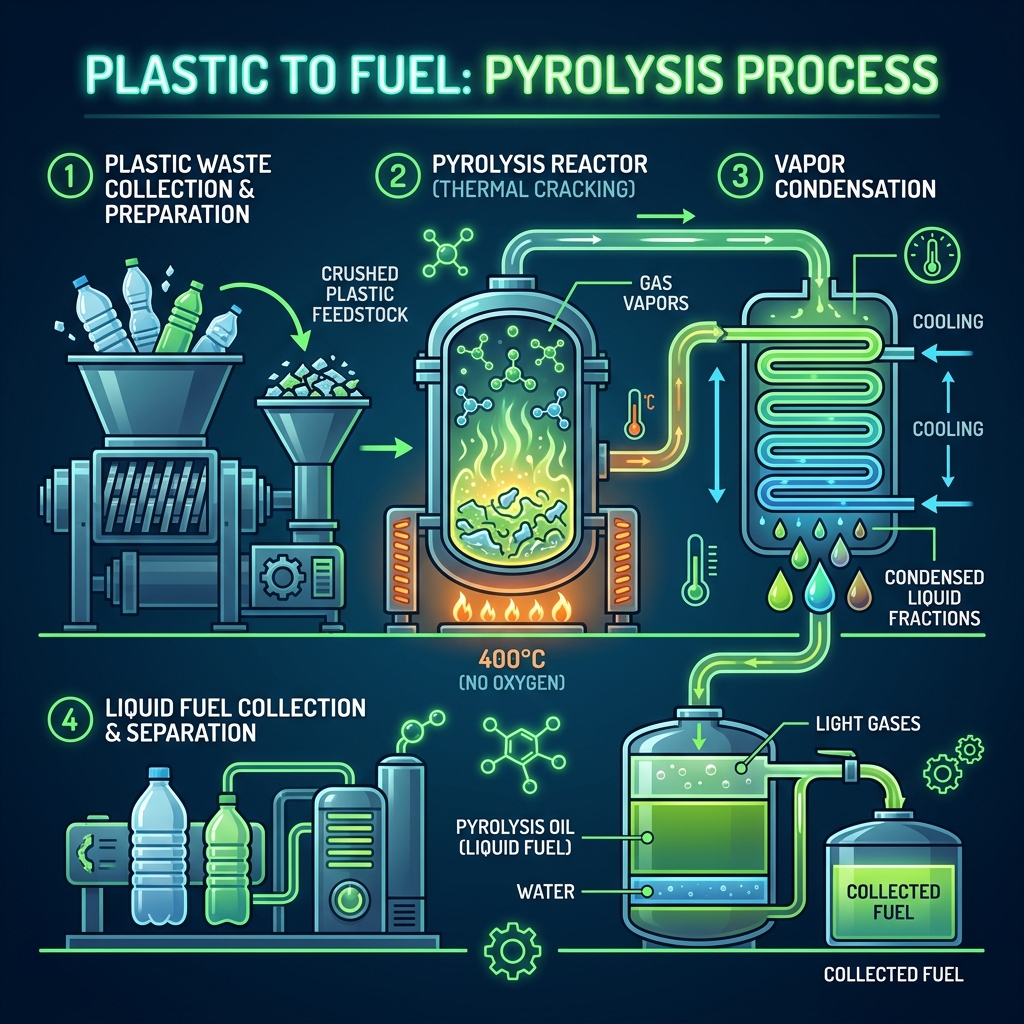
How It Works: The Science Behind Pyrolysis
Pyrolysis is not new technology. The concept has existed since the 19th century. But in recent decades, advances in catalysts, temperature control, and materials engineering have made the process economically viable at small scale for the first time.
The Step-by-Step Process
1. Plastic Collection and Shredding
PET bottles, packaging, bags, and other plastic waste are collected and shredded into small pieces. No thorough washing or sorting is required — most modern reactors accept mixed plastics.
2. Heating in an Oxygen-Free Environment (370°C to 420°C)
The shredded plastic enters a sealed reactor. Here's the key: heating occurs without oxygen. Without oxygen, the plastic doesn't burn — it thermally decomposes, breaking long polymer chains into smaller hydrocarbon molecules.
3. Vaporization and Condensation
The resulting vapors are directed to a condensation system (similar to a beverage distiller). The vapor cools and transforms into a synthetic crude oil — a golden liquid containing hydrocarbons of different molecular sizes.
4. Distillation and Separation
The crude oil is then distilled to separate fractions:
- Gasoline (short chains, C5-C12)
- Diesel (medium chains, C12-C20)
- Aviation kerosene (similar to diesel, optimized for jets)
- Light gases (butane, propane — can power the reactor itself)
Julian Brown's Innovation: Microwave Pyrolysis
While conventional pyrolysis uses external furnaces to heat the reactor (which consumes lots of energy and is slow), Brown's system uses microwaves to heat the plastic from the inside out — exactly how a household microwave heats food. This speeds up the process, reduces energy consumption, and enables much smaller reactors.
Mexico: Cleaning Beaches and Producing Fuel
Julian Brown isn't alone. In Mexico, the startup PETGAS went beyond the garage and set up an operation that transforms plastic pulled from the ocean and beaches into high-quality fuel.
Operating in Boca del Río, Veracruz, PETGAS collects plastics from Mexican beaches and processes them using conventional thermal pyrolysis. The result is gasoline with an octane rating between 90 and 93 — equivalent to premium gasoline sold at gas stations.
The fuel produced is donated to public services: firefighters, ambulances, and food delivery services. The company processes tons of marine plastic monthly, proving that the circular economy is not just a nice concept — it's an operational reality.
Organic Gasoline: Fuel Born from Plants
But the story doesn't stop at plastic. A second revolution is happening in parallel: the production of gasoline chemically identical to petroleum-based fuel, but made from plants, vegetable oils, and biogas.
Vertimass: Turning Ethanol into Gasoline
The American company Vertimass, based on technology developed at the Oak Ridge National Laboratory (ORNL) for the U.S. Department of Energy, created a process called CADO (Consolidated Alcohol Deoxygenation and Oligomerization) that converts ethanol into renewable gasoline in a single step.
The system's brilliance:
- No external hydrogen required (dramatically reduces costs)
- Works with any ethanol concentration (from 5% to 100%)
- Can be "bolted on" to existing ethanol plants (bolt-on model)
- Product approved by the EPA in 2024 as VertiGas20 — renewable fuel that can be blended up to 20% with conventional gasoline
Petrobras: $1.2 Billion for Brazil's First Biorefinery
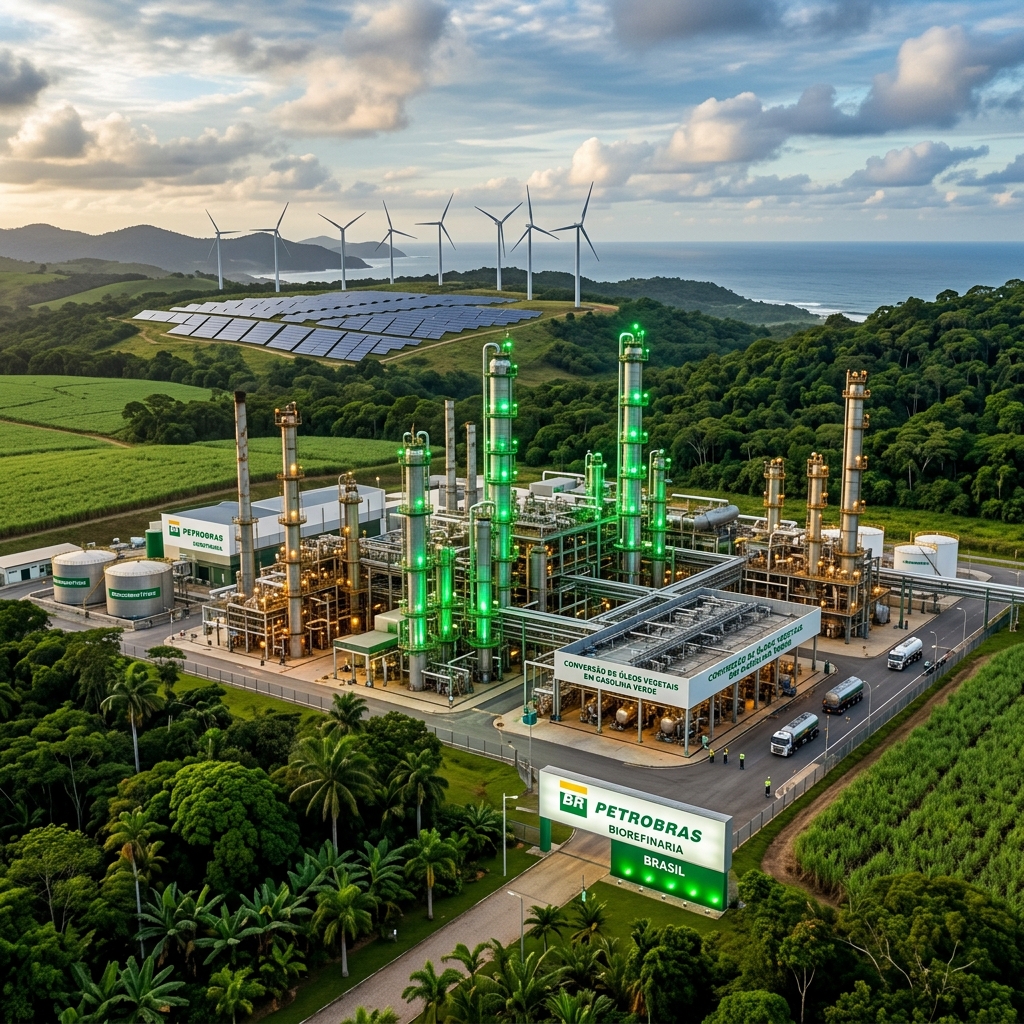
Brazil, already the world leader in ethanol, is taking the next step. In January 2026, Petrobras announced a $1.2 billion (R$6 billion) investment to convert the Riograndense Petroleum Refinery (RPR) in Rio Grande do Sul into Brazil's first biorefinery.
The concept: instead of refining crude oil, the plant will process vegetable oils (soybean, palm, animal fats) using co-processing — blending renewable raw materials with petroleum feedstock during refining to produce fuels with renewable content.
E-Fuels: Gasoline Made from CO₂ and Water
The third frontier is even more futuristic: e-fuels — synthetic fuels produced from atmospheric CO₂ capture, water, and renewable electricity.
- Water electrolysis: Using solar or wind energy, water is split into hydrogen and oxygen
- CO₂ capture: CO₂ is captured directly from the atmosphere
- Fischer-Tropsch synthesis: Hydrogen and CO₂ are catalytically combined to form liquid hydrocarbons
- Result: A "carbon-neutral" fuel that works in any existing engine
The HIF (Haru Oni) plant in Chile and Infinium in Corpus Christi, Texas, are already producing e-fuels commercially.
LanzaJet: The World's First Commercial Ethanol-to-Jet Plant
In November 2025, LanzaJet inaugurated Freedom Pines Fuels in Soperton, Georgia (USA) — the world's first integrated commercial-scale plant converting ethanol into ASTM-certified sustainable aviation fuel (SAF).
Meanwhile, Gevo in North Dakota is pursuing its ATJ-30 project, which will produce 30 million gallons of SAF per year.
The Challenges No One Talks About
1. The Scale Problem
The world consumes 100 million barrels of oil per day. Replacing that requires an industrial transformation that doesn't happen overnight.
2. The Emissions Question
Pyrolysis of plastic produces fuel that, when burned, still releases CO₂. The advantage is that the carbon was already in the cycle (from plastic, not from underground) — but it's not "zero carbon." It's "recycled carbon."
3. Competition with Electrification
Electric vehicles are advancing rapidly. Many argue that investing in liquid fuels is "looking backward." Counter-argument: aviation, maritime shipping, agricultural machinery, and heavy transport cannot easily be electrified — and will need liquid fuels for decades.
Conclusion: The "Petroleum" of the Future Doesn't Come from Underground
Julian Brown, in his Alabama garage, proved something skeptics said was impossible: that plastic bottles can become 110-octane premium fuel. PETGAS in Mexico showed that clean beaches and full tanks are not mutually exclusive. Petrobras is betting $1.2 billion that the future is not to abandon refineries — but to make them process what nature produces, not what has been buried for millions of years.
The question is no longer "If" — it's "When." And in 2026, the answer is becoming increasingly clear: now.
Sources: U.S. Department of Energy (DOE), Oak Ridge National Laboratory (ORNL), EPA, Petrobras, LanzaJet, Vertimass, World Economic Forum, IEA Bioenergy, Infinium.


