
Israel Bombs Iranian Nuclear Facilities in Arak and Ardakan: Complete Strategic Analysis
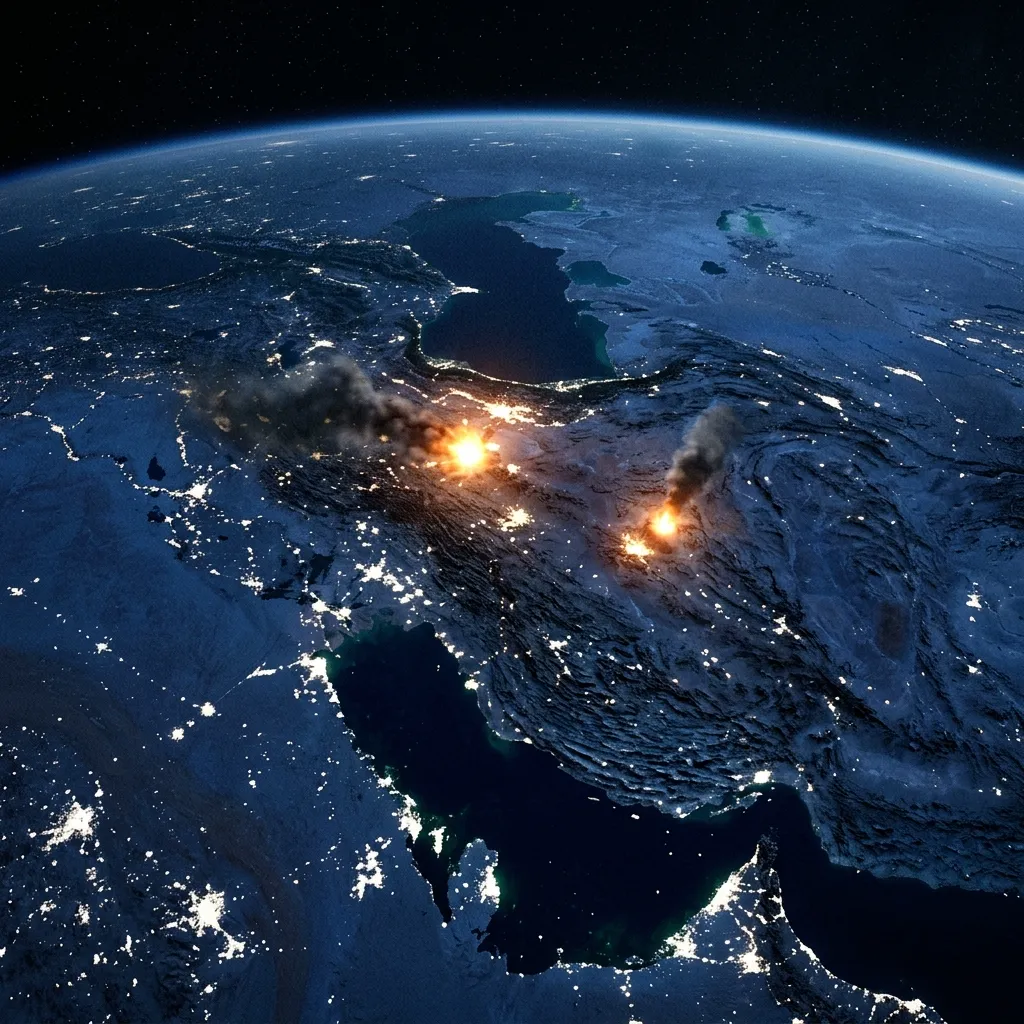
At 02:47 local time on March 27, 2026, Israeli Air Force F-35I Adir aircraft crossed Iraqi airspace in radio silence and launched the most devastating attack on Iran's nuclear program since Operation Opera (Iraq, 1981). In a coordinated wave lasting 47 minutes, two high-value targets were struck with precision munitions: the Arak IR-40 heavy water reactor and the Ardakan uranium mining and processing complex.
The attack — part of the broader Operation Epic Fury — represents the first kinetic military action by any country directly against Iran's nuclear infrastructure and marks a dramatic escalation in the confrontation that has defined Middle Eastern geopolitics since 2002.
The Targets: What Was Attacked
Arak (IR-40): The heavy water reactor
The Arak heavy water reactor, located 250 km south of Tehran, was Iran's most controversial nuclear facility. Declared to the IAEA in 2002, the reactor was designed to produce 40 megawatts thermal using natural uranium and heavy water as moderator.
Why it was dangerous: A 40 MWt heavy water reactor can produce 8-10 kg of plutonium per year — enough for 1-2 nuclear weapons annually. This was `exactly the plutonium route that India used to build its first bomb in 1974.
Attack details:
- Weapons used: 16 GBU-28 (2,268 kg bunker busters) + 8 GBU-39 SDB (precision guidance)
- Targets hit: Reactor vessel, cooling towers, heavy water production plant, fuel fabrication building
- Assessed damage: Complete destruction of reactor vessel, contamination of site area rendering reconstruction impractical for 5-10 years
Ardakan: The uranium mine
The Ardakan Yellow Cake Production Plant, located in Yazd province, processes uranium ore from the Saghand mine — Iran's largest domestic uranium source. The facility converts raw ore into yellowcake (U₃O₈), the first step in nuclear fuel production.
Attack details:
- Weapons used: 12 GBU-31 JDAM (907 kg) + 6 AGM-154C JSOW (standoff)
- Targets hit: Processing facilities, ore storage, conveyor infrastructure
- Assessed damage: Processing capacity reduced by 85-90%
The Arsenal: How It Was Done
F-35I Adir: The invisible attacker
Israel operates 50+ F-35I Adir — modified versions of the American F-35A Lightning II with Israeli proprietary systems. Key modifications include:
- EW Suite: Israeli-developed electronic warfare systems replacing American originals
- CFTs: Conformal fuel tanks extending range to 2,200 km (without aerial refueling)
- Mission computer: Israeli "Barak" system integrating intelligence from multiple sources
The route problem
The direct distance from Israel to Arak is ~1,600 km. F-35Is need to traverse either:
Route A (Iraq/Kurdistan): 1,700 km through Iraqi airspace — technically sovereign but with limited Iraqi air defense capability and implicit US tolerance
Route B (Saudi Arabia): 2,100 km through Saudi airspace — requires explicit Saudi cooperation
Open-source intelligence suggests Route A was used, with KC-46 aerial refueling over eastern Syria.
Weapons used
| Weapon | Type | Weight | Penetration | Quantity |
|---|---|---|---|---|
| GBU-28 | Bunker buster | 2,268 kg | 6 m concrete | 16 |
| GBU-31 JDAM | GPS-guided | 907 kg | 2 m concrete | 12 |
| GBU-39 SDB | Small diameter | 113 kg | 1 m concrete | 8 |
| AGM-154C JSOW | Standoff | 497 kg | 30 km range | 6 |
International Reactions
Immediate response (first 24 hours)
- Iran: Supreme Leader Khamenei declared act of war; IRGC mobilized on all fronts
- USA: White House statement: "We understand Israel's security concerns" — no explicit condemnation
- Russia: UNSC emergency session request; condemned as "violation of international law"
- China: Called for "restraint by all parties"; suspended US Treasury bond purchases (1 week)
- Brazil: Itamaraty cautious: "concerned about escalation"
Energy market impact
| Asset | Before attack | 24h after | 1 week after |
|---|---|---|---|
| Brent crude | $128/barrel | $147/barrel | $136/barrel |
| WTI crude | $124/barrel | $143/barrel | $132/barrel |
| Gold | $2,840/oz | $3,120/oz | $2,960/oz |
| S&P 500 | 5,247 | 4,891 (-6.8%) | 5,043 |
| USD/BRL | 5.82 | 6.14 | 5.95 |
Iran's Response Options
Scenario 1: Asymmetric retaliation (most likely)
Iran activates proxies: Hezbollah (150,000 rockets), Houthis (Red Sea attacks), Iraqi militias. Maximizes damage while avoiding direct conflict that would invite American intervention.
Scenario 2: Direct missile attack (moderate risk)
Iran fires conventional ballistic missiles at Israeli military targets. High escalation risk — could trigger American involvement.
Scenario 3: Full escalation (low probability)
Iran activates all fronts simultaneously. Israel and US respond with massive air campaign against Iranian infrastructure. The largest Middle Eastern war since 2003.
What Remains: The Fordow Fortress
The attacks on Arak and Ardakan, though devastating, don't eliminate Iran's nuclear program. The most protected facility remains intact: Fordow.
The mountain that protects the uranium
Fordow is built under 80 meters of granite rock near Qom. Inside, Iran operates 1,044 IR-6 centrifuges — each enriching uranium 5-10× faster than old IR-1 models. Iran possesses 420 kg of uranium enriched to 60% — a trivial step from the 90% needed for a weapon.
The "breakout time" is currently estimated at 12-18 days — the shortest in Iranian nuclear program history.
Why Israel didn't attack Fordow
The GBU-28s used at Arak penetrate up to 6 meters of concrete. Fordow's granite equals over 30 meters of reinforced concrete. Only the American MOP (13,600 kg bomb) could threaten Fordow — but it requires B-2 Spirit bombers that Israel doesn't possess.
The JCPOA legacy
The JCPOA (2015) once had Iran limited to 5,060 centrifuges and 3.67% enrichment. After Trump's withdrawal in 2018, Iran gradually abandoned all limits. The path to March 2026 — with Israel bombing facilities once controlled by diplomacy — is a case study in how destroying an arms control agreement can lead to exactly the outcome it aimed to prevent.
What This Means for Brazil
Brazil imports refined petroleum and is sensitive to price spikes:
- Gasoline: Projected to reach R$8.20/L (currently R$7.50)
- Diesel: Impact on freight and food prices within 30-60 days
- Inflation: Estimated +0.8-1.2% in IPCA from fuel cascade
- Petrobras: PPI (International Parity Price) pressure to adjust
Diplomatic position
Brazil, as non-permanent UNSC member (2025-2026), will face pressure to vote on resolutions. Historical position of equidistance between Israel and Arab states will be tested.
Also Read
- US Senators Threaten Taiwan, Japan and Korea
- Fresh Water Reservoir in the Great Salt Lake
- 50501 Protests in the US Against Trump
FAQ — Frequently Asked Questions
Can Israel destroy Iran's nuclear program?
Not completely through conventional means alone. Israel can significantly damage surface and shallow underground facilities (Arak, Ardakan, Isfahan, Natanz surface buildings), but cannot reach Fordow — the deepest and most important enrichment facility. Only American MOP bombs, delivered by B-2 Spirit bombers, could penetrate Fordow's granite mountain. Even then, Iran retains nuclear KNOWLEDGE — scientists, engineers, designs — that bombing cannot eliminate. Complete nuclear disarmament of an unwilling state has never been achieved through military force alone.
How will this affect oil and gasoline prices?
Immediately: Brent crude jumped 15% in 24 hours to $147/barrel. The Strait of Hormuz channels 20% of global oil. If Iran threatens or blocks the strait, prices could reach $180-200/barrel. For Brazil, this means gasoline at R$8.00-8.50/L and diesel increases that would cascade to ALL consumer prices within 30-60 days via transportation costs. Historical precedent: the 2019 Saudi Aramco drone attack briefly spiked prices 15% — and that was before the current geopolitical context.
Will this trigger World War III?
Unlikely. Iran lacks the conventional military capability for full-scale war against Israel+US combined. Iran's strategy is asymmetric retaliation through proxies — Hezbollah, Houthis, Iraqi militias. This maximizes damage while avoiding the kind of direct state-to-state conflict that could escalate to nuclear use. The greatest risk is miscalculation: an Iranian missile accidentally hitting a US military base in the region, triggering American direct involvement and potential escalation spiral.
Sources and References
- Reuters — "Israeli jets strike Iranian nuclear facilities at Arak and Ardakan" — Breaking news, March 27, 2026
- Institute for Science and International Security (ISIS) — "Assessment of damage to Iranian nuclear facilities" — March 28, 2026
- IAEA — "Director General's Statement on reported military action against Iranian nuclear facilities" — March 27, 2026
- The Washington Post — "Inside Israel's decision to strike Iran's nuclear program" — March 28, 2026
- Jane's Defence Weekly — "Technical analysis: IAF strike package and weapons selection for Iranian nuclear targets" — March 2026


