🌍 Your knowledge portal
Technology

Zero Income Tax Up to R$5,000: Brazil 2026

📅 2026-02-15⏱️ 11 min read📝

Quick Summary

Complete guide to Brazil's income tax exemption for earners up to R$5,000. Understand who benefits, how it works, economic impacts and what changes in practice.

The Promise Fulfilled: Zero Income Tax for Earners Up to R$5,000 #

For the first time in Brazil's recent history, millions of workers woke up to news that seemed too good to be true: anyone earning up to R$5,000 per month no longer pays Income Tax. Zero. Nothing. Not a single cent.

The measure, which took effect in January 2026, represents the largest reform to the Income Tax table in decades. But how does it work in practice? Who really benefits? And perhaps the most important question: where does the money come from to offset this revenue loss?

In this article, we'll break down every detail of this historic change — from the real numbers to the impacts you'll feel (or are already feeling) in your wallet.


What Exactly Changed? #

The New 2026 Income Tax Table #

The federal government submitted and approved through the National Congress a bill that changes the Personal Income Tax (IRPF) exemption bracket. The change is significant:

Monthly Income Bracket Previous Rate 2026 Rate
Up to R$2,259.20 Exempt Exempt
R$2,259.21 to R$2,826.65 7.5% Exempt
R$2,826.66 to R$3,751.05 15% Exempt
R$3,751.06 to R$4,664.68 22.5% Exempt
R$4,664.69 to R$5,000.00 27.5% Exempt
R$5,000.01 to R$7,000.00 27.5% 15% (reduced)
Above R$7,000.00 27.5% 27.5%

The most impactful change: the exemption bracket jumped from R$2,259.20 to R$5,000.00 — an increase of over 121%.
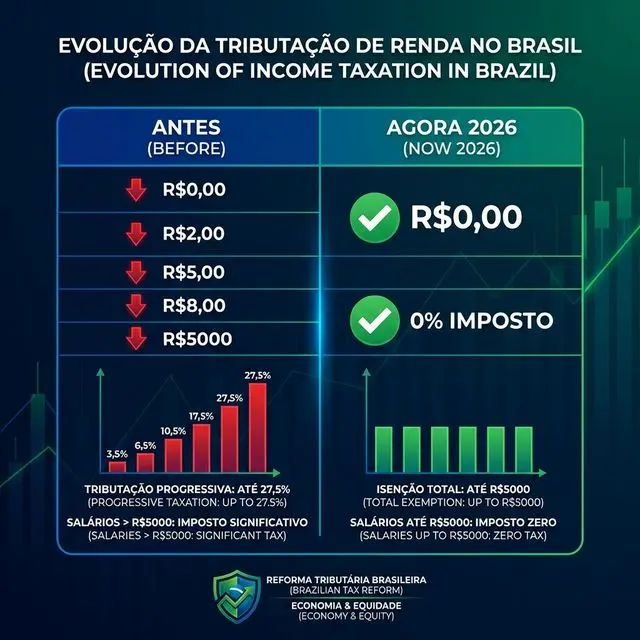
Infographic comparing Income Tax rates before and after the 2026 reform, showing the evolution from progressive taxation to total exemption up to R$5,000

Who Benefits? #

The numbers are impressive. According to data from the Federal Revenue Service and IBGE:

  • 36 million Brazilians stop paying income tax with the new bracket
  • This represents 73% of all Income Tax filers
  • Average savings per person range from R$150 to R$600 per month, depending on the previous salary bracket
  • In annual terms, that's up to R$7,200 more in the worker's pocket

For a family with two adults earning R$4,000 each, the combined savings can reach R$9,600 per year — enough money to pay off debts, invest, or improve quality of life.


How the Law Was Approved #

The Path Through Congress #

The proposal didn't come out of nowhere. It was a campaign promise and went through a lengthy legislative process:

  1. March 2025: Bill submitted by the Executive to Congress
  2. June 2025: Approved in the Chamber of Deputies with 367 votes in favor and 102 against
  3. October 2025: Senate approves with amendments, altering the intermediate exemption bracket
  4. November 2025: Chamber approves final version
  5. December 2025: Presidential signature
  6. January 2026: Takes effect

The National Congress in Brasília at sunset, symbol of the historic tax reform that exempted millions of Brazilians from Income Tax

Opposition and Debates #

Not everyone applauded. The opposition raised valid points:

  • Estimated revenue loss: R$35 billion per year
  • Fiscal risk: Possible increase in public deficit
  • Compensation: Taxation of income above R$50,000/month (minimum effective rate of 10%)
  • Criticism: Some economists argue the measure is populist and unsustainable long-term

The government responded with data: compensation through taxation of the ultra-wealthy and adjustments to tax subsidies would be sufficient to cover the loss.


Real Economic Impacts #

For Workers #

The most immediate impact is felt in the wallet:

  • Public school teachers (average salary R$4,200): savings of ~R$280/month
  • Nurses (average salary R$3,800): savings of ~R$195/month
  • Ride-share drivers (average income R$3,500): savings of ~R$150/month
  • IT technicians (average salary R$4,800): savings of ~R$520/month

Brazilian workers from various professions celebrating the Income Tax exemption, representing the millions of families benefited by the new rule

For the National Economy #

Economists project chain effects:

  • Increased consumption: More money circulating in the economy stimulates commerce
  • Reduced defaults: With more available income, workers can pay off debts
  • Housing market stimulus: Families with more purchasing power consider financing
  • Work formalization: The exemption makes formal employment more attractive

According to projections from the Ministry of Finance, the increase in consumption could generate up to R$52 billion in additional economic activity, partially offsetting the revenue loss.


What Changes in Practice? Step-by-Step Guide #

If You Earn Up to R$5,000 #

  1. Your paycheck already changed: Withholding at source was zeroed since January 2026
  2. Annual declaration: You may still need to file (if you have assets above R$800,000, received exempt income above R$200,000, etc.)
  3. Refund: If you paid income tax in 2025, you may be entitled to a larger refund
  4. MEIs: Micro-entrepreneurs with revenue resulting in income up to R$5,000 also benefit

If You Earn Between R$5,001 and R$7,000 #

The change also brings relief, but partial:

  • The rate was reduced from 27.5% to 15% in this bracket
  • Savings vary from R$300 to R$800 per month
  • The progressive discount ensures no one pays more than they should

If You Earn Above R$7,000 #

Rates remain the same. However, there's a change for income above R$50,000/month:

  • Minimum effective rate of 10%: Total income (including dividends and investments) above R$600,000/year will have a minimum rate
  • Impact on dividend recipients: Business owners who pay themselves via dividends to pay less tax will be affected
  • This affects 141,000 taxpayers (the wealthiest in the country)

International Comparison #

Brazil is not alone in this trend of expanding the exemption bracket:

Country Exemption Bracket (R$ equivalent) Average Income
🇧🇷 Brazil (2026) R$5,000/month R$3,200
🇺🇸 USA ~R$6,500/month ~R$22,000
🇬🇧 United Kingdom ~R$7,800/month ~R$18,000
🇩🇪 Germany ~R$6,200/month ~R$15,000
🇦🇷 Argentina ~R$2,800/month ~R$2,000
🇲🇽 Mexico ~R$1,500/month ~R$3,500

Brazil positions itself competitively in Latin America, although it still falls behind developed countries when considering the exemption bracket / average income ratio.


Criticisms and Controversies #

"Is It Sustainable?" #

The biggest criticism from liberal economists is about fiscal sustainability. The R$35 billion loss is significant in a country already facing fiscal deficit. The government argues that:

  1. Taxation of the ultra-wealthy will compensate R$25 billion
  2. Increased consumption will generate more revenue via indirect taxes (ICMS, PIS/COFINS)
  3. Adjustments to tax subsidies will close the remaining R$10 billion

"Who Really Pays the Bill?" #

Compensation through taxation of the ultra-wealthy is controversial. Some debate points:

  • Capital flight: The wealthy may transfer assets abroad
  • Tax planning: Tax lawyers are already looking for loopholes in the law
  • Tax evasion: Brazil loses ~R$600 billion/year to evasion — improving enforcement could compensate without new rates

"Is It Just Political Marketing?" #

Critics accuse the measure of being electorally motivated. Defenders argue that correcting the income tax table is a longstanding demand from society — the last significant correction was in 2015, and since then inflation eroded workers' purchasing power, pushing people into higher tax brackets.


The Psychological Effect of "Zero Income Tax" #

Beyond the direct financial impact, there's a powerful psychological effect. Datafolha surveys show that:

  • 78% of Brazilians approve the measure
  • 62% say they plan to use the extra money to pay off debts
  • 23% plan to invest or save
  • 15% intend to consume more

The feeling of "not paying tax" generates a sense of tax justice that, according to economic psychologists, can increase consumer confidence — an important indicator for economic growth.


Impact on Society and the Future #

The implications of this technology for society are profound and multifaceted. Experts around the world agree that we are only at the beginning of a transformation that will redefine how we live, work, and relate to one another. The speed of technological change in recent years has surpassed all predictions, and projections for the next five years are even more ambitious.

The job market is already being transformed in ways few anticipated. Entirely new professions are emerging while others become obsolete. The ability to adapt and engage in continuous learning has become the most valuable skill in today's market. Universities and educational institutions are reformulating their curricula to prepare students for a future where technology permeates every aspect of professional life.

The question of accessibility is also crucial. While developed countries advance rapidly in adopting these technologies, developing nations risk falling even further behind. Global initiatives are being created to democratize access to technology, but the challenge remains immense. Countries like Brazil and India have shown significant potential to become hubs of technological innovation, with startups gaining international recognition and attracting billions in venture capital investment.

Ethical Challenges and Regulatory Frameworks #

Technological advances bring complex ethical questions that society is still learning to address. Personal data privacy has become a central concern, with legislation like GDPR in Europe and LGPD in Brazil attempting to establish limits on the collection and use of personal information. However, the speed of innovation frequently outpaces legislators' ability to create adequate regulations.

Cybersecurity is another critical challenge. As more aspects of our lives become digital, the attack surface for cybercriminals expands exponentially. Ransomware attacks, phishing, and social engineering are becoming increasingly sophisticated, requiring continuous investment in digital defenses and security awareness training for individuals and organizations alike.

Environmental sustainability of technology also deserves attention. Data centers consume enormous amounts of energy, and the production of electronic devices generates significant toxic waste. Technology companies are being pressured to adopt more sustainable practices, from using renewable energy to designing more durable and recyclable products that minimize their environmental footprint.

Innovations Transforming Everyday Life #

Technology has moved beyond laboratories and large corporations to become an inseparable part of our daily lives. From the moment we wake up until bedtime, we interact with dozens of technological systems that make our lives easier in ways we often don't even notice. Virtual assistants control our smart homes, algorithms personalize our entertainment experiences, and health apps monitor our vital signs in real time.

The Internet of Things is connecting billions of devices around the world, creating an unprecedented network of information. Refrigerators that automatically place orders, cars that communicate with each other to prevent accidents, and entire cities that optimize energy consumption are just a few examples of what is already reality in many places. By 2030, it is estimated that there will be more than 75 billion connected devices globally.

Cloud computing has democratized access to powerful computational resources. Small businesses and individual entrepreneurs now have access to the same technological infrastructure that was once exclusive to large corporations. This is driving an unprecedented wave of innovation, with startups emerging in every corner of the planet and solving problems that once seemed unsolvable through creative application of technology.

The Role of Technology Education #

Digital literacy has become as fundamental as knowing how to read and write. In a world increasingly dependent on technology, understanding the basic principles of programming, digital security, and computational thinking is no longer a differentiator but a necessity. Countries that invest in technology education from childhood are reaping the rewards in the form of more innovative and competitive economies.

Distance learning, boosted by the pandemic and refined in subsequent years, has opened doors for millions of people who previously lacked access to quality education. Platforms like Coursera, edX, and Khan Academy offer courses from renowned universities for free, while programming bootcamps train developers in a matter of months. The gamification of learning has made studying more engaging and effective for learners of all ages.

Around the world, initiatives to bridge the digital divide are bringing technology to underserved communities. Young people from disadvantaged backgrounds are learning programming and becoming sought-after professionals in the job market. Technology, when accessible, has the power to transform lives and reduce social inequalities in significant and measurable ways across entire communities.

Technology trends for the coming years point to an even greater integration between the physical and digital worlds. Augmented reality and virtual reality are becoming more accessible, with devices that are increasingly smaller and more powerful. Quantum computing promises to solve problems that traditional computers would take millions of years to process, opening possibilities in areas such as drug development and climate modeling.

Intelligent automation is expanding into sectors that previously depended exclusively on human labor. Collaborative robots work alongside employees in factories, artificial intelligence algorithms assist doctors in diagnoses, and autonomous vehicles are beginning to circulate in cities around the world. The key to the success of this transition lies in ensuring that technology complements human capabilities rather than simply replacing them.

Frequently Asked Questions #

Do I need to do anything to get the discount? #

No. The discount is applied automatically to payroll. Your employer has already adjusted withholdings since January 2026.

Do I still need to file an Income Tax return? #

It depends. The obligation to file still exists in specific cases (assets above R$800,000, stock market operations, exempt income above R$200,000, among others). If you only receive a salary of up to R$5,000 and don't fall into these criteria, you don't need to file.

What about freelancers or companies? #

Freelancers with monthly income up to R$5,000 also benefit. For companies, the situation is more complex and depends on the tax regime (Simples, Presumed Profit, or Real Profit). Consult your accountant.

Is the exemption permanent? #

The law was approved without an expiration date, but future governments can change it. Historically, changes to the income tax table are rare — the trend is for the bracket to remain, adjusted for inflation.

How much will I save per month? #

It depends on your current salary. Estimates:

  • R$3,000/month → savings of ~R$120/month
  • R$4,000/month → savings of ~R$300/month
  • R$5,000/month → savings of ~R$580/month

Conclusion: A Historic Change, But With Caveats #
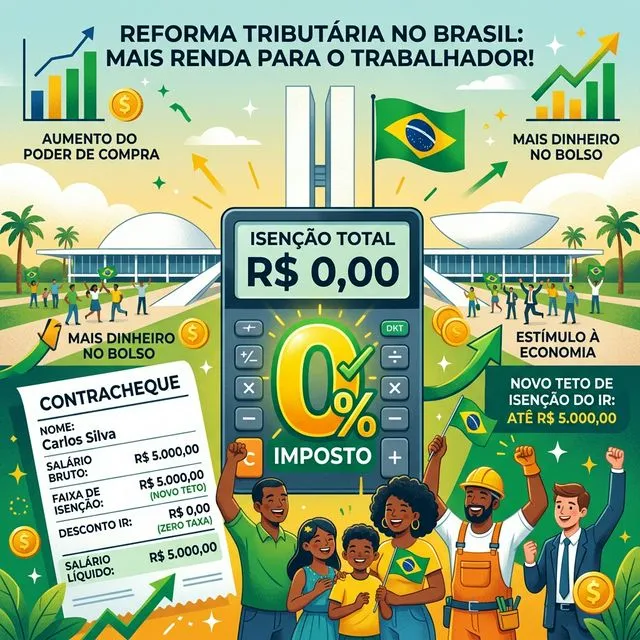
Imposto renda zero - Imagem 4

The income tax exemption for earners up to R$5,000 is, unquestionably, the biggest tax change in Brazil in decades. For 36 million Brazilians, it means more money in their pockets, more financial dignity, and a feeling — even if symbolic — that the tax system can be fairer.

But the story doesn't end here. Fiscal sustainability, the effectiveness of taxing the ultra-wealthy, and the real impact on the economy will still be tested throughout 2026 and beyond. The promise was fulfilled — now it remains to prove that the numbers add up.

One thing is certain: if you earn up to R$5,000 per month, your next paycheck already arrived fatter. And that, regardless of political positions, is good news for millions of Brazilian families.


Sources and References #

Imposto renda zero - Imagem 5

Last updated: February 15, 2026

📢 Gostou deste artigo?

Compartilhe com seus amigos e nos conte o que você achou nos comentários!

Frequently Asked Questions

The numbers are impressive. According to data from the Federal Revenue Service and IBGE: - 36 million Brazilians stop paying income tax with the new bracket - This represents 73% of all Income Tax filers - Average savings per person range from R$150 to R$600 per month, depending on the previous salary bracket - In annual terms, that's up to R$7,200 more in the worker's pocket For a family with two adults earning R$4,000 each, the combined savings can reach R$9,600 per year — enough money to pay off debts, invest, or improve quality of life. ---
No. The discount is applied automatically to payroll. Your employer has already adjusted withholdings since January 2026.
It depends. The obligation to file still exists in specific cases (assets above R$800,000, stock market operations, exempt income above R$200,000, among others). If you only receive a salary of up to R$5,000 and don't fall into these criteria, you don't need to file.
Freelancers with monthly income up to R$5,000 also benefit. For companies, the situation is more complex and depends on the tax regime (Simples, Presumed Profit, or Real Profit). Consult your accountant.
The law was approved without an expiration date, but future governments can change it. Historically, changes to the income tax table are rare — the trend is for the bracket to remain, adjusted for inflation.
It depends on your current salary. Estimates: - R$3,000/month → savings of ~R$120/month - R$4,000/month → savings of ~R$300/month - R$5,000/month → savings of ~R$580/month ---

Receba novidades!

Cadastre seu email e receba as melhores curiosidades toda semana.

Sem spam. Cancele quando quiser.

💬 Comentários (0)

Seja o primeiro a comentar! 👋

📚Read Also

Jensen Huang Declares: "AGI Has Arrived" — The Statement That Shook the Tech WorldTechnology

Jensen Huang Declares: "AGI Has Arrived" — The Statement That Shook the Tech World

NVIDIA CEO claims Artificial General Intelligence has been achieved. Statement on Lex Fridman podcast shakes markets and divides scientific community.

⏱️8 minLer mais →
OpenAI Raises $122 Billion and Becomes the World's Most Valuable CompanyTechnology

OpenAI Raises $122 Billion and Becomes the World's Most Valuable Company

AI startup reaches $852 billion valuation and surpasses Apple as most valuable company. IPO expected in 2026 could redefine tech market.

⏱️8 minLer mais →
Sora Shut Down: The Rise and Fall of the Video Generator That Promised to Revolutionize HollywoodTechnology

Sora Shut Down: The Rise and Fall of the Video Generator That Promised to Revolutionize Hollywood

OpenAI shuts down Sora after Disney cancels $1 billion deal. Revolutionary AI video tool lasted only 14 months on the market.

⏱️6 minLer mais →
IA + Computador Quântico: O Que Isso Muda Para a Nossa Realidade?Technology

IA + Computador Quântico: O Que Isso Muda Para a Nossa Realidade?

Como seria uma inteligência artificial rodando em computador quântico? Comparação com IAs atuais e o que esperar do futuro.

⏱️10 minLer mais →
100 Robotaxis Stop Dead in the Middle of Traffic in Wuhan: The Day AI Froze an Entire CityTechnology

100 Robotaxis Stop Dead in the Middle of Traffic in Wuhan: The Day AI Froze an Entire City

Over 100 Baidu Apollo Go autonomous vehicles stopped simultaneously on Wuhan's highways, trapping passengers for up to 2 hours. The incident reignites the AI safety debate

⏱️7 minLer mais →
IA Já Faz Compras Sozinha: Visa e Mastercard Completam Primeiros Pagamentos por Agentes AutônomosTechnology

IA Já Faz Compras Sozinha: Visa e Mastercard Completam Primeiros Pagamentos por Agentes Autônomos

Visa and Mastercard confirm real transactions made by AI agents. Learn how agentic commerce works and what changes in your life.

⏱️11 minLer mais →