A research report called "The 2028 Global Intelligence Crisis" has shaken Wall Street, gone viral on social media and triggered a wave of panic among investors and workers worldwide. The central premise is terrifying: artificial intelligence may destroy so many jobs so quickly that it will cause an unprecedented economic collapse — with the S&P 500 falling between 40% and 60%.
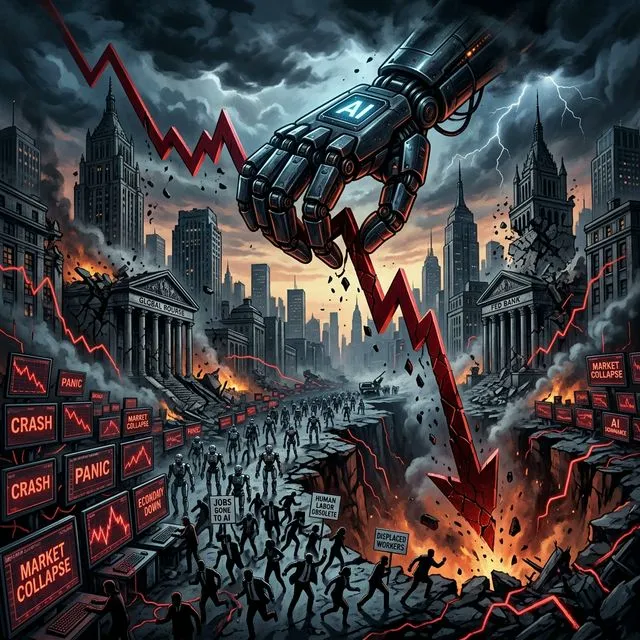
Published by Citrini Research, the document describes a scenario where accelerated AI advancement causes mass layoffs of white-collar workers, pushing unemployment above 10%, destroying consumption and triggering a spiral of defaults in private credit and mortgages. The result? What the authors call "free fall."
But is this apocalyptic scenario realistic? Or is it, as many critics claim, financial "doom porn"? In this article, we'll break down the report piece by piece, analyze the evidence from both sides and help you understand what's really at stake.
The Citrini Report: What It Actually Says
The Central Thesis
Citrini Research — an independent financial research firm — published in February 2026 a 47-page document titled "The 2028 Global Intelligence Crisis." The authors themselves describe it as a "thought exercise," not a prediction. But the content is so detailed and the scenarios so plausible that many treated it as prophecy.
The central thesis rests on three pillars:
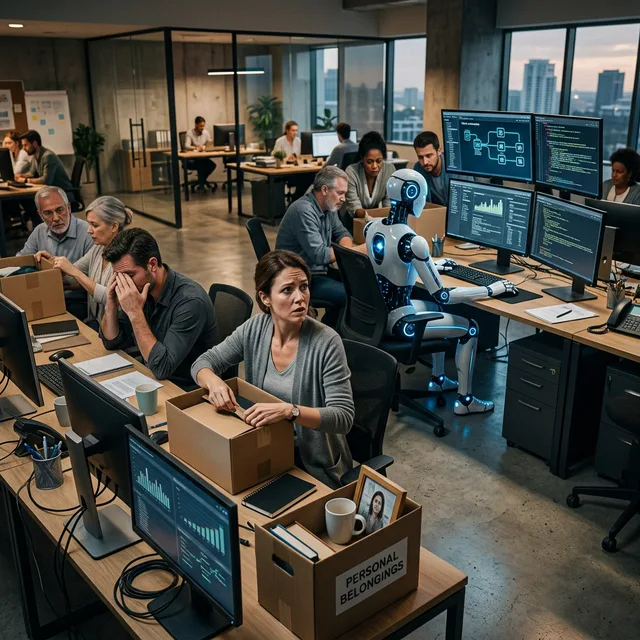
Accelerated AI adoption in offices: Companies are replacing white-collar workers (analysts, accountants, junior lawyers, programmers, writers, customer service) with AI systems at unprecedented speed.
Massive white-collar unemployment: Unlike previous industrial revolutions, where automation primarily hit manual workers, AI is eliminating skilled jobs — precisely those that sustain the consuming middle class.
Deflationary consumption spiral: Without income, former employees stop consuming. Without consumption, companies lose revenue. Without revenue, more layoffs. A self-feeding vicious cycle.
The Predicted Numbers
| Period | Prediction |
|---|---|
| 2026 Q3-Q4 | First waves of mass layoffs in tech and financial services |
| 2027 Q1 | US unemployment exceeds 8% (compared to ~4% current) |
| 2027 Q3 | Private credit defaults spike 300% |
| October 2026 | S&P 500 reaches historic peak (the last before the fall) |
| June 2028 | S&P 500 is 38% below October 2026 peak |
| Extreme Scenario | Total S&P 500 drop of 40-60%, unemployment above 10% |
The "Ghost GDP" Concept
One of the report's most original and disturbing concepts is "Ghost GDP":
- AI increases corporate productivity — factories produce more, services are delivered faster
- Technical GDP rises — the economy appears to be growing
- But the value generated doesn't circulate through society — it doesn't become wages, consumption or human taxes
- Companies get richer, but families get poorer
- GDP grows, but social wellbeing plummets
It's like an economy that works perfectly — just without people.
Market Impact: Real Panic
Immediate Reaction
When the report went viral, the market effect was immediate:
- AI tech stocks: Fell between 3% and 8% in a single session
- Enterprise software stocks: Most affected — Salesforce, SAP and ServiceNow saw significant declines
- Temporary employment sector: Staffing companies like Robert Half and Adecco plummeted over 10%
- Gold and Bitcoin: Rose as safe-haven assets
- VIX (fear index): Jumped 25% in one day

The Critics: "Doom Porn" or Legitimate Warning?
Arguments Against the Report
1. History doesn't support catastrophic automation scenarios
Every previous technological revolution — the steam engine, electricity, personal computers, the internet — generated panic about mass unemployment. In every case, new jobs emerged to replace those eliminated.
2. AI reduces costs → reduces prices → increases purchasing power
If AI makes services cheaper, the cost of living drops. Healthcare, education, legal services — everything becomes more accessible.
3. The report is a "thought exercise," not a prediction
The authors themselves emphasized the document was created to explore "left tail risks" — unlikely but high-impact scenarios.
4. Governments will intervene
AI profit taxation, universal basic income, mass reskilling — governments won't remain idle.
Arguments Supporting the Report
1. This revolution is different
For the first time in history, technology isn't replacing manual labor — it's replacing intellectual work. And there's no "higher category" of employment for these professionals to migrate to.
2. The speed is unprecedented
Previous industrial revolutions took decades. Generative AI went mainstream in less than 3 years.
3. Wealth concentration is real
AI profits are going to an ever-smaller group of companies (Nvidia, Microsoft, Google, OpenAI). Inequality is increasing at an accelerated rate.
4. Initial data is concerning
Tech companies have already laid off over 500,000 employees between 2023 and 2026. Many positions were replaced by AI, not new humans.
What's Actually Happening: Concrete Data
Confirmed AI-Related Layoffs (2024-2026)
| Company/Sector | Layoffs | Stated Reason |
|---|---|---|
| 12,000+ | "Efficiency and AI" | |
| Meta | 21,000+ | "Year of efficiency" |
| Amazon | 27,000+ | Warehouse and office automation |
| IBM | 3,900 | AI replacement explicitly stated |
| Duolingo | ~700 contractors | AI translation replacement |
| UPS | 12,000 | AI route optimization |
| Media sector | ~50,000+ | AI-generated content, summaries, translation |
The New Corporate Normal
- 85% of Fortune 500 declared they'll use AI to "optimize" workforce by 2027
- 60% of new software projects are partially or fully AI-generated
- Call centers: 40% headcount reduction since advanced chatbot adoption
- Legal sector: AI reviews contracts 94% faster than junior lawyers, with 97% accuracy
What to Do: A Survival Guide
For Workers
- Learn to use AI — don't fight it. Professionals who use AI as a tool are worth more than those who ignore it.
- Invest in "AI-proof" skills: complex creativity, emotional leadership, face-to-face negotiation, specialized manual work.
- Diversify income: Don't depend on a single employer.
- Stay updated: AI changes weekly.
For Investors
- Don't panic over alarmist reports — but don't completely ignore them either.
- Diversify: Don't concentrate everything in tech.
- Watch defensive sectors: Healthcare, energy, infrastructure.
- Monitor employment indicators: They're the canary in the coal mine.
Quantitative Modeling and Verification Protocols for AI crash economy 2026
A rigorous technical evaluation of Will AI Cause an Economic Crash? The Report That requires correlating the empirical records associated with AI crash economy 2026 against the structural variables documented under The Citrini Report: What It Actually Says. When domain specialists examine the behavior of Accelerated AI adoption in offices and Massive white collar unemployment across quantifiable benchmarks such as 3 years, a clear causal link emerges between methodological precision and operational stability within Technology. This analytical convergence around Citrini Research report removes speculative ambiguity and establishes verifiable metrics for tracking the progression of Deflationary consumption spiral across upcoming observational cycles.
Bridging the empirical findings reported in Market Impact: Real Panic with the practical deployment of artificial intelligence unemployment highlights the methodological maturity achieved in recent evaluations of Deflationary consumption spiral and doesn't circulate through society. By contrasting the 2026 metric against the historical baseline of AI tech stocks, analysts confirm that sustaining efficiency across S&P 500 40% drop demands continuous auditing and precise instrumental calibration. This verification architecture applied to The Critics: "Doom Porn" or Legitimate Warning and Enterprise software stocks ensures that breakthroughs recorded in Technology maintain strict reproducibility and operational consistency.
Conclusion: Neither Apocalypse Nor Paradise
The truth, as almost always, lies in the middle. The Citrini Research report isn't prophecy — it's a thought exercise about what might happen if everything goes wrong. But the risks it identifies are real, documented and growing.
AI won't "destroy the economy" overnight. But it is undeniably transforming the job market at a pace that society hasn't yet learned to keep up with. The question isn't whether there will be disruption — it's whether we'll have the wisdom to manage the transition.
And that answer depends on something no artificial intelligence can provide: human leadership, empathy and long-term vision.
References and Sources
- Citrini Research — The 2028 Global Intelligence Crisis
- Business Insider — AI economy crash report goes viral
- The Guardian — Citrini Research AI free fall scenario
- Nasdaq — Market reaction to AI crash report
- Forbes — Ghost GDP and the AI economy
- Gizmodo — Is AI doom porn or legitimate warning?
- Washington Post — AI-induced economic free fall report