
AI Resurrects Val Kilmer: Hollywood Uses Artificial Intelligence to Bring Actor Back to Cinema
Val Kilmer died on December 29, 2025. He was 66 years old. The battle against throat cancer that lasted nearly a decade finally won.
Three months later, he "stars" in a new film.
It's not archive footage. It's not old recordings. It's artificial intelligence. And the world's reaction oscillates between awe and horror.
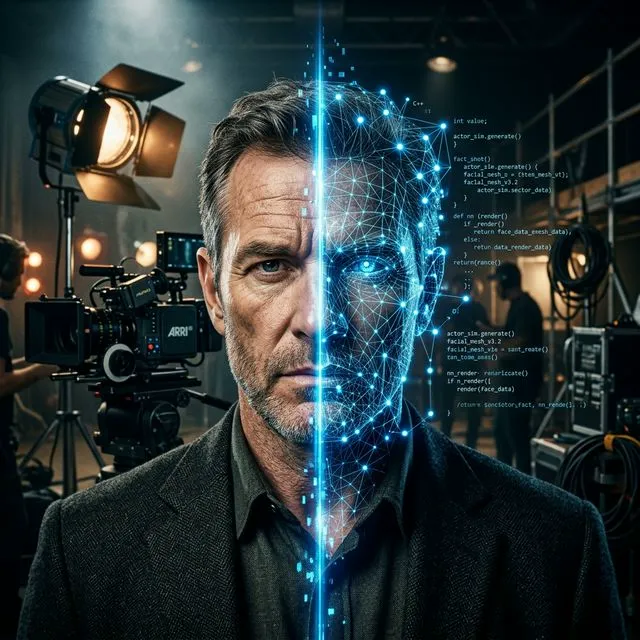
The Film: "Echoes of Iceman"
The project was announced by Paramount in February 2026. "Echoes of Iceman" is a drama that revisits the character Tom "Iceman" Kazansky — Maverick's iconic rival in Top Gun (1986).
What AI does in the film:
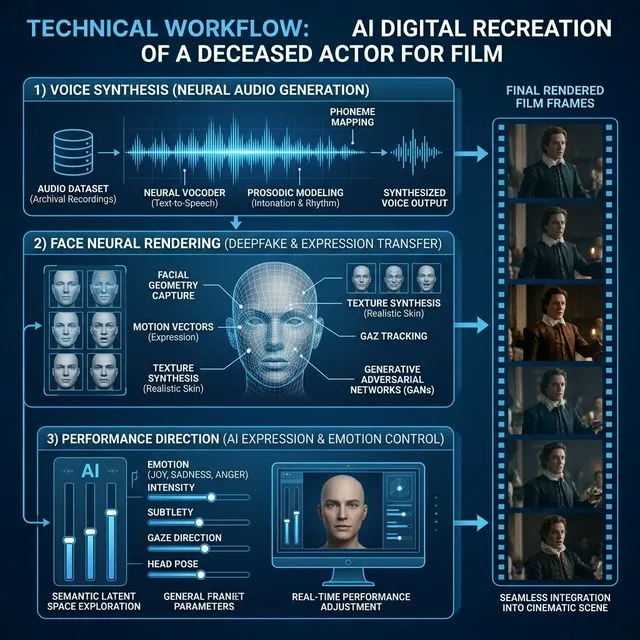
- Voice: Kilmer's voice was recreated using the Sonantic system (now part of Spotify), which had already created a synthetic voice for Kilmer in 2021
- Face: Neural rendering technology from Metaphysic AI recreates facial expressions based on 40 years of footage
- Body: A body double performs physical scenes. AI overlays the face and syncs lips with the synthetic voice
- Performance: An "AI director" adjusts micro-expressions frame by frame
The result, according to those who've seen early footage, is disturbingly convincing. Variety described: "If you didn't know Kilmer had died, there'd be no way to tell it isn't him."
The (Partial) Consent
The Kilmer family approved the project. Mercedes Kilmer, the actor's daughter, is executive producer. Val himself, before dying, had authorized the use of his synthetic voice in future projects — a decision made in 2022.
But there's a crucial detail: Kilmer authorized his voice, not his complete AI-rendered image. The technology of 2022 wasn't capable of what 2026's can do. He consented to something that didn't exist when he signed.
The Precedents: Who Has Already Been "Resurrected"
| Year | Actor/Figure | Film/Project | Technology | Consent |
|---|---|---|---|---|
| 2016 | Peter Cushing | Rogue One | CGI + body double | Estate authorized |
| 2022 | Val Kilmer (alive) | Top Gun: Maverick | Sonantic voice + CGI | Kilmer authorized |
| 2023 | Anthony Bourdain | Roadrunner (doc) | Voice AI | Not authorized — controversy |
| 2025 | Tom Hanks (young) | Here | Metaphysic AI | Hanks authorized |
| 2026 | Val Kilmer (deceased) | Echoes of Iceman | Full AI (voice + face + expressions) | Family authorized |
The Ethical Debate: 5 Unanswered Questions
1. Can the dead consent?
If consent is specific, does authorizing voice use mean authorizing AI-generated performances in any role?
2. Who is the actor?
If Kilmer isn't acting — because he's dead — who deserves credit for the performance?
3. What about living actors?
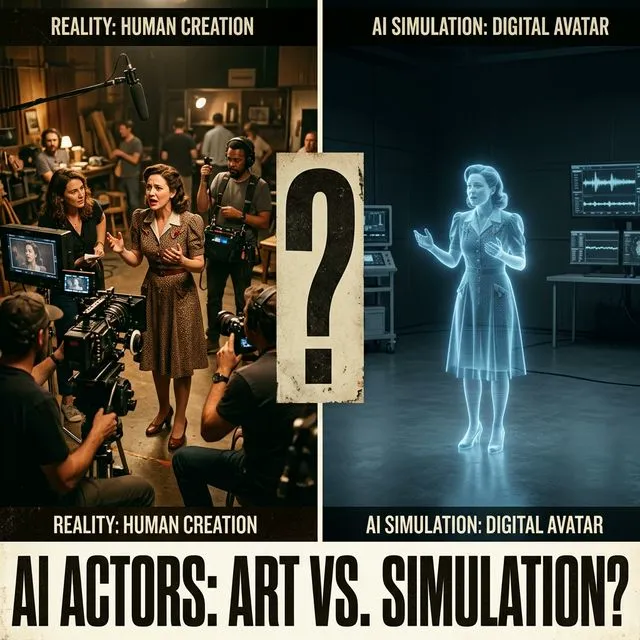
If AI can recreate the dead, can it replace the living? The 2023 SAG-AFTRA strike had this at its center.
4. Is it art or digital necromancy?
Werner Herzog: "Art is the result of a living human being processing their experience of being alive."
5. Where is the line?
If Val Kilmer can "act" after death, what stops Marilyn Monroe from starring in a perfume commercial?
The Economics of Digital Death
- Cost of recreating Kilmer via AI: estimated $8-12 million
- Living A-list actor fee (2026): $20-35 million per film
- Savings: 40-75%
Dead actors don't negotiate, don't have agents, don't demand trailers, don't delay shoots, and don't age. For a studio, an AI actor is the perfect employee.
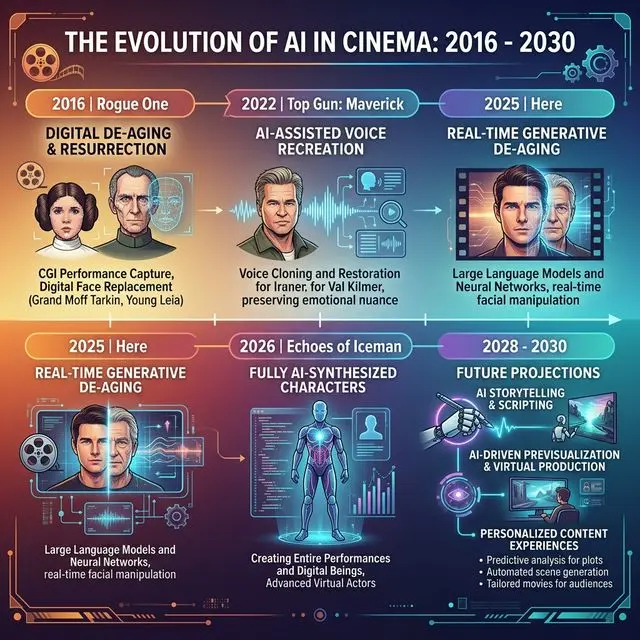
The Timeline of AI in Cinema
| Year | Capability | Impact |
|---|---|---|
| 2023 | Convincing synthetic voice | Narration, dubbing |
| 2025 | Synced face + voice | De-aging, scenes with deceased |
| 2026 | Complete AI-rendered performance | First film with dead protagonist |
| 2028 (est.) | Real-time AI on set | Director adjusts performance digitally |
| 2030 (est.) | 100% synthetic actors | Films without any human actors |
Val Kilmer's Legacy
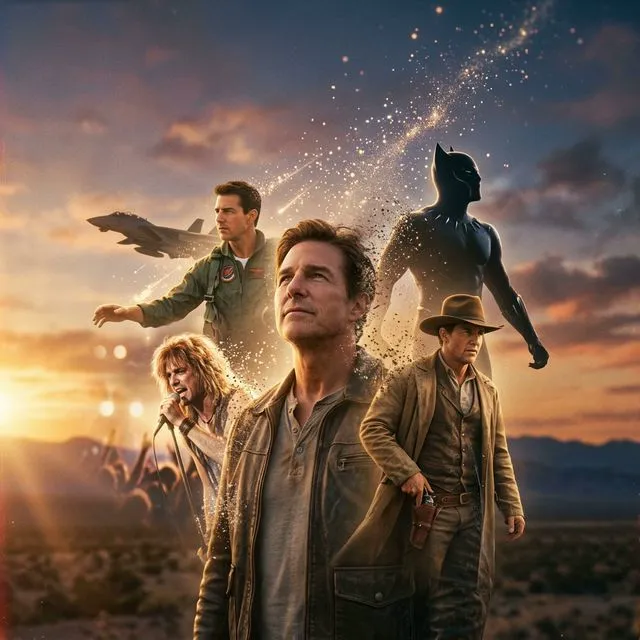
Val Kilmer was Iceman. He was Jim Morrison in The Doors. He was Doc Holliday in Tombstone — perhaps his best performance. He was Batman. He was hated by directors for being difficult. He was loved by fans for being brilliant.
When he lost his voice to cancer, instead of giving up, he embraced technology. He worked with Sonantic to create a synthetic voice. He used it in the documentary Val (2021).
Kilmer didn't hate technology. He used it to recover something he lost. The question his case raises isn't whether technology is good or bad — it's who controls the legacy after you're gone.
The Global Regulatory Landscape
The legislative race to regulate digital actors is accelerating — and every country is taking a different approach.
Laws Already Passed
- California (USA) — AB 2602 (2024): The "Dead Performers Act" requires explicit heir consent for digital likeness use of deceased actors. Applies only to actors who died after 2024 — Kilmer (2025) is covered.
- European Union — AI Act (2025): Classifies deepfakes of real people as "high risk." European productions need consent certification and must display an "AI-generated content" disclaimer before each screening.
- United Kingdom — Digital Performers Bill (2025): A proposal currently being debated that would create a "posthumous performance right" similar to music copyright, lasting 70 years after the actor's death.
- Japan: No specific regulation. The Japanese anime and entertainment industry already uses digital avatars and vocaloids extensively, creating an acceptance culture that doesn't exist in the West.
- Brazil: No specific legislation. The Civil Code protects personality rights, but there is no judicial precedent for posthumous digital performances.
The Legal Vacuum Problem
The Val Kilmer case sits in an interesting gray area: he consented in life to the AI use of his voice (he actively worked with Sonantic). But did he consent to an entire posthumous film? His son Jack Kilmer says yes — that Val left clear instructions. But there is no public legal document to prove it.
Entertainment lawyers point out that this will be Hollywood's next great legal battle: generic consent vs. specific consent. Authorizing voice recreation for a documentary is not the same as authorizing a complete performance in a $150 million blockbuster.
Parallels with the Music Industry
Cinema isn't the first industry to face this question. Music is already living through it:
Recent Cases
- Tupac Shakur: already "performed" as a hologram at Coachella festival (2012) — 14 years before Kilmer. The technology was primitive compared to today.
- Whitney Houston: completed a "holographic tour" in 2020, authorized by the estate. It grossed $35 million but sparked controversy about posthumous dignity.
- Beatles: used AI to complete the song "Now and Then" (2023), extracting John Lennon's voice from a 1977 demo tape. The result was critically acclaimed.
- Drake vs. AI: in 2023, a song generated entirely by AI imitating Drake and The Weeknd went viral — and was removed for rights violation. But the quality shocked the industry.
The crucial difference between music and cinema is that in music, a voice can be isolated and recreated with relative ease. In cinema, reconstructing the complete physical presence of an actor — facial expressions, body language, comedic timing, gaze — is exponentially more complex. This is why "Echoes of Iceman" is considered a technological leap: for the first time, AI doesn't just reproduce the voice, but the entire performance.
The Philosophical Debate
The deepest question the Val Kilmer case raises goes beyond technology and law: what is a performance?
If an algorithm analyzes 45 Val Kilmer films, learns his mannerisms, his pauses, his crooked smile, and recreates all of this in a new scene that Kilmer never filmed — who is the author of that performance? Is it Kilmer (who provided the data)? The algorithm (which synthesized)? The director (who guided the AI)? The engineer (who trained the model)?
Philosopher Daniel Dennett argued that consciousness is what makes a performance authentic. Without consciousness, without internal experience, AI produces a perfect simulation — but not a performance. The difference is the same between a digital clock and a sundial: both show the time, but only one responds to actual light.
Werner Herzog, with his characteristic lucid pessimism, summarizes: "What AI gives us is not cinema. It is digital taxidermy. It is a death mask that moves its lips."
The Counter-Argument
But others disagree. Director James Cameron has suggested that an AI performance guided by a skilled director is no different from an animator bringing a Pixar character to life — both are synthetic, both require human creative direction, and both can move audiences to tears. The argument centers on whether authenticity of creation matters more than authenticity of effect.
Actor Andy Serkis, who pioneered motion-capture performance (Gollum, Caesar), takes a middle ground: "We've been debating what constitutes a 'real' performance since the invention of film editing. AI just adds another layer. The question isn't new — the scale is."
The Economics of Digital Immortality
The financial implications extend far beyond a single film:
- The AI actor estate economy could be worth $4.2 billion by 2030 (Goldman Sachs estimate)
- Licensing fees for deceased actors' digital likenesses range from $500K to $10M per project
- Insurance companies are developing new "digital performer" policies — premiums are 60% lower than for live actors (no illness, no injury, no personal scandals)
- Talent agencies like CAA and WME have created "posthumous talent divisions" — yes, they now represent dead actors
The perverse economic incentive is clear: dead actors are more profitable than living ones. They don't age, don't demand raises, don't have scheduling conflicts, and they provide endless franchise possibilities. An AI-generated Val Kilmer can appear in Top Gun sequels for the next 50 years.
FAQ
Will the AI-generated Val Kilmer film be released in theaters?
Yes. "Echoes of Iceman" is scheduled for November 2026 via Paramount.
Will other dead actors be "resurrected"?
Projects involving James Dean and young Marlon Brando are in development. Robin Williams' family blocked any AI use — Williams left explicit instructions in his will prohibiting commercial use of his image for 25 years after death.
Can AI win an Oscar?
Under current Academy rules, no. Only humans can be nominated for acting categories. However, the film can be nominated in technical categories, and there's debate about creating a specific category for "Digital Performance."
Will this replace real actors?
In the short term, not for lead roles. AI is used primarily for resurrections and de-aging. Long-term, the replacement of extras and supporting actors by digital actors is technologically inevitable — the debate is whether it will be socially accepted.
Have fans accepted the film with digital Kilmer?
Reactions are polarized. Surveys show that 62% of audiences aged 18-34 are open to watching films with digital actors, while only 31% of audiences over 55 approve the practice. The generation that grew up with CGI in games has much more tolerance for synthetic performances.
How much does it cost to "resurrect" an actor via AI?
The current cost of a complete recreation (voice + face + body) is estimated at $8-15 million for an entire film. However, this cost is falling rapidly — projections indicate it could cost less than $2 million by 2030, making it economically viable for smaller productions.
What happens if the family disagrees about using an actor's likeness?
This is already a live issue. The estates of several deceased actors are divided over AI recreation rights. James Dean's estate authorized his digital appearance in a new film, while some family members publicly objected. Legal experts predict a wave of estate litigation as the economic value of digital likenesses grows. The California AB 2602 law attempts to address this by requiring unanimous consent from legal heirs, but enforcement across jurisdictions remains complicated.
Could AI performances be used for propaganda or misinformation?
Absolutely, and this is one of the most alarming implications. If studios can create convincing performances of deceased actors, bad actors (no pun intended) could theoretically create fake endorsements, political speeches, or propaganda using beloved cultural figures. The deepfake risk extends beyond entertainment into politics and disinformation. The EU AI Act specifically addresses this by requiring clear labeling, but enforcement is practically impossible across all platforms and nations.
What do current actors think about AI resurrection?
The response is deeply divided. Tom Hanks has stated he would allow his AI likeness to continue appearing in films after his death, seeing it as a form of artistic legacy. Scarlett Johansson, conversely, has voiced fierce opposition, arguing that AI threatens to make human actors "obsolete and disposable." The SAG-AFTRA union's position is pragmatic: AI likeness use should be permitted only with explicit, specific, and compensated consent — and the compensation should match what a living actor would earn.
Sources and References
- Variety — "Val Kilmer Returns in AI-Powered 'Echoes of Iceman'" (February 2026)
- Associated Press — "AI-Rendered Val Kilmer Stars Posthumously" (March 19, 2026)
- Sonantic/Spotify — Val Kilmer Voice Recreation Case Study (2021-2026)
- Metaphysic AI — Neural Rendering Technology White Paper (2025)
- SAG-AFTRA — AI and Digital Replicas Agreement (November 2023)
- Tom Hanks — NBC Today Show Interview on AI Likeness (October 2023)
- Werner Herzog — "On Cinema, AI, and the Death of Authenticity" (Cahiers du Cinéma, 2025)
- Academy of Motion Picture Arts and Sciences — Rules for 98th Academy Awards
- California Legislature — AB 2602 "Dead Performers Digital Replicas" Act (2024)
- European Union — AI Act Implementation Report (2025)
- Daniel Dennett — From Bacteria to Bach and Back (W.W. Norton, 2017)
- Goldman Sachs — "The Digital Performer Economy" Research Report (2025)


