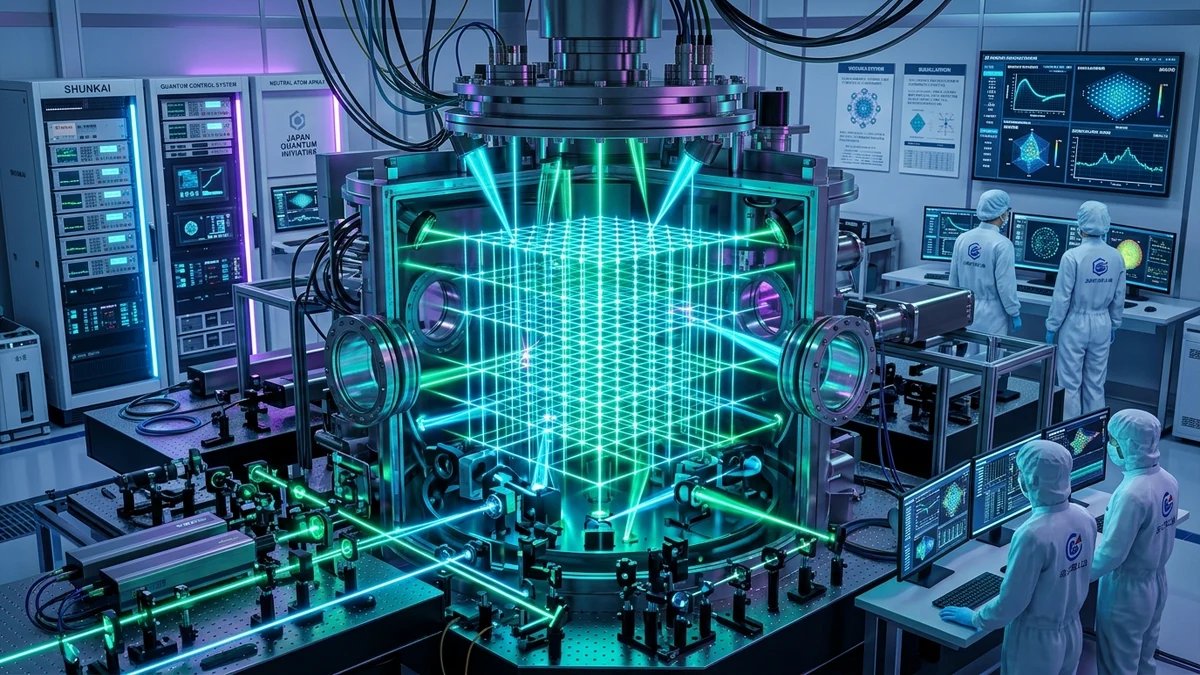
At an official commissioning ceremony in Tokyo in August 2026, global quantum hardware provider Infleqtion, in partnership with the Japan Science and Technology Agency (JST) and the University of Tokyo, announced the commercial deployment of Shunkai (Spring Ocean). The installation represents Japan's first operational full-stack commercial neutral-atom quantum computer, marking a transformative transition from experimental academic physics to industrial-scale high-performance quantum computing. The machine utilizes high-precision optical laser tweezers to trap, cool, and dynamically position hundreds of individual rubidium and cesium atoms in reconfigurable three-dimensional arrays within a room-temperature vacuum chamber.
Unlike traditional superconducting quantum processors (such as those from IBM and Google) that necessitate massive cryostats operating near absolute zero, Shunkai's neutral-atom architecture relies on laser-driven electromagnetic isolation. Individual atoms are cooled via laser beams and held motionless in optical dipole traps with sub-nanometer accuracy, entirely circumventing physical lithography fabrication defects. This fundamental advantage allows atomic qubits to sustain quantum coherence times up to ten times longer than solid-state chips, facilitating ultra-deep quantum circuit execution without phase degradation.
The deployment of Shunkai cements Japan's national Quantum Moonshot program mandate to establish global leadership in material science simulations, pharmaceutical chemistry, and combinatorial supply chain optimization. Leading Japanese automotive and chemical corporations have already integrated Shunkai into production workflows to model solid-state EV battery chemistries and design green hydrogen synthetic catalysts. The platform demonstrates that neutral atoms represent the most scalable hardware pathway toward fault-tolerant quantum computation.
Hardware Comparison: Neutral Atoms versus Superconducting Qubits
The evolution of quantum computing reaches a pivotal inflection point with the commercial maturation of optical neutral-atom tweezer arrays. To evaluate the architectural leap delivered by Shunkai in August 2026, we must contrast its performance metrics against traditional superconducting circuits and trapped-ion systems. The dynamic 3D connectivity of atomic arrays eliminates the rigid planar routing bottlenecks that constrain classical silicon chips.
| Architecture Metric | Superconducting Circuits (Solid-State) | Trapped Ions (RF Quadrupole Traps) | Neutral Atoms (Shunkai - Infleqtion) |
|---|---|---|---|
| Physical Qubit Substrate | Microfabricated Josephson junction loops | Charged ions confined by electric fields | Identical individual atoms held in optical lattices |
| Lattice Topology | Fixed 2D planar connectivity on silicon | 1D linear chains with shuttling delays | Dynamically reconfigurable 3D spatial matrices |
| Operating Temperature | Millikelvin dilution refrigeration (< -273°C) | Cryogenic vacuum packages | Room-temperature vacuum enclosure with laser cooling |
| Coherence Lifetime | Microseconds to tens of microseconds | Seconds to minutes | Multiple seconds with 99.6% two-qubit gate fidelity |
During commercial benchmark tests, Shunkai demonstrated the capability to physically shuttle and re-arrange atomic positions in real time to execute multi-qubit entangling gates, slashing circuit depth by over seventy percent compared to fixed-grid architectures. High-speed scientific cameras resolved single-atom fluorescence with near-perfect fidelity, enabling mid-circuit error syndrome measurements without destroying the superposition of adjacent unmeasured qubits.
Furthermore, collaborative engineering between Japanese research teams and hardware architects enabled low-latency hybrid integration linking Shunkai directly with the world-renowned Fugaku supercomputer. This hybrid quantum-classical pipeline orchestrates complex computational workloads, delegating dense linear algebra to classical nodes while offloading combinatorial optimization to the atomic quantum processor.
Next-Generation Semiconductor Fabrication and Molecular Modeling
The commercial operation of Shunkai accelerates multinational collaborations across Japan, North America, and Europe targeting next-generation microelectronics manufacturing. In a complementary August 2026 development, Xanadu Quantum Technologies and Mitsubishi Chemical expanded their joint quantum chemistry initiative to simulate extreme ultraviolet (EUV) lithography photoresist reactions, compressing multi-year development cycles for sub-2-nanometer semiconductor chips.
Infleqtion and Professor Kenji Ohmori's research group plan to scale Shunkai's atomic payload to over one thousand error-corrected logical qubits by 2028. This geometric scaling will unlock breakthroughs in room-temperature superconductivity research and sustainable nitrogen-fixation catalyst discovery. Neutral-atom quantum computing firmly establishes the era of atomic-scale software engineering.
The Shunkai quantum computer embodies the profound convergence between optical precision engineering and the fundamental laws of atomic physics. By mastering individual atoms suspended in beams of light, Japan illuminates the frontier of human technological capability.
Frequently Asked Questions
What is the Shunkai quantum computer and how does it operate?
Shunkai is a commercial neutral-atom quantum computer developed in Japan that utilizes optical laser tweezers to trap and manipulate individual atoms as qubits inside a 3D matrix.
Why are neutral atoms superior to conventional superconducting chips?
Because natural atoms are intrinsically identical and free from manufacturing flaws, maintaining quantum coherence for longer durations without requiring millikelvin cryogenic refrigeration.
Which industries will benefit from Shunkai's computational power?
It will accelerate advanced materials discovery for EV solid-state batteries, molecular drug synthesis, EUV semiconductor lithography modeling, and global logistics optimization.
Official Scientific References
- Infleqtion Official Press Room — Commercial deployment announcements and architectural specifications for Shunkai.
- Japan Science and Technology Agency (JST) Quantum Moonshot — Technical reports on Japan's national fault-tolerant quantum computing roadmap.
- Physical Review X Quantum — Peer-reviewed studies on Rydberg gate fidelities and 3D neutral-atom optical tweezers.