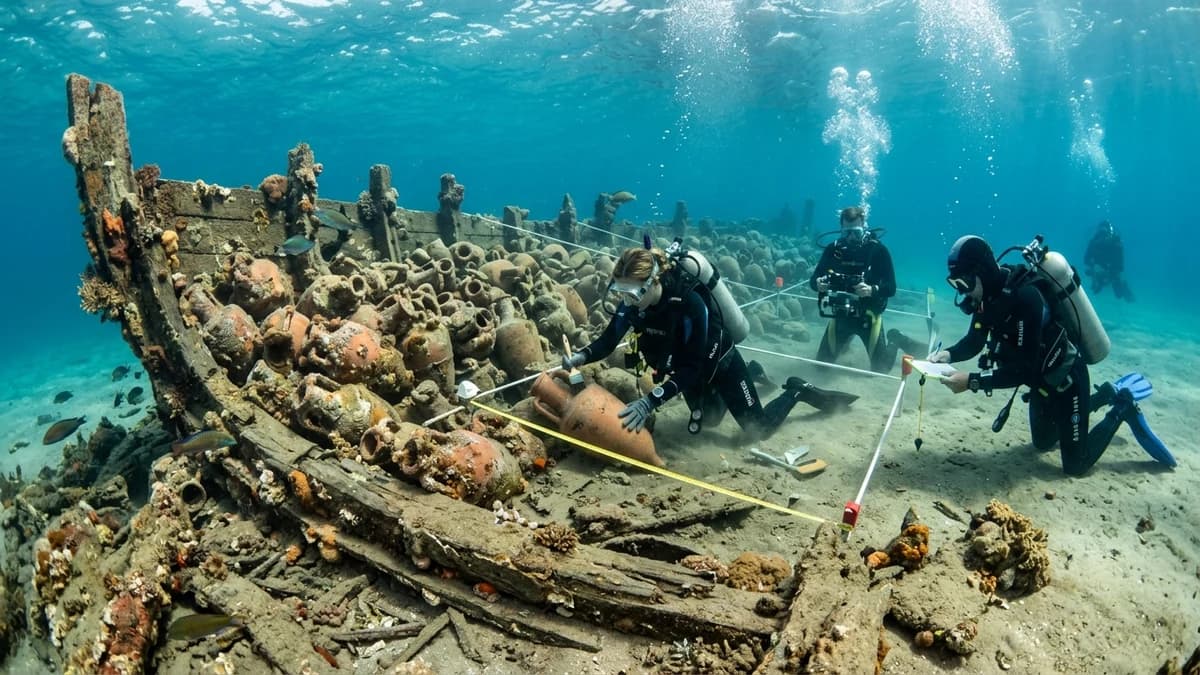
Given the intriguing data, the expedition mobilized remote-controlled underwater vehicles operated by artificial intelligence. These abyssal robots descended under extreme conditions of hydrostatic pressure to collect direct visual data. The goal was to record images in ultra-high definition and collect physical fragments from the structure's surface.
When the vehicle's powerful LED searchlights illuminated the structure, the team on the research vessel fell into absolute silence. The light partially penetrated the wall of the pyramid, revealing a translucent consistency with a vitreous luster. The material gleamed under the water like a huge polished crystal, reflecting greenish and bluish colors.
The submarine's articulated robotic arm was activated to try to scrape the outer surface and collect mineral samples. To the surprise of the engineers, the diamond tips of the mechanical manipulator suffered severe wear when trying to drill the compound. With extreme difficulty, the team extracted a few millimeter-sized flakes that broke off from a smaller crevice.
These fragments were immediately sent to the pressurized chamber of the chemical analysis laboratory on board the Nautilus II. Preliminary analysis by X-ray diffraction indicated a molecular purity that rules out natural sedimentation processes. The result suggests a planned manufacture, with an atomic alignment that increases the physical resistance of the material.
To understand the importance of this discovery, it is essential to compare it with other known underwater archaeological mysteries. Several sites around the globe present structural anomalies that have divided the opinion of geologists and historians. Comparative analysis helps to discern between unusual natural phenomena and deliberate works of ancestral engineering.
| Site Name |
Location |
Depth |
Material Composition |
Core Hypothesis |
| Crystal Pyramid |
Bermuda Triangle |
700 meters |
High-purity silicate and metallic oxides |
Ancient device concentrating piezoelectric energy. |
| Yonaguni Monument |
Yonaguni Island, Japan |
25 meters |
Natural sandstone and claystone with fractures |
Sculpted artificial ceremonial site or rare geological formation. |
| Bimini Road |
Bahamas Islands |
6 meters |
Rectangular limestone blocks (Beachrock) |
Remnants of an ancient wall or road of the Atlantean civilization. |
| Ruins of Dwarka |
Gulf of Khambhat, India |
40 meters |
Carved sandstone blocks and mortar |
Fortified city of the legendary kingdom of King Krishna. |
| Baltic Sea Anomaly |
Gulf of Bothnia |
90 meters |
Granite and basaltic rock with high iron content |
Exotic glacial deposit or remnants of a wartime sonar device. |
As we can observe, the structure located in the Bermuda Triangle stands out drastically due to its extreme depth and exotic composition. While Bimini and Yonaguni are situated in shallow and accessible waters, the crystal pyramid requires space-level technology to be studied. This deep geographical isolation has preserved the monument from human disturbances for thousands of years.
One of the most intriguing discoveries of the expedition involves the electromagnetic fluctuations recorded around the submerged monument. The magnetometers installed on the ROVs detected regular pulses of energy emanating from the top of the pyramidal structure. These rhythmic signals suggest that the pyramid acts as a huge transducer of mechanical energy into electrical currents.
This phenomenon is scientifically known as the piezoelectric effect, typical of quartz crystals under constant stress or physical pressure. In the depths of the Bermuda Triangle, the structure is under a monumental hydrostatic pressure of dozens of atmospheres. In addition, the strong deep ocean currents exert a perpetual shear force on its smooth faces.
This combination of continuous pressure and salt water movement can force the constant generation of static electricity and magnetism. The accumulation of this fluid energy would be directed to the upper vertex of the monument, creating a vertical electromagnetic beam. This regular discharge of ionizing energy would explain the legendary disturbances in electronic instruments in the Atlantic basin.
Historical accounts of aviators and sailors who described disoriented compasses and glowing mists gain a new scientific outline from this perspective. Far from being just an urban legend, the mystery of the Triangle may have a concrete and colossal geophysical explanation. The physicists on board continue to model the charge storage capacity of this marine megacrystal.
The estimated age of the sediment layers at the base of the monument suggests it was built at least twelve thousand years ago. This chronology perfectly coincides with the end of the last glacial period and with the myths of global floods present in various ancient cultures. The rapid flooding would have buried this jewel of engineering under hundreds of meters of ocean water.
Comparative studies seek to understand if the engineering of these oceanic ruins shares conceptual traits with the civilization recently identified in the enigma of the lost ruins in the Danakil desert. After all, the development of extreme hydraulic solutions and synthetic materials seems to have been a constant in the unknown past of our planet. Both societies mastered techniques that far surpassed the resources of their contemporary neighbors.
The decoding of these geometric patterns and energy properties may require new technological tools of advanced computational translation. The process recalls the challenges faced when artificial intelligence deciphers a new page of the Voynich manuscript, opening frontiers in our documentary and historical understanding. The union of classical archaeology with deep learning algorithms is crucial to unraveling these untouched mysteries.
Many archaeologists speculate whether this lost civilization possessed a global communication network based on mineral resonance monuments. Similar structures may be buried in other ocean trenches not yet mapped in detail by world governments. The systematic mapping of the seas could completely rewrite the tree of our species' technological development.
The logistical challenges to continue research in the Bermuda Triangle are immense due to the region's unpredictable weather. Frequent tropical storms and the strength of tidal currents make it difficult to keep vessels in fixed anchoring positions. However, scientists are already planning a new expedition equipped with high-capacity drilling robots.
The goal of the next season is to perform a micro-drilling in the internal walls of the monument to extract gases preserved in microscopic air bubbles. This atmospheric analysis will reveal the exact composition of Earth's air at the moment the crystal was manufactured. With these data, climatologists will be able to draw a precise panorama of the ecological collapse that ended that era.
Regardless of whether its origin is terrestrial or external, the crystal pyramid remains as a silent testimony of our fascinating planetary history. It reminds us that the ocean still shelters grandiose secrets that challenge our current scientific arrogance. The rescue of this lost knowledge can illuminate surprising paths for the future of our own energy engineering.