
There's a problem that the world's most powerful computers — supercomputers with millions of cores processing data in parallel — simply cannot solve in a practical timeframe. That problem is precisely calculating the energy of complex molecules. It sounds esoteric, but it's the bottleneck preventing humanity from developing more effective medications, longer-lasting batteries, less polluting fertilizers, and revolutionary materials.
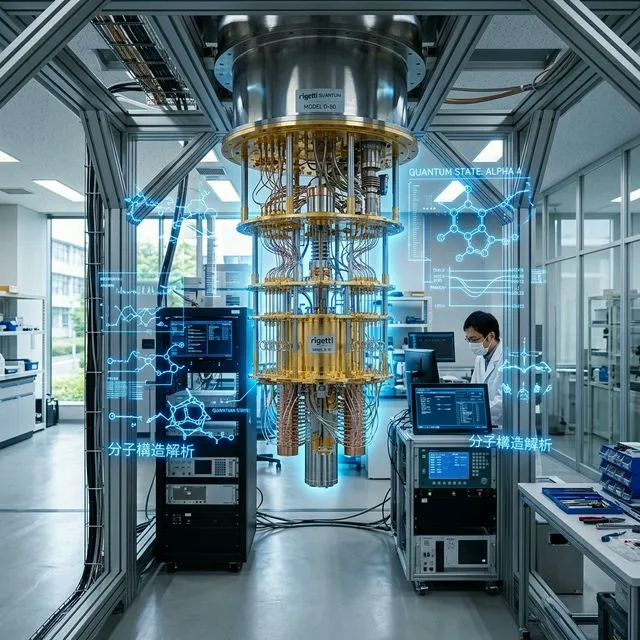
On March 25, 2026, Fujitsu and the University of Osaka announced they may have broken this bottleneck. The team developed new quantum computing techniques that reduce the computational resources needed for molecular energy calculations by up to 95%, making it feasible to perform simulations that would take years on classical supercomputers in just minutes on next-generation quantum computers.
Why Calculating Molecules Is So Hard
Each atom in a molecule has electrons that obey the laws of quantum mechanics. The number of possible quantum states grows exponentially with the number of electrons.
| Molecule | Atoms | Electrons | Time on supercomputer |
|---|---|---|---|
| Water (H₂O) | 3 | 10 | Milliseconds |
| Caffeine | 24 | 102 | Hours |
| Penicillin | 41 | 174 | Weeks |
| Insulin | 788 | ~3,400 | ~100 years |
| Monoclonal antibody | ~25,000 | ~100,000 | Impossible |
The Three Key Innovations
1. Adaptive Orbital Decomposition: instead of simulating all electrons simultaneously, the algorithm identifies which electronic orbitals are most relevant and simulates only those, reducing qubits needed by 60-80%.
2. Probabilistic Error Correction: instead of full quantum error correction codes (which multiply qubits by ~1,000x), the team developed a technique that estimates and corrects errors statistically, achieving a 90% reduction in error correction overhead.
3. Hybrid Quantum-Classical Loop: the algorithm divides calculations between quantum processors (for genuinely quantum parts) and classical processors (for optimization and post-processing).
Practical Result:
| Calculation | Traditional FTQC | Fujitsu-Osaka Method |
|---|---|---|
| Fe₂S₂ cluster energy | ~4 million logical qubits | ~100,000 logical qubits |
| Estimated time | ~50 hours FTQC | ~15 minutes early-FTQC |
| Hardware needed | Quantum computer ~2035 | Quantum computer ~2028 |

Revolutionary Impacts
Drug Discovery
New drug development takes 12 years on average and costs $2.6 billion. About 90% of drug candidates fail during clinical trials. Precise quantum simulations could potentially cut development time to 3-5 years and reduce costs by 70%.
Advanced Materials
Next-generation batteries, high-temperature superconductors, and carbon capture catalysts depend on understanding molecular interactions beyond classical computing capabilities.
The Global Quantum Race
| Player | Country | Qubits (2026) | Focus |
|---|---|---|---|
| IBM | USA | 1,386 (Flamingo) | General / Enterprise |
| USA | 1,000+ (Willow+) | Error correction | |
| Fujitsu | Japan | 256 + simulator | Chemistry / Materials |
| Baidu | China | 550 (Qianshi) | Drugs / Defense |

FAQ
Will quantum computing replace normal computers?
No. Quantum computers are superior only for specific problem types. For everyday tasks, classical computers remain superior.
When will I have a quantum computer at home?
Probably never in current form. Access will be via cloud services.
Will this breakthrough cure diseases?
Not directly. It accelerates drug discovery by enabling more precise molecular simulations. Clinical trials and regulatory approval still take years.
Sources and References
- Fujitsu Limited — Press Release (March 25, 2026)
- University of Osaka — Research Paper (2026)
- Nature Chemistry — Preview (March 2026)
- IBM Research — Quantum Computing Roadmap 2026-2030


