
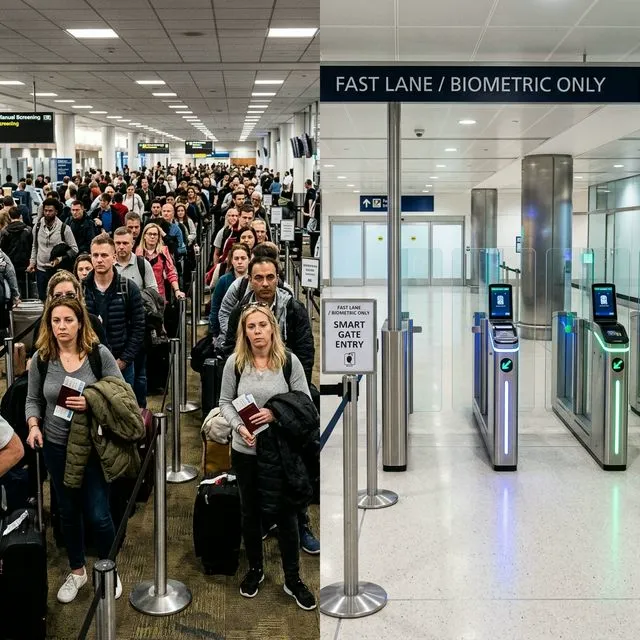
It's 5:47 AM at Los Angeles International Airport. The security checkpoint line stretches 340 meters — nearly the length of three football fields. Children cry, executives nervously check their watches, and an electronic display shows the estimated wait time: 2 hours and 15 minutes. It's March 2026, and American airports are experiencing the worst delays in history.
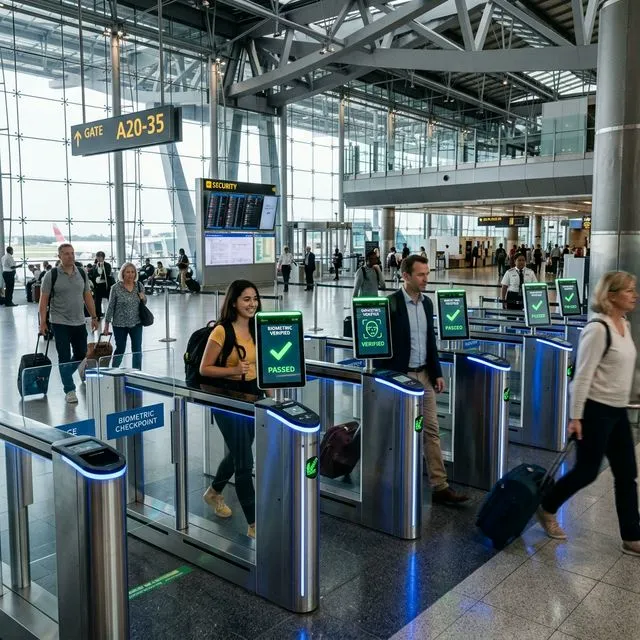
Fifty meters away, a parallel lane tells a completely different story. Passengers walk at a normal pace, glance briefly at a camera atop a metal portal, and in exactly 8 seconds, they're on the other side. No removing shoes. No opening bags. No showing documents. Just their face and iris — unique biological information that no forger can replicate.
That lane is operated by CLEAR, a biometric identity verification company that became, practically overnight, one of the most valuable startups in the United States. And what's happening at American airports is just the beginning of a revolution that will transform how we prove who we are worldwide.
The Crisis That Created the Opportunity
March 2026: The Collapse of American Airports
The airport crisis in the US in March 2026 has a precise cause: the combination of record passenger increases (2.91 million daily, according to TSA), reduced post-pandemic security personnel, and geopolitical tensions that elevated the TSA alert level to "orange" (high risk).
| Metric | 2019 (pre-pandemic) | March 2026 |
|---|---|---|
| Daily passengers (TSA) | 2.5 million | 2.91 million |
| Average wait time | 28 minutes | 87 minutes |
| TSA agents | 47,000 | 39,200 |
| Flights delayed by security | 3.2% | 14.7% |
| Passenger complaints | 12,000/month | 89,000/month |
The economic impact is colossal: Airlines for America (A4A) estimates that airport delays in January-March 2026 cost the American economy $4.7 billion — in missed flights, cancelled connections, emergency hotel reservations, and lost productivity.
CLEAR Searches on Google Exploded
The predictable result: millions of Americans searched "CLEAR airport" on Google. Interest in the service grew 473% between February and March 2026. In a single day — March 17 — CLEAR registered 87,000 new sign-ups, an absolute record.
How CLEAR Works
The Initial Process
To sign up for CLEAR, a passenger needs to download the app, scan a valid identity document, register biometric data (iris scan of both eyes + 3D facial recognition + 10 fingerprints), and pay the subscription: $189/year.
The entire registration takes 5 minutes and can be done at home or at CLEAR kiosks at airports.
At the Airport
When a CLEAR passenger arrives at security:
- They go directly to the CLEAR lane (no line or minimal line)
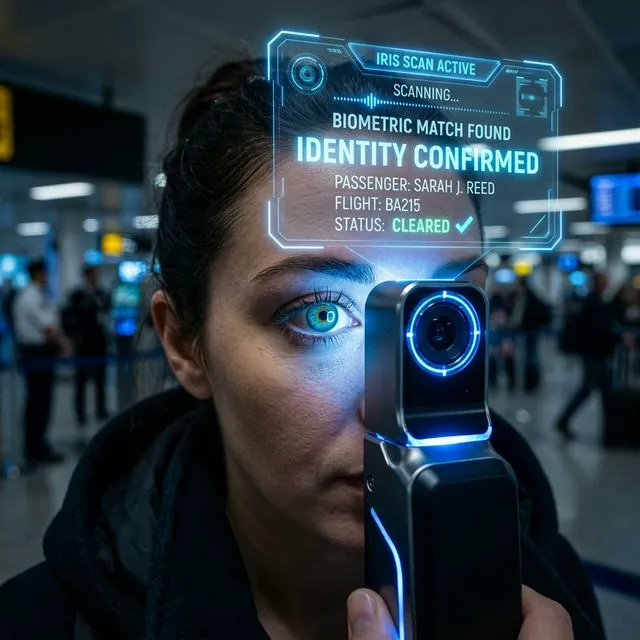
- Look at a camera for iris + facial recognition
- In 3-8 seconds, the system confirms identity
- The passenger is directed to the X-ray area, skipping the entire document verification line
Total process time, from entering the CLEAR lane to the other side of X-ray: average 4 minutes 30 seconds. Compared to the 87-minute regular line, that's a 95% difference.
The Technology Behind It
Biometric Precision
The CLEAR system uses three layers of biometric verification simultaneously:
Iris recognition: The human iris has 256 unique reference points (vs. 40 for fingerprints). The false positive rate is only 1 in 1.2 million. Unlike fingerprints, the iris doesn't change with cuts, dirt, or aging.
3D facial recognition: Cameras with depth sensors (LiDAR) create a three-dimensional map of the face, making the system immune to fraud attempts with photos or screen videos.
Fingerprints: Used as backup in case lighting or environmental conditions impair iris scanning.
Global Expansion
The CLEAR model is being replicated worldwide:
| Country/Region | System | Status (March 2026) |
|---|---|---|
| USA | CLEAR | 57 airports, 22 million members |
| European Union | EES (Entry/Exit System) | Deploying across all 27 countries |
| UAE | Smart Gates | 100% of airports |
| Singapore | FAST System | 100% of airports |
| Japan | Face Express | 7 international airports |
| Australia | SmartGate | 8 international airports |
| Brazil | Biometric boarding | GRU, GIG (partial) |
Privacy: The Great Debate
The expansion of airport biometrics generates legitimate privacy concerns. CLEAR stores mathematical templates of biometric data (not actual images) with AES-256 encryption. However, critics note there is no independent audit of CLEAR's systems, the company has contracts with US intelligence agencies (ICE, CBP), and biometric templates cannot be "changed" like passwords if data is breached.
Illinois's BIPA law requires explicit consent for biometric collection — CLEAR has already paid $26 million in violation lawsuits. The EU's GDPR classifies biometric data as a "special category" requiring granular consent.
The Future: The Queue-Free Airport
Vision 2030
IATA published its "One ID Vision 2030" document in January 2026, envisioning entirely queue-free airports by the end of the decade:
- Check-in: Done automatically upon entering the airport (geolocation + biometrics)
- Baggage drop: Robots collect bags from home (already tested in Dubai)
- Security: Walk-through portals with integrated body X-ray and biometrics — no stopping
- Boarding: Aircraft doors verify identity automatically — no boarding pass
- Immigration: Pre-travel digital verification eliminates destination immigration queues
The projected investment: $84 billion globally between 2025 and 2030.
FAQ — Frequently Asked Questions
Does CLEAR replace TSA PreCheck?
No — they're complementary. CLEAR verifies identity (who you are). TSA PreCheck is a trust program that reduces security screening (what you carry). The ideal combination is both: CLEAR + PreCheck = ~2 minutes total.
Does facial recognition work with masks?
Since 2023, the latest systems recognize faces with masks, glasses, and even hats at 99.2% accuracy.
How much does it cost and is it worth it?
$189/year in the US. For frequent travelers (8+ flights/year), the time and stress savings easily justify the cost. Family members can be added for $60/person.
Sources and References
- TSA. "March 2026 Passenger Volume and Wait Time Report." March 2026.
- Airlines for America (A4A). "Economic Impact of Airport Congestion Q1 2026." March 2026.
- CLEAR. "Annual Transparency Report: Biometric Data Practices." 2026.
- IATA. "One ID Vision 2030: The Seamless Airport Journey." January 2026.
- Business Insider. "Why Everyone Is Suddenly Signing Up for CLEAR." March 2026.


