Carnival Behind the Spotlight 🎬🔧
When the lights come on and the drumline begins to roll at the Marquês de Sapucaí, the audience sees the final result of 12 months of hard work. But what happens behind the scenes is just as fascinating as the spectacle that reaches the parade avenue.
Get ready to discover the numbers, secrets, and curiosities that make Carnival work.
💰 How Much Does a Samba School Parade Cost?
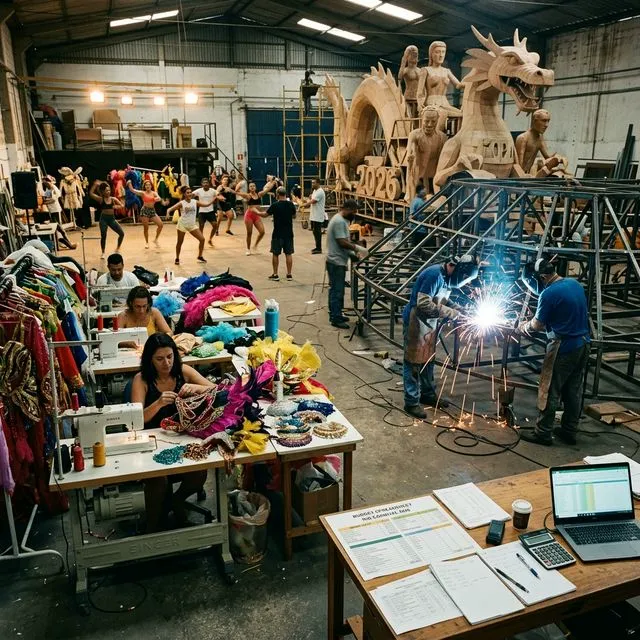
Carnival is the largest artistic production in the world — and it comes with a hefty price tag. Each school in the Special Group (Grupo Especial) invests between R$ 10 and R$ 30 million (approximately US$ 1.7 to 5.2 million) to put together their parade. But where does all that money go?
Budget breakdown for an average school
| Item | % of Budget | Estimated Value |
|---|---|---|
| Floats (allegorical cars) | 35-40% | R$ 4-12 million |
| Costumes | 25-30% | R$ 3-9 million |
| Workshop (barracão) | 10-15% | R$ 1.5-4 million |
| Theme song (recording, rehearsals) | 5-8% | R$ 500K-2.4 million |
| Logistics | 5-7% | R$ 500K-2 million |
| Marketing and communications | 3-5% | R$ 300K-1.5 million |
Where does the money come from?
- City government subsidy: R$ 3-4 million (equal for all Special Group schools)
- Sponsorships: Companies like Petrobras, Brahma, and banks (ranging from R$ 2 to R$ 15 million)
- Costume sales: Each participant pays between R$ 300 and R$ 2,000 for their costume
- VIP boxes and tickets: The school receives a portion of ticket revenue
- Events and parties: Shows and open rehearsals generate revenue throughout the year
Fun fact: The wealthiest schools (Beija-Flor, Portela, Mangueira) have budgets exceeding R$ 25 million. Smaller schools in the Access Group (second division) work with R$ 2-5 million.
👥 How Many People Make a Parade Happen?
| Role | Number |
|---|---|
| Performers on the avenue | 3,000-5,000 per school |
| Drummers (bateria) | 250-350 per school |
| Baianas (traditional dancers) | 100-150 per school |
| Front commission (comissão de frente) | 15-20 dancers |
| Workshop workers | 200-500 per school |
| Seamstresses | 100-300 per school |
| Security and support staff | 500-1,000 per school |
| Judging panel | 40 judges total |
In total, each night of parades mobilizes approximately 25,000-35,000 people among performers, technicians, and support staff — not counting the audience of 72,500 spectators at the Sambódromo.
⚖️ How Does the Judging Work?
The score tallying (apuração) is the moment of maximum tension during Carnival. Here's how it works:
The 9 Judging Criteria
- Bateria (Drumline): Cadence, rhythm, precision, and power
- Samba-enredo (Theme Song): Melody, lyrics, and adaptation to the theme
- Harmony: Synchronization between singing and drumline
- Evolution: Flow of the parade along the avenue
- Enredo (Theme/Plot): Clarity, coherence, and creativity of the story
- Mestre-sala and Porta-bandeira (Flag Bearer Couple): Technique, elegance, and synchronization
- Front Commission: Choreography and visual impact
- Floats and Props: Grandeur, finishing quality, and functionality
- Costumes: Creativity, luxury, and coherence with the theme
The scoring system
- Each criterion is evaluated by 4 judges (positioned at different points along the avenue)
- Scores range from 9.0 to 10.0 (in increments of 0.1)
- The highest and lowest scores for each criterion are discarded
- This means only 2 scores per criterion count (out of the 4 given)
- Maximum theoretical score: 270 points (9 criteria × 2 scores × 10.0 + bonuses in some years)
Why are the scores so high?
In Carnival 2026, the São Paulo champion scored 269.8 — nearly the maximum. This happens because the level of Special Group schools is extremely high. The difference between the champion and the last-place school is usually only 1-2 points out of 270 possible.
🏗️ The Barracão: Carnival's Factory
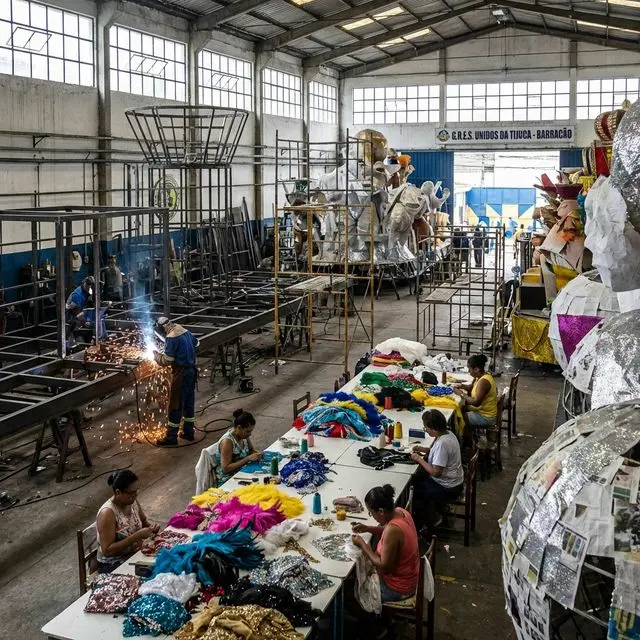
The barracão (workshop) is the hidden heart of Carnival — an industrial warehouse where the floats are built. The largest workshops are located at the Cidade do Samba (Samba City), inaugurated in 2005 in the Gamboa neighborhood of Rio de Janeiro.
Impressive numbers
- 14 workshops at Samba City (one for each Special Group school)
- Each warehouse covers 6,500 m² (70,000 sq ft) of floor space
- Construction begins in March (11 months before the parade)
- Peak work period: December to February (24-hour shifts)
- Up to 5,000 liters of paint per school
- Up to 300 kg of glue for props and decorations
- Each allegorical float can reach up to 15 meters tall (49 feet) and 8 meters wide (26 feet)
Unexpected professionals
The workshops employ welders, sculptors, painters, electricians, mechanical engineers, set designers, carpenters, metalworkers, and even aeronautical engineers (for structures that need to move safely during the parade).
📺 The Audience Numbers
Rio's Carnival is one of the most-watched events on Brazilian television:
| Year | Peak Audience (TV Globo) | Share |
|---|---|---|
| 2020 | 28 million | 70% |
| 2023 | 34 million | 68% |
| 2024 | 38 million | 72% |
| 2025 | 41 million | 71% |
| 2026 | ~43 million | ~74% |
On social media (Carnival 2026)
- TikTok: 4.2 billion combined views with the hashtag #Carnaval2026
- Instagram: 248 million related posts
- X (Twitter): 2.1 billion impressions
- YouTube: 1.8 billion views on parade videos
🎶 Curiosities You Didn't Know
The most famous samba-enredo (theme song) in history is "Aquarela Brasileira" (Silas de Oliveira, 1964, Império Serrano) — but it never actually won the Carnival competition
The tallest allegorical float ever built was 17 meters high (Beija-Flor, 2015) — nearly the height of a 5-story building
The most powerful drumline in Rio is considered to be Mangueira's — nicknamed "Surdo Um" (Bass Drum One), it has an unmistakable cadence
The most controversial judging criterion is Evolution — because it depends on external factors (traffic jams in the staging area, technical problems with the floats)
The oldest active samba school is Portela (founded in 1923), with 22 titles — the all-time record
The longest-serving drum queen is Viviane Araújo, who has paraded with Salgueiro for over 15 consecutive years
The cost of a featured costume (for a muse or the flag bearer couple) can reach R$ 200,000 (approximately US$ 35,000)
The Sapucaí is 700 meters long (2,300 feet) — schools must cover this distance in 65-80 minutes, without speeding up or slowing down
💰 The Economic Impact of Carnival
Carnival isn't just a party — it's one of Brazil's largest economic engines. The numbers are staggering:
| Metric | Value (2026) |
|---|---|
| Total economic activity | R$ 12.3 billion (CNC estimate) |
| Foreign tourists | ~1.8 million |
| Temporary jobs | ~350,000 across Brazil |
| Hotel revenue (Rio + SP) | R$ 2.1 billion |
| Bar and restaurant revenue | R$ 4.7 billion |
| Tax collection | R$ 1.5 billion |
Impact by city
- Rio de Janeiro: Accounts for ~35% of the total activity (R$ 4.3 billion), with 6.4 million revelers at street parties (blocos)
- São Paulo: The country's second-largest Carnival, with 17 million participants at street parties and R$ 3.1 billion in economic activity
- Salvador: The world's largest street Carnival, with 2.5 million revelers per day and R$ 2.7 billion in revenue
- Recife/Olinda: Home to Galo da Madrugada (the world's largest street party according to Guinness) + Frevo dance, a UNESCO Intangible Cultural Heritage. Generates R$ 1.8 billion
Carnival represents approximately 0.4% of Brazil's GDP concentrated in just one week — one of the largest contributions of a cultural event to any country's economy in the world.
🎨 The Carnavalesco: The Genius Behind the Spectacle
The carnavalesco is the artistic director of the parade — the person who conceives the theme, designs the costumes, projects the floats, and coordinates the entire visual narrative. Think of them as a film director, but with 5,000 "actors" and a 700-meter "set."
The Great Carnavalescos in History
| Carnavalesco | School(s) | Titles | Style |
|---|---|---|---|
| Joãosinho Trinta | Beija-Flor, Viradouro | 6 | Extreme luxury, controversy ("The people love luxury. It's intellectuals who love misery") |
| Rosa Magalhães | Imperatriz Leopoldinense | 5 | Deep historical research, meticulous detail |
| Paulo Barros | Unidos da Tijuca, Mocidade | 3 | Technological innovation, special effects, transforming floats |
| Leandro Vieira | Mangueira | 2 | Political and social themes, Afro-Brazilian aesthetics |
| Jorge Silveira | Portela, Salgueiro | 4 | Tradition with modernity, vibrant colors |
The carnavalesco begins working on the theme immediately after the previous Carnival — meaning they have 12 months to create from scratch a spectacle that will be judged in 80 minutes. The process includes:
- Research (March-May): Deep study of the theme, museum visits, interviews with experts
- Conception (June-August): Costume design, float blueprints, color palette definition
- Production (September-January): Construction in the workshop, costume sewing, rehearsals
- Final adjustments (February): Last touches, technical rehearsal at the Sapucaí, day-of logistics
A Carnavalesco's Salary
A carnavalesco for a Special Group school earns between R$ 300,000 and R$ 1.5 million per Carnival — depending on the school and their prestige. The most sought-after ones negotiate profit-sharing from sponsorships and merchandising. But the work is brutal: 16-18 hour days in the final months, extreme pressure, and the certainty that a single mistake can cost the title.
🥁 The Bateria: The Pulsing Heart of Samba
The bateria (drumline) is considered the most important element of the parade — without it, there is no samba. A Special Group school's drumline is a percussive orchestra with 250 to 350 drummers playing simultaneously.
The Instruments of the Bateria
| Instrument | Function | Typical Quantity |
|---|---|---|
| Surdo de primeira (First bass drum) | Marks the strong beat (deep bass) | 20-30 |
| Surdo de segunda (Second bass drum) | Responds to the first (mid-range) | 20-30 |
| Surdo de terceira (Third bass drum) | Makes the "cut" (higher pitch) | 15-25 |
| Caixa de guerra (Snare drum) | Continuous rhythmic base | 40-60 |
| Repinique (Repique drum) | Calls and conventions | 20-30 |
| Tamborim (Small frame drum) | Percussive melody (the "telecoteco" pattern) | 50-80 |
| Chocalho (Shaker/Platinela) | Sound filling | 30-50 |
| Agogô (Double bell) | Rhythmic accentuation | 10-20 |
| Cuíca (Friction drum) | Characteristic sound (the "moaning" tone) | 10-20 |
| Pandeiro (Tambourine) | Rhythmic complement | 10-20 |
The Drum Master
The mestre de bateria (drum master) is one of the most respected professionals in Carnival. He commands hundreds of drummers using whistles and hand gestures — like a symphony orchestra conductor, but in the middle of a packed avenue with 72,500 people screaming. The most famous drum masters (such as Mestre Odilon from Mangueira and Mestre Ciça from Salgueiro) are living legends of samba.
The drumline rehearses 3 to 4 times per week throughout the entire year. In the last two months before Carnival, rehearsals are daily. The synchronization must be perfect — a single drummer off-beat can cost precious tenths of a point in the scoring.
🌍 Carnival Around the World: How Brazil Inspires the Planet
Brazilian Carnival is a worldwide reference, but other countries have their own traditions:
| Country/City | Style | Difference from Brazil |
|---|---|---|
| Trinidad and Tobago | Soca and Calypso | Focus on live music and band competitions |
| Venice (Italy) | Masks and balls | Aristocratic elegance, no street parades |
| New Orleans (USA) | Mardi Gras | Floats throw bead necklaces to the crowd |
| Barranquilla (Colombia) | Cumbia and Mapalé | UNESCO Heritage, indigenous-African-European blend |
| Tenerife (Spain) | Murgas and Comparsas | Self-proclaimed second-largest in the world after Rio |
| Notting Hill (London) | Caribbean | Europe's largest street festival, Jamaican influence |
What makes Brazilian Carnival unique is the industrial scale of its production. No other country builds 15-meter-tall floats, dresses 5,000 people in coordinated costumes, and judges the result with decimal-point scores. It's art, engineering, logistics, and passion — all at the same time.
🎭 The Front Commission: From Choreography to Theatrical Spectacle
The front commission (comissão de frente) is the school's calling card — the first to enter the avenue. What was once a group of gentlemen in suits and ties has transformed, over the past decades, into the most innovative element of Carnival.
The Evolution of the Front Commission
| Decade | Style | Notable Example |
|---|---|---|
| 1980s | Elegant gentlemen in suits | Formal tradition |
| 1990s | First choreographies | Theater influence |
| 2000s | Contemporary dance | Fusion of styles |
| 2010s | Full theatrical spectacle | Acrobatics, transforming props |
| 2020s | Total artistic performance | Technology, projections, special effects |
Choreographer Marcelo Misailidis revolutionized this element by bringing in circus arts, contemporary dance, and physical theater. His front commissions for Vila Isabel and Paraíso do Tuiuti are considered works of performance art.
Each commission has between 15 and 20 dancers who rehearse for 6 months, 4 times per week. The costumes can weigh up to 15 kg (33 lbs) and include transformation mechanisms — a costume that opens to reveal another underneath, wings that expand, structures that change shape. All of this while performing complex choreography across 700 meters of avenue.
📱 Carnival in the Digital Era
Carnival 2026 is the most connected in history. Technology has changed how the spectacle is produced, broadcast, and consumed:
- Drones: Used for aerial footage by TV Globo, replacing helicopters and offering previously impossible camera angles
- LED panels on floats: Allegorical cars with integrated LED panels that change color and display animations synchronized with the samba
- 4K broadcast: For the first time, the parade is broadcast in 4K HDR on Globoplay, with cameras positioned inside the floats
- Popular voting: Apps allow the audience to vote for the "best moment" of each parade, generating real-time engagement
- Augmented reality: Instagram and TikTok filters featuring virtual samba school costumes reached 800 million uses during Carnival 2026
Frequently Asked Questions
How much does a samba school parade cost?
Between R$ 10 and R$ 30 million (US$ 1.7-5.2 million) for Special Group schools, including floats, costumes, workshop operations, and logistics.
How many people participate in a parade?
Each school brings between 3,000 and 5,000 performers to the avenue, plus hundreds of workers behind the scenes.
How are Carnival judges selected?
The 40 judges are selected by LIESA (in Rio) or Liga-SP (in São Paulo) from professionals in fields such as music, dance, visual arts, and culture. Their identities are kept secret until the day of the parade.
Why are the scores so close?
Because the level of Special Group schools is extremely high. The maximum difference between 1st and 14th place rarely exceeds 2 points out of 270 possible.
Sources and References
- LIESA — Independent League of Samba Schools
- Cidade do Samba — Rio City Hall
- Carnavalesco.com.br
- IBGE — Economic Impact of Carnival
Last updated: February 17, 2026
About the Author
Hercules Gobbi is a cultural journalist and researcher of Brazilian Carnival's behind-the-scenes world, documenting curiosities and data about the world's greatest popular festival.