
The lithium era may be coming to an end. CATL (Contemporary Amperex Technology Co., Ltd.), the world's largest battery manufacturer, announced in March 2026 the start of large-scale commercial production of sodium-ion batteries — a technology that promises to be cheaper, safer, and infinitely more abundant than the lithium-ion batteries that have dominated the market for two decades.
If the promise holds true, we're witnessing an energy revolution comparable to the transition from coal to oil: a material that exists in virtually unlimited quantities in the Earth's crust and oceans, that can be extracted without devastating sensitive ecosystems, and that can democratize access to stored energy at unimaginable scales.
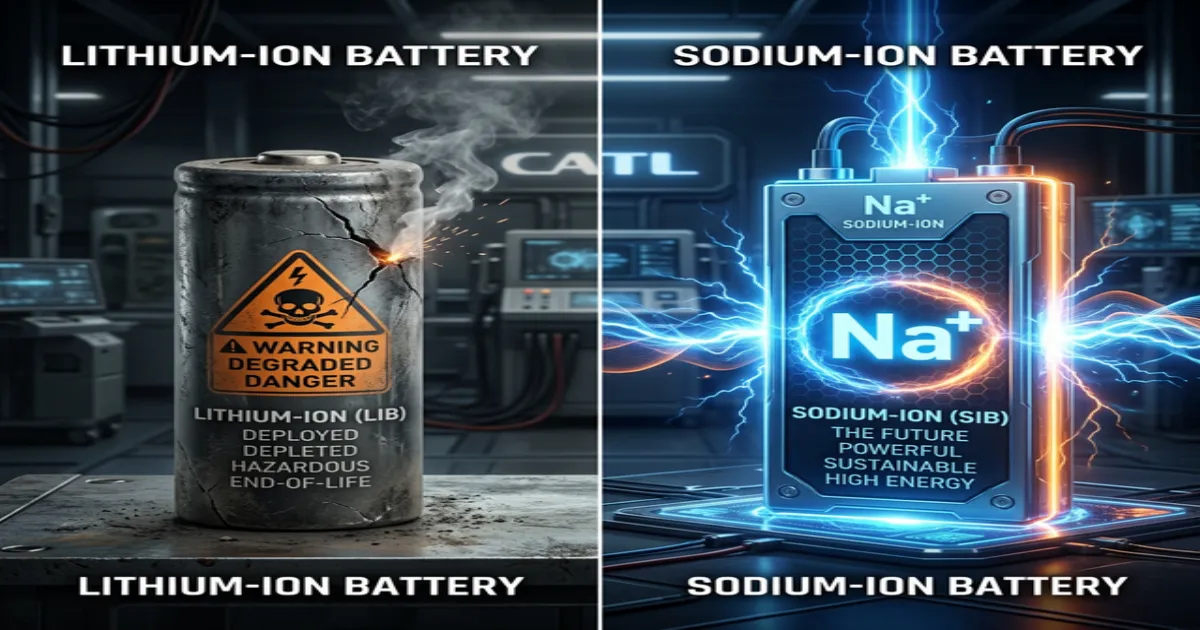
The Lithium Problem: Why We Need an Alternative
Scarcity and Geographic Concentration
Lithium is the "white petroleum" of the EV era, but with a fundamental problem: it's scarce and geographically concentrated. Approximately 53% of world reserves are in the "Lithium Triangle" — Chile, Argentina, and Bolivia. This creates a concerning geopolitical dependency.
Environmental Impact
Lithium extraction consumes massive amounts of water — about 500,000 gallons per ton extracted — in regions already facing water scarcity. In Chile's Atacama Desert, lithium mining consumed 65% of the region's water.
Rising Costs
With EV demand growing exponentially, lithium carbonate prices oscillated between $10,000 and $80,000 per ton over the last 5 years.
Sodium-Ion Batteries: How They Work
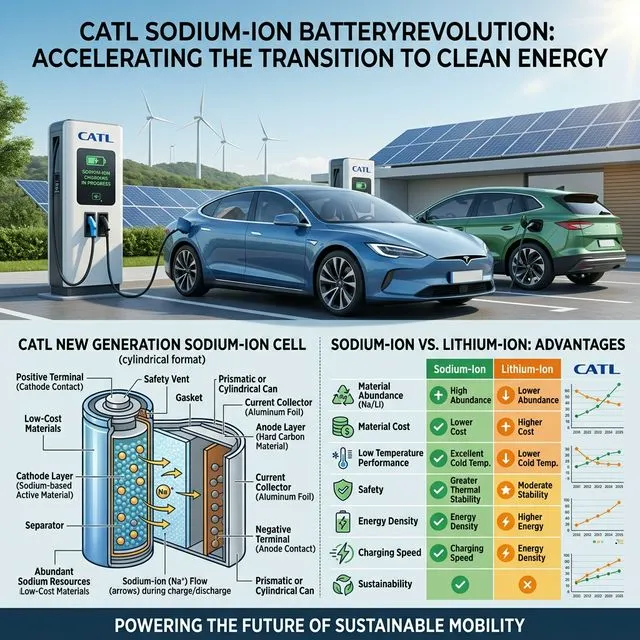
Sodium-ion batteries (SIB) work on the same principle as lithium-ion: ions move between anode and cathode during charge and discharge. The crucial difference: they use sodium (Na+) instead of lithium (Li+).
Sodium is the 6th most abundant element in Earth's crust and can be obtained from sea salt. While lithium costs $10,000-80,000/ton, sodium carbonate costs less than $200/ton — up to a 400x reduction.
Technical Comparison: Sodium vs. Lithium
| Feature | Lithium-Ion | Sodium-Ion |
|---|---|---|
| Energy density | 250-300 Wh/kg | 160-200 Wh/kg |
| Raw material cost | $10,000-80,000/ton | ~$200/ton |
| Life cycles | 1,000-3,000 | 3,000-10,000 |
| Fire safety | Moderate risk | Very low |
| Operating temp | -20°C to 60°C | -40°C to 80°C |
| Abundance | 0.002% Earth's crust | 2.3% Earth's crust |
| Charge speed | 30-60 min (0-80%) | 15-30 min (0-80%) |
CATL's Announcement: Commercial Production Plans
In March 2026, CATL officially announced:
- First dedicated factory for sodium-ion batteries with 40 GWh/year capacity in Fujian, China.
- Vehicle integration: partnership with Chery, BYD, and SAIC for Na-ion models from Q4 2026.
- Stationary storage: grid storage contracts in Chinese provinces.
- Global target: 100 GWh/year by 2028, with factories in Hungary and Morocco.
EVs with sodium-ion batteries will cost 20-30% less than lithium equivalents.
Geopolitical Impact: Winners and Losers
Winners:
- China: consolidates battery chain dominance without lithium dependency.
- Countries with salt/sodium access: virtually everyone — sodium is ubiquitous.
- Global consumers: cheaper, more accessible energy.
Losers:
- Chile, Argentina, Bolivia: massive lithium mining investments may lose returns.
- Australia: main lithium exporter faces devaluation risk.
- Lithium-ion manufacturers: companies that bet exclusively on lithium.
Conclusion: The Salt of the Earth Could Save the Planet
Sodium-ion batteries won't replace lithium overnight. But for affordable cars, grid storage, e-bikes, and billions of devices in the developing world, sodium represents something revolutionary: abundant, cheap, and safe energy, made from salt.
If CATL meets its targets, by 2030 we may look back at March 2026 as the month the lithium economy began losing relevance — replaced by something that literally exists in every ocean on the planet.
Sources and References
- Bloomberg — CATL Sodium-Ion Commercial Production
- Nature Energy — Sodium-Ion Battery Review 2026
- Reuters — CATL Factory Inauguration
- IEA — Battery Technology Outlook 2026
Last updated: March 11, 2026


