
Quantum Batteries: The Technology That Defies Physics and Could Change the World
Imagine a battery that charges faster the bigger it gets. That is charged wirelessly, by a laser. That retains stored energy for hundreds of times longer than its own charging time. And that works based on quantum mechanics principles that seem to violate everything we know about conventional batteries. Sounds like science fiction? Well, Australian scientists from CSIRO (Commonwealth Scientific and Industrial Research Organisation) just proved it works. In March 2026, the team published the results of the first functional proof-of-concept of a quantum battery — and the numbers are impressive enough to make physicists and energy engineers take notice.
What Is a Quantum Battery?
The Basic Concept
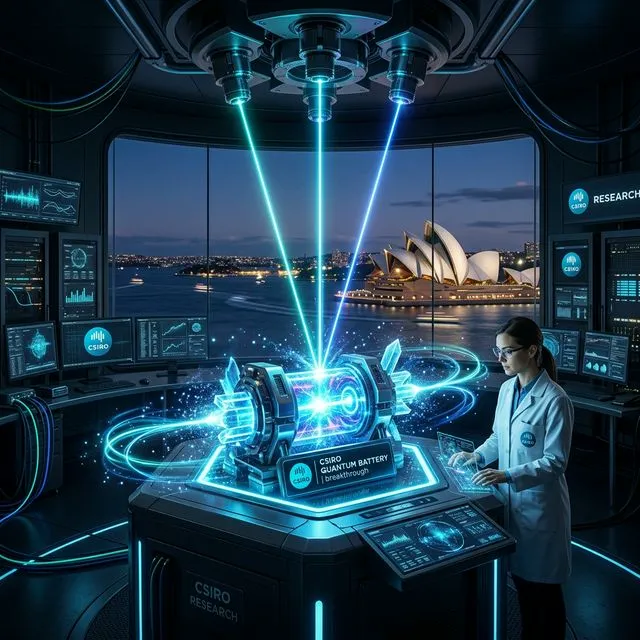
A quantum battery is an energy storage device that exploits quantum mechanics phenomena — like superposition and entanglement — to store and release energy in ways impossible for classical batteries.
The fundamental difference:
| Aspect | Classical Battery (Li-ion) | Quantum Battery |
|---|---|---|
| Principle | Electrochemical reaction | Quantum states of matter |
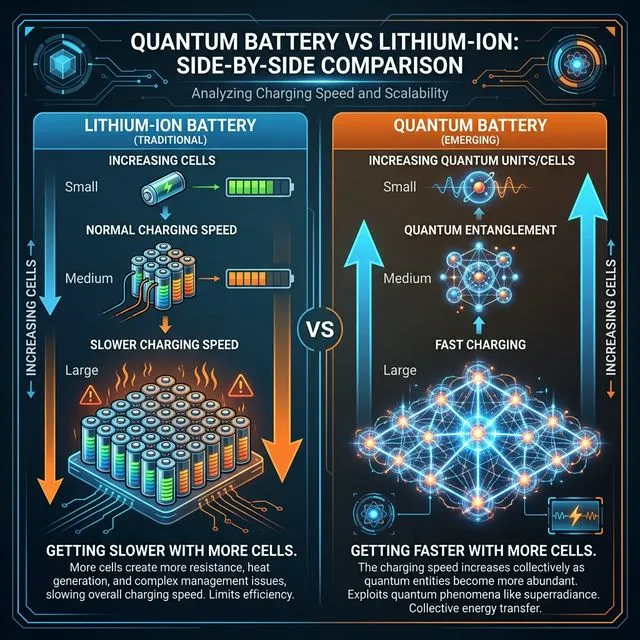
| Charging | Linear (more units = more time) | Superlinear (more units = LESS time per unit) |
| Retention | Gradual degradation | Stable retention via protected quantum states |
| Charging method | Electrical (cable) | Optical (laser) or electromagnetic |
| Scale | Macro (grams to kilos) | Micro/Nano (microcavities) |
The most counterintuitive — and most revolutionary — property is superlinear charging: in a classical battery, if you need to charge 100 units, it takes 100x the time of one unit. In a quantum battery, thanks to quantum entanglement between units, 100 units can be charged simultaneously, and the total time can be less than for a single unit.
The Analogy
Think of a class of 30 students copying text from the board:
- Classical battery: Each student copies individually. 30 students × 5 minutes = 150 minutes total work.
- Quantum battery: Thanks to "entanglement," all students are quantumly connected. When one learns, all learn simultaneously. 30 students × 0 additional minutes = 5 minutes total. And the more students, the faster it gets.
The CSIRO Breakthrough: What They Did
The Device
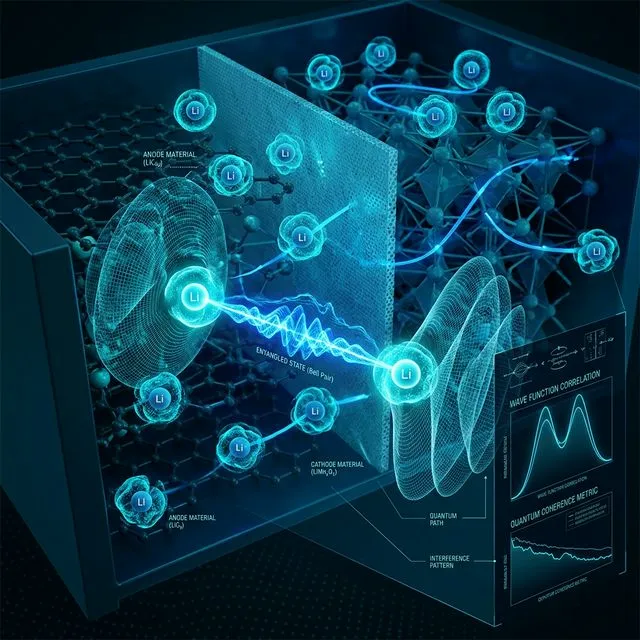
The CSIRO team, led by Dr. James Q. Quach, built the first functional quantum battery prototype using:
- Multilayer organic microcavity: A sandwich structure of organic semiconductor materials. The organic molecules serve as individual "cells" of the quantum battery
- Bragg mirrors: Layers that reflect light internally, creating an optical cavity that amplifies quantum interactions
- Laser for charging: Energy is injected by a laser pulse — wireless, contactless
The Results
| Metric | Result | Significance |
|---|---|---|
| Charging | Completed in ~270 femtoseconds (270 × 10⁻¹⁵ seconds) | Nearly instantaneous |
| Retention | Energy retained for hundreds of picoseconds | ~500x longer than charge time |
| Scaling | Charge time reduced with more layers | Confirmed "quantum advantage" |
| Efficiency | ~65% storage efficiency | Comparable to early classical batteries |
The crucial point: CSIRO demonstrated that adding more layers to the microcavity (i.e., making the battery "bigger") made charging faster per unit — exactly what theory predicted. This is the opposite of what happens with any conventional battery.
Why This Is Revolutionary
In lithium-ion batteries — the technology powering your phone, laptop, and electric cars — each cell needs to be charged separately. If you double battery capacity, you double charge time. It's a linear and inescapable relationship.
The quantum battery breaks that relationship. And that has enormous implications.
The Global Race: Who Else Is Doing This
CSIRO isn't alone in the race. At least three approaches compete globally:
1. Australian Approach (CSIRO)
- Method: Organic microcavity + laser
- Advantage: First functional proof-of-concept
- Challenge: Scalability to practical sizes
- Status: Lab-scale prototype, peer-reviewed publication
2. Chinese-Spanish Approach (Shanghai-Barcelona)
- Method: Superconductors + transmon qubits
- Advantage: Uses existing quantum computing technology
- Challenge: Requires temperatures near absolute zero (-273°C)
- Status: Simulations and experimental components
3. Italian Theoretical Approach (University of Pisa)
- Method: Quantum spin networks
- Advantage: Most advanced theoretical models for massive scaling
- Challenge: No physical prototype yet
- Status: Theoretical publications, no implementation
4. Japanese Approach (RIKEN + Tohoku University)
- Method: Diamonds with NV (nitrogen-vacancy) centers
- Advantage: Operates at room temperature
- Challenge: Very low storage capacity
- Status: Initial proof of concept
What This Means for the Future: 5 Scenarios
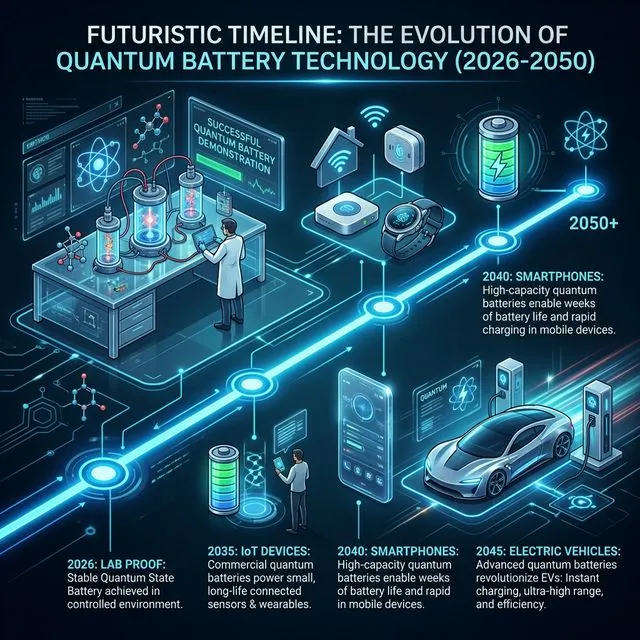
Scenario 1: Electric Cars That Charge in Seconds (2035-2045)
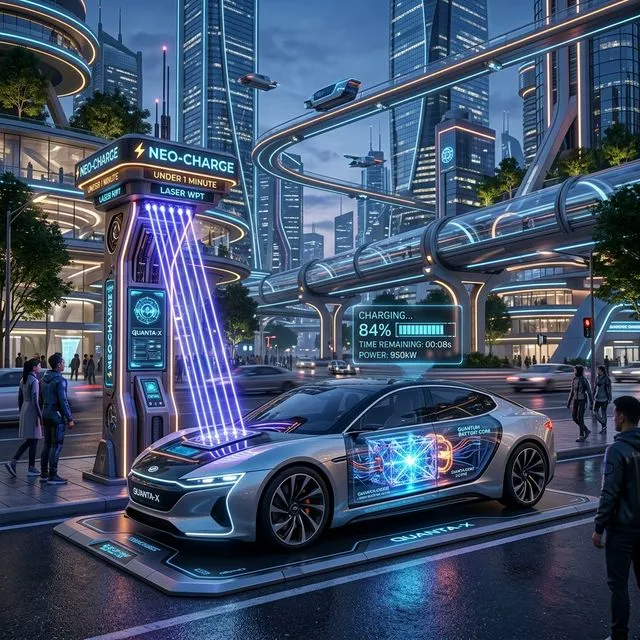
If quantum batteries can be scaled to kilowatt-hours (car battery size), recharging an electric vehicle could take seconds instead of hours. Imagine:
- Today (Li-ion): Tesla Model 3 charges 0 to 80% in ~30 minutes at Supercharger
- Future (quantum): Same car could charge 0 to 100% in less than 1 minute
- Implication: Completely eliminates "range anxiety" — the main barrier to EV adoption
Scenario 2: Grid-Scale Quantum Storage (2040-2050)
The biggest problem with renewable energy (solar and wind) is storage: the sun doesn't shine at night, wind doesn't always blow. Grid-scale quantum batteries could:
- Store excess solar energy during the day
- Release instantly during demand peaks
- Eliminate the need for backup thermal power plants
- Reduce electricity sector CO₂ emissions by up to 90%
Scenario 3: Personal Electronics with Infinite Charge (2030-2040)
Phones, laptops, and wearables with micro-scale quantum batteries could:
- Charge completely in fractions of a second
- Retain charge for weeks
- Be charged by low-power laser (built into street lights, ceilings, desks)
Scenario 4: Satellites and Space (2035-2045)
Satellites and space probes with quantum batteries would have:
- Recharging via concentrated solar laser
- Long-duration storage without degradation
- Dramatic weight reduction (conventional batteries represent 30-40% of satellite weight)
Scenario 5: Medicine and Implants (2040+)
Medical implants (pacemakers, neurostimulators, insulin pumps) could:
- Be recharged externally by low-power laser near the body
- Last decades without surgical replacement
- Be miniaturized to scales impossible with classical batteries
The Obstacles: Why It Won't Happen Tomorrow
1. Scale
CSIRO's prototype operates in femtoseconds and picoseconds — subatomic timescales. Transitioning to practical scales (milliseconds, seconds, minutes) requires fundamental advances in:
- Maintaining quantum coherence at larger scales
- Protection against environmental decoherence (heat, vibration, electromagnetic fields)
- Manufacturing microcavities with billions of layers
2. Temperature
Most approaches (except the Japanese diamond NV approach) require extremely low temperatures. Operating at room temperature is the Holy Grail of quantum technology — and hasn't been achieved for practical-scale batteries.
3. Cost
Today, a single qubit (in quantum computing) costs between $10,000 and $1 million in infrastructure. A practical quantum battery would need millions of "energy qubits" at a cost competitive with lithium batteries ($130/kWh). The path is long.
4. Integration
Quantum batteries would need an entirely new ecosystem:
- Laser charging stations
- Miniaturized quantum controllers
- Safety protocols for high-power lasers
- Specific regulations
Realistic Timeline
| Milestone | Forecast |
|---|---|
| First milliwatt-scale prototype | 2028-2030 |
| First practical application (micro-satellite) | 2032-2035 |
| First commercial device (IoT sensor) | 2035-2038 |
| Phone with quantum battery | 2040-2045 |
| Electric car with quantum battery | 2045-2050+ |
Comparison: Quantum Batteries vs. Other Emerging Technologies
| Technology | Advantage | Maturity (TRL) | Timeline |
|---|---|---|---|
| Advanced Li-ion | Incremental but reliable | TRL 9 (commercial) | Now |
| Sodium-ion (CATL) | Cheap, lithium-free | TRL 8-9 | 2026-2027 |
| Solid state | Safer, denser | TRL 6-7 | 2027-2030 |
| Flow battery | Grid scale | TRL 7-8 | 2026-2028 |
| Green hydrogen | Seasonal storage | TRL 6-7 | 2028-2035 |
| Quantum battery | Instant charge, reversed scaling | TRL 2-3 | 2035-2050 |
The quantum battery is at the earliest stages (TRL 2-3 = laboratory proof of concept). But the conceptual leap it represents is comparable to the leap from transistor to integrated circuit in the 1960s.
The Investment Landscape
Who's Funding It?
The race for quantum batteries is attracting significant investment — though still modest compared to lithium batteries:
| Investor/Program | Amount | Focus |
|---|---|---|
| Australian Government (via CSIRO) | $45 million AUD | Scalable prototype |
| DARPA (USA) | ~$30 million USD | Military/space applications |
| Horizon Europe (EU) | €20 million | Fundamental research |
| National Natural Science Foundation (China) | ¥150 million (~$21M USD) | Quantum superconductors |
| Private startups (USA/Israel) | ~$50 million USD (total) | IP commercialization |
Trend: Investment in quantum batteries grew 300% between 2024 and 2026 — part of the broader "quantum boom" that includes quantum computing, sensing, and communications.
Startups to Watch
Although most research is academic, some startups are already working on commercializing the technology:
- Quantergy (Australia): CSIRO spinoff focused on quantum batteries for satellites
- QBat Technologies (Israel): Working on quantum microbatteries for IoT sensors
- QuVolt (USA): Focused on quantum storage for data centers — where fast charging is crucial
- Shanghai Quantum Energy (China): CATL subsidiary exploring integration with sodium-ion batteries
The Energy Crisis Context
In March 2026, with oil at $109/barrel and the Strait of Hormuz blocked, the urgency for energy alternatives has never been higher. Although the quantum battery won't solve the 2026 crisis, it's part of a broader landscape where the world desperately seeks ways to store energy more efficiently, more quickly, and more sustainably.
The irony is that geopolitical crises — war, embargo, blockade — are historically the greatest accelerators of energy innovation. The 1973 Arab embargo boosted nuclear energy in France. The 2008 oil crisis accelerated electric cars. The 2022 Ukraine war turbocharged renewables in Europe.
The 2026 crisis may be the catalyst that transforms the quantum battery from laboratory curiosity to global strategic priority.
The Philosophical Impact: Energy and Quantum Mechanics
The Frontier Between Energy and Information
One of the most fascinating aspects of the quantum battery is the relationship between energy and information in quantum mechanics. The fact that entanglement (an informational property) can accelerate charging (an energy process) suggests that energy and information are fundamentally the same thing — an idea dating back to Claude Shannon and John von Neumann's work in the 1940s-1950s, but now with experimental confirmation.
Philosophical implications:
- If energy = information, then data processing is physically equivalent to moving energy — which explains why computers generate heat
- Storing quantum energy may be equivalent to storing quantum information — batteries and quantum memories may be the same device
- The entire universe may be, fundamentally, an information processor — an idea proposed by physicist John Wheeler ("It from Bit") that quantum batteries help confirm
Frequently Asked Questions (FAQ)
Can quantum batteries explode like lithium ones?
Not in the classical sense. Quantum batteries store energy in quantum states, not chemical reactions. There's no flammable electrolyte. However, the high-power charging laser has its own safety risks.
When can I buy a quantum battery?
For personal devices (phone, laptop), the most optimistic estimate is 2040-2045. For industrial or space applications, possibly 2032-2035.
Do quantum batteries make lithium ones obsolete?
Long-term, potentially yes. But for the next two decades, lithium, sodium-ion, and solid-state batteries will continue dominating. The transition will be gradual, just like the transition from combustion engines to electric.
Does Brazil research quantum batteries?
Brazil has quantum computing research groups (USP, Unicamp, CBPF), but there are no specific quantum battery programs at significant scale yet. The country could position itself as a material supplier (niobium, rare earths) for the quantum industry.
What's the relationship between quantum batteries and quantum computers?
Both use quantum mechanics principles but for different purposes. Quantum computers use qubits for information processing. Quantum batteries use quantum states for energy storage. The fabrication technology has significant overlap.
Conclusion: The Future Charges Differently
The CSIRO quantum battery is, today, a laboratory curiosity. A device operating at timescales no human can perceive, storing energy no current device can use. But the history of technology teaches us that this is exactly how revolutions begin.
The 1947 transistor was smaller than a coin and barely worked. In 2026, there are 50 billion transistors in a single phone chip. The 2026 quantum battery may be the seed of an equivalent energy revolution.
In a world struggling with the oil crisis, the Strait of Hormuz blockade, and the urgency of energy transition, the promise of a battery that charges instantly and improves as it scales isn't just interesting — it's potentially civilizational.
One day, perhaps, charging your phone via laser in 0.3 seconds will be as mundane as plugging in a USB cable is today. And on that day, we'll look back and say: "It all started with some crazies in Australia and a laboratory laser."
Sources and References
- CSIRO — World's First Proof-of-Concept Quantum Battery (2026)
- Nature Energy — Quantum Battery Superlinear Charging (2026)
- Battery Technology Online — Global Quantum Battery Race
- Physical Review Letters — Organic Microcavity Quantum Storage
- Shanghai Jiao Tong University — Superconducting Quantum Battery
- RIKEN — Diamond NV Center Energy Storage


