
Solid-State Batteries: The Energy Revolution That Is Finally Arriving — And Will Change Absolutely Everything
Date: March 8, 2026
Reading time: 25 minutes
Emoji: 🔋
Imagine charging your electric car in just 10 minutes and driving 1,000 kilometers without stopping. Imagine a smartphone that lasts an entire week on a single charge, or an electrical grid capable of storing solar and wind energy with near-perfect efficiency, definitively eliminating dependence on fossil fuels. None of this is science fiction anymore — it is the concrete promise of solid-state batteries, a revolutionary technology that in March 2026 is finally making the transition from research laboratories to industrial production lines. After decades of promises, prototypes, and frustrations, companies like Toyota, CATL, Samsung SDI, and QuantumScape are announcing the beginning of mass commercial production of solid-state batteries, inaugurating a new era in the history of energy that promises to be as transformative as the petroleum revolution of the 20th century.
What Are Solid-State Batteries and Why Are They Revolutionary?
The Fundamental Difference: Liquid vs. Solid
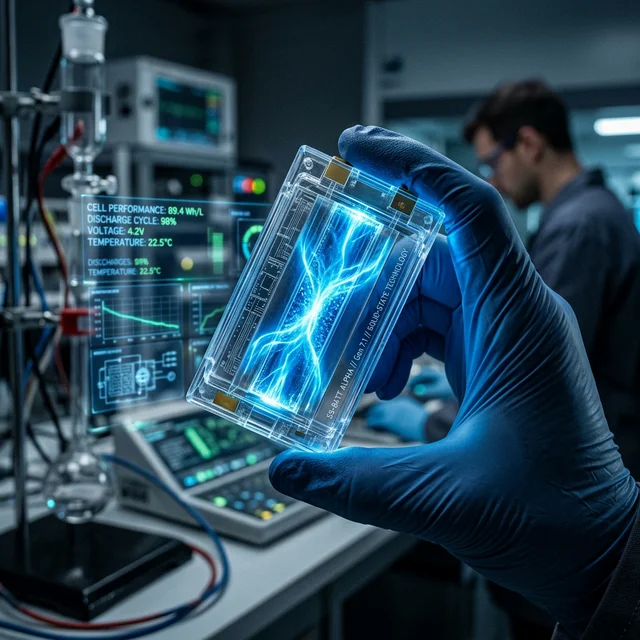
To understand why solid-state batteries represent such a fundamental shift in energy storage technology, it is first necessary to understand how current batteries work — and why they have such frustrating limitations that prevent the complete advance of global electrification. The battery industry has spent more than three decades refining lithium-ion technology, squeezing incremental improvements year after year, but the fundamental chemistry has reached its theoretical ceiling. What the world needs now is not another incremental refinement — it is a completely new paradigm.
Conventional lithium-ion batteries — the same ones that power your smartphone, laptop, and the vast majority of current electric cars — work through the movement of lithium ions between two electrodes (anode and cathode) through a liquid electrolyte. This liquid electrolyte is the critical component that enables ionic conduction, but it is also the technology's Achilles' heel: it is highly flammable, limits the energy density the battery can safely store, degrades over time reducing battery lifespan, and restricts charging speed to prevent overheating and the dreaded "thermal runaway" phenomenon — an uncontrolled chain reaction that can lead to catastrophic fires and explosions. This fundamental limitation has been responsible for numerous high-profile battery fires in electric vehicles, smartphones, and even commercial aircraft, costing billions in recalls and eroding consumer confidence.
Solid-state batteries completely eliminate the liquid electrolyte and replace it with a solid electrolyte — typically a ceramic, glass, or polymeric material — that performs the same ionic conduction function but without any of the risks associated with flammable liquids. This seemingly simple change — from liquid to solid — is actually a profound technological revolution that unlocks a cascade of extraordinary improvements in virtually every performance aspect.
The Game-Changing Advantages
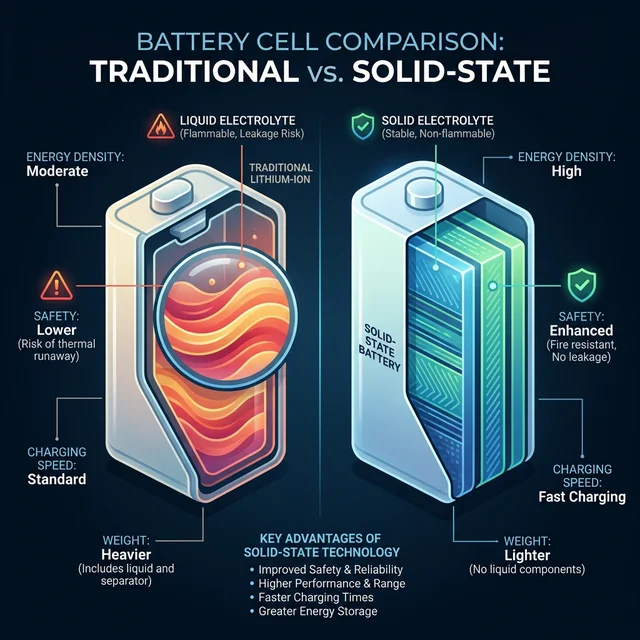
The advantages of solid-state batteries over conventional lithium-ion batteries are so significant that they represent a generational leap in energy storage technology:
| Feature | Conventional Li-ion Battery | Solid-State Battery | Improvement |
|---|---|---|---|
| Energy density | 250-300 Wh/kg | 500-700 Wh/kg | +100-130% |
| Charging time (0-80%) | 30-60 minutes | 8-15 minutes | 4x faster |
| Lifespan (cycles) | 1,000-2,000 | 5,000-10,000 | 5x more durable |
| Fire risk | High (flammable electrolyte) | Virtually zero | Eliminated |
| Temperature range | -10°C to 45°C | -30°C to 80°C | Much wider |
| Weight (same capacity) | Reference | 30-40% lighter | Significantly lower |
| Annual degradation | 5-8% | 1-2% | 4x slower |
These improvements are not incremental — they are transformative. A solid-state battery with 500 Wh/kg density means an electric car that today travels 400 km on a charge will travel 800-1,000 km. Charging in 10 minutes completely eliminates the "range anxiety" that is the main psychological barrier to electric car adoption. And a lifespan of 10,000 cycles means the battery will outlast the car itself — potentially 20-30 years of intensive use.
The Technology Race: Who Is Leading?
Toyota: Decades of Investment Finally Reach the Market
Toyota, the world's largest automaker, has been quietly investing in solid-state batteries since 2008 and holds more than 1,300 patents in the field — significantly more than any other company on the planet. The company has dedicated an entire research division with over 500 engineers exclusively focused on solid-state technology, spending an estimated $13 billion over the past 18 years on this single initiative. In February 2026, the Japanese automaker announced it will begin series production of its first vehicle equipped with a solid-state battery in the second half of 2026, with the planned launch of the Toyota bZ5X — a premium electric SUV promising 1,200 km of range on a single charge and a 0-to-80% charging time of just 10 minutes.
Toyota's strategy has always been fundamentally different from most manufacturers, and it was widely criticized for years by industry analysts who viewed it as dangerously conservative. While rivals like Tesla, BYD, and Volkswagen bet on existing lithium-ion batteries and optimized them incrementally, Toyota deliberately delayed its aggressive transition to pure electric vehicles, wagering that solid-state technology would be the true game-changer that would make electric cars indisputably superior to combustion vehicles in every aspect — range, charging time, operating cost, and safety. That gamble now appears to be paying off spectacularly.
CATL: The Chinese Giant That Dominates the World of Batteries
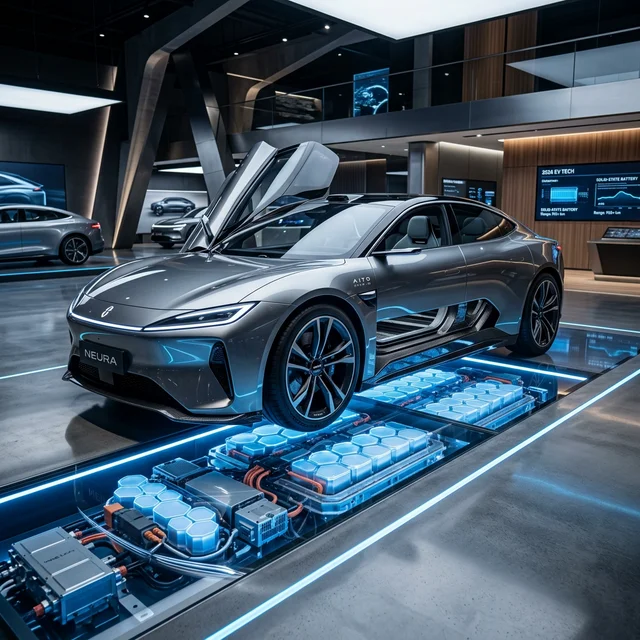
CATL (Contemporary Amperex Technology Co. Limited), the world's largest battery manufacturer based in Ningde, China, announced in January 2026 the development of its first commercial semi-solid battery — the "Condensed Battery 2.0" — with an energy density of 500 Wh/kg. The Chinese company, which already supplies batteries to Tesla, BMW, Mercedes-Benz, Volkswagen, and virtually all major automakers, declared it will begin mass production in the second half of 2026, with an initial capacity of 20 GWh per year — equivalent to batteries for approximately 400,000 electric vehicles.
In parallel, Chinese startup NIO announced it is already testing vehicle prototypes with semi-solid batteries achieving 620 miles (approximately 1,000 km) of range on a single charge, using internally developed cells with solid sulfide electrolyte. NIO plans to make these batteries available in its quick-swap system ("battery swap") by the end of 2026, allowing drivers to exchange a depleted battery for a fully charged one in less than 5 minutes.
Samsung SDI and the South Korean Race
Samsung SDI, the battery arm of the Samsung conglomerate, is developing solid-state cells with a pure lithium metal anode — considered the most advanced configuration with the highest energy density potential. In laboratory tests, Samsung SDI cells demonstrated energy densities of 900 Wh/L (volumetric) and a lifespan exceeding 20 years with less than 3% degradation. Samsung's goal is to begin pilot production in 2027, with mass production starting in 2028, initially focusing on premium electric vehicles for partners like BMW and Audi.
LG Energy Solution, another South Korean giant, follows a different strategy, developing solid-state batteries with polymeric electrolyte that can be produced on existing lithium-ion battery manufacturing equipment — drastically reducing the investment needed for the transition.
QuantumScape: The Startup That Overcame Skepticism
QuantumScape, an American startup founded by former Stanford University researchers and financially backed by Volkswagen (which invested more than $1 billion in the company), released in March 2026 results from large-scale tests of its solid-state cells with lithium oxide ceramic electrolyte. The results were impressive: cells maintained more than 95% capacity after 1,000 fast-charge cycles (15 minutes from 10% to 80%), operate efficiently at temperatures from -30°C to +60°C, and demonstrated zero safety incidents in more than 100,000 combined hours of testing.
The Mass Production Challenge: Why Did It Take So Long?
The Valley of Death Between Laboratory and Factory
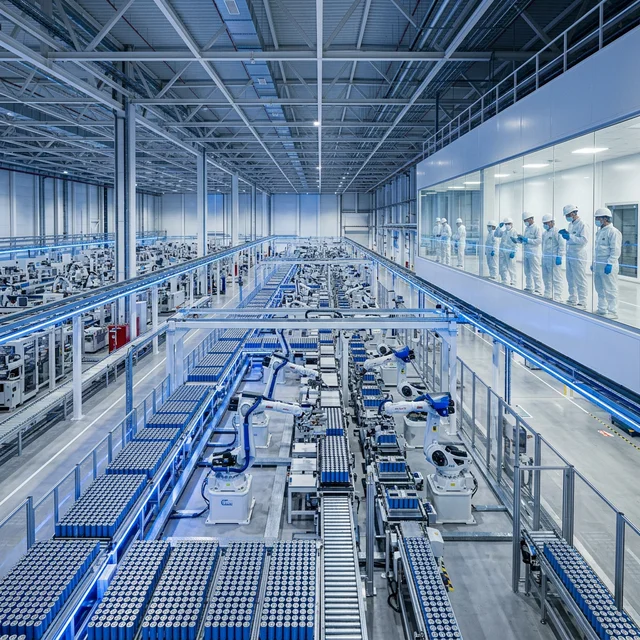
If solid-state batteries are so superior, why did they take so long to reach the market? The answer lies in what industry calls the manufacturing "valley of death" — the brutal gap between making something work in a controlled laboratory and producing millions of identical units in a factory at competitive cost and consistent quality.
The main challenges the industry needed to overcome include:
- Electrode-electrolyte interface: In solid-state batteries, contact between the electrode and solid electrolyte is remarkably harder to maintain than with a liquid that naturally fills all spaces. Micro-gaps at this interface can cause excessive resistance, accelerated degradation, and premature failures. Solving this problem required developing advanced surface engineering techniques and new interface materials that maintain intimate contact even after thousands of expansion and contraction cycles during charging and discharging
- Dendrite formation: Using pure lithium metal anodes (which maximizes energy density) carries the risk of dendrite formation — microscopic lithium filaments that grow through the electrolyte and can cause internal short circuits. This problem was the obstacle that prevented solid-state battery development for decades, until researchers discovered that ceramic electrolytes with specific crystalline structure can completely suppress dendrite formation
- Material costs: The ceramic and glass electrolytes used in solid-state batteries are significantly more expensive to produce than traditional liquid electrolytes. Materials like LLZO (Li₇La₃Zr₂O₁₂) require high-temperature processing and rigorous atmospheric control, substantially elevating manufacturing costs
- Production scale: Producing solid-state batteries at industrial scale requires completely new equipment and manufacturing processes that did not exist five years ago. Conventional lithium-ion battery production lines simply cannot be adapted — entirely new facilities must be built with investments of billions of dollars per factory
The Cost Curve: From Prohibitive to Competitive
In 2020, the estimated cost of a solid-state battery was approximately $800 per kWh — about 6 times more expensive than a conventional lithium-ion battery. By 2024, advances in manufacturing and materials science reduced this cost to approximately $250 per kWh. Bloomberg NEF and McKinsey projections indicate that with mass production starting in 2026-2027, costs will drop to $100-120 per kWh by 2028 — reaching parity with lithium-ion batteries — and will continue falling below $60 per kWh by 2032, making electric cars definitively cheaper than combustion cars in all market segments.
Impact Beyond Cars: A Complete Revolution
Renewable Energy: Solving the Storage Problem
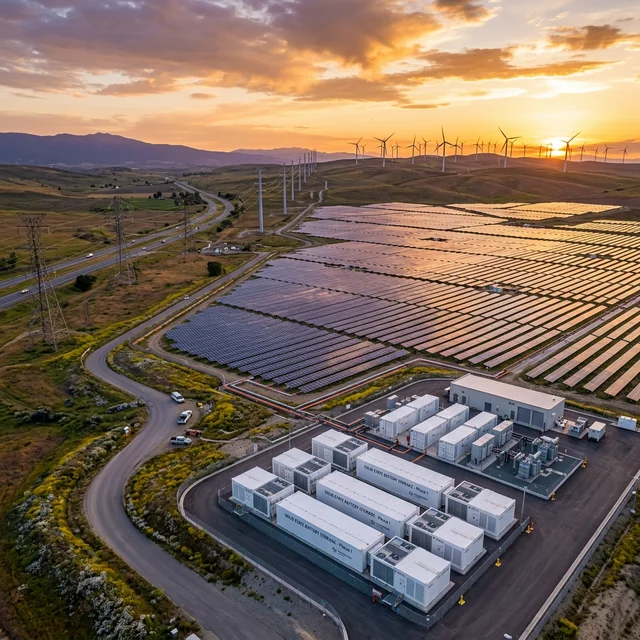
The biggest obstacle to mass adoption of solar and wind energy has always been storage: the sun doesn't shine at night and wind doesn't blow constantly. Current lithium-ion battery storage systems degrade too quickly and cost too much to provide reliable, long-duration energy storage at the scale that modern power grids require. Solid-state batteries with 20-30 year lifespans and minimal degradation fundamentally change this equation, making grid-scale energy storage economically viable for the first time in history, allowing entire cities to run on 100% renewable energy without needing natural gas or coal backup plants.
China is already building the world's largest solid-state battery energy storage facility in Qinghai province — a 1 GWh project capable of storing enough energy to supply 200,000 homes for 8 hours. The project uses CATL cells with a projected lifespan of 25 years and is considered the model for the next generation of global energy infrastructure. Similar projects are being planned in California, Australia, and Germany, indicating that the global energy storage market — currently valued at approximately $15 billion — is expected to exceed $120 billion by 2035.
Electric Aviation: From Dream to Reality
Solid-state batteries are also unlocking a sector that conventional lithium-ion batteries could never convincingly make viable: electric aviation. With energy densities of 500-700 Wh/kg (compared to aviation fuel at 12,000 Wh/kg, but with electric motors 3-4 times more efficient than turbines), solid-state batteries finally make short-distance regional flights practical — routes up to 500 km connecting medium-sized cities that represent more than 40% of all global commercial flights.
Companies like Lilium (Germany), Joby Aviation (USA), and Vertical Aerospace (UK) have already announced plans to integrate solid-state batteries into their eVTOL aircraft (electric vertical takeoff and landing) from 2028, promising urban air taxis and regional flights with zero carbon emissions and operating costs 70% lower than conventional helicopters.
Electronic Devices: The Next Generation
For the average consumer, the most immediately noticeable impact will come in personal electronic devices. Smartphones with solid-state batteries could offer 5-7 days of battery life with the same battery size, or maintain current 2-day life in a significantly thinner and lighter device. Laptops could run for 24-48 continuous hours without recharging. Wearables like smartwatches and earbuds could last weeks on a single charge.
Apple has already registered dozens of patents related to solid-state batteries for future iPhones, Apple Watches, and MacBooks, and industry analysts speculate the iPhone 19 (expected in 2027) could be the first high-volume commercial smartphone to use this technology, potentially offering a week of battery life with normal use.
The Geopolitical Impact: Who Controls the Batteries?
The New Gold Rush: Critical Materials
The transition to solid-state batteries is reconfiguring the global geopolitics of critical materials. Although solid-state batteries use less lithium per kWh than conventional ones, they introduce demand for new materials like lanthanum, zirconium, and germanium for ceramic electrolytes. China currently dominates more than 70% of global processing of rare earths and advanced ceramic materials, consolidating a strategic position that concerns the United States, Europe, and Japan.
In response, the US approved in 2025 the "Critical Battery Materials Act," investing $12 billion in domestic mining, battery recycling, and alternative material development. The European Union launched the "European Battery Alliance 2.0" with a goal of building 15 solid-state battery gigafactories by 2030, reducing dependence on the Asian supply chain.
The Decline of Oil: An Inevitable Transition
Solid-state batteries represent possibly the final blow to the fossil fuel era for ground transportation. When an electric car offers 1,000 km of range, 10-minute charging, 80% lower energy costs than gasoline, zero engine maintenance, and battery lifespan exceeding 20 years — the value proposition of an internal combustion vehicle becomes definitively unsustainable under any rational analysis.
The International Energy Agency (IEA) projects that with mass adoption of solid-state batteries, global oil demand for ground transportation will peak in 2028 and begin an accelerated decline, falling 40% by 2035. The implications for oil-producing countries like Saudi Arabia, Russia, Iran, Iraq, Venezuela, and Brazil are profound and potentially destabilizing — accelerating the need for economic diversification that many of these countries have not yet begun with the necessary urgency.
Conclusion: The Future Charges in 10 Minutes
Solid-state batteries represent one of those rare technological convergences where multiple seemingly unsolvable problems are solved simultaneously by a single fundamental innovation. Limited range, excessive charging time, fire risk, premature degradation, excessive weight, temperature limitations — all the obstacles that prevented complete electrification of transportation and global energy infrastructure are being eliminated by a seemingly simple change: replacing a liquid with a solid.
In 2026, we are living the exact moment when this technology makes the critical transition from laboratory to factory. The next 5-10 years will be absolutely transformative — comparable to the transition from horse to automobile at the beginning of the 20th century or the internet revolution of the 1990s. The companies, countries, and economies that master the solid-state battery value chain will define the global economic and energy order for the decades and generations to come. Those that fail to adapt risk being left behind permanently.
As Toyota CEO Koji Sato said when announcing the start of production: "Oil defined the 20th century. Solid-state batteries will define the 21st century. And this time, we're ready."
Sources and References
- Toyota — Solid-State Battery Development — Solid-state battery program
- CATL — Condensed Battery Technology — Condensed battery technology
- Bloomberg NEF — Battery Price Survey 2026 — Battery price survey
- Nature Energy — Solid-State Electrolytes — Solid-state electrolyte research
- IEA — Global EV Outlook 2026 — Global electric vehicle outlook
- QuantumScape — Technical Results — Technical test results


