
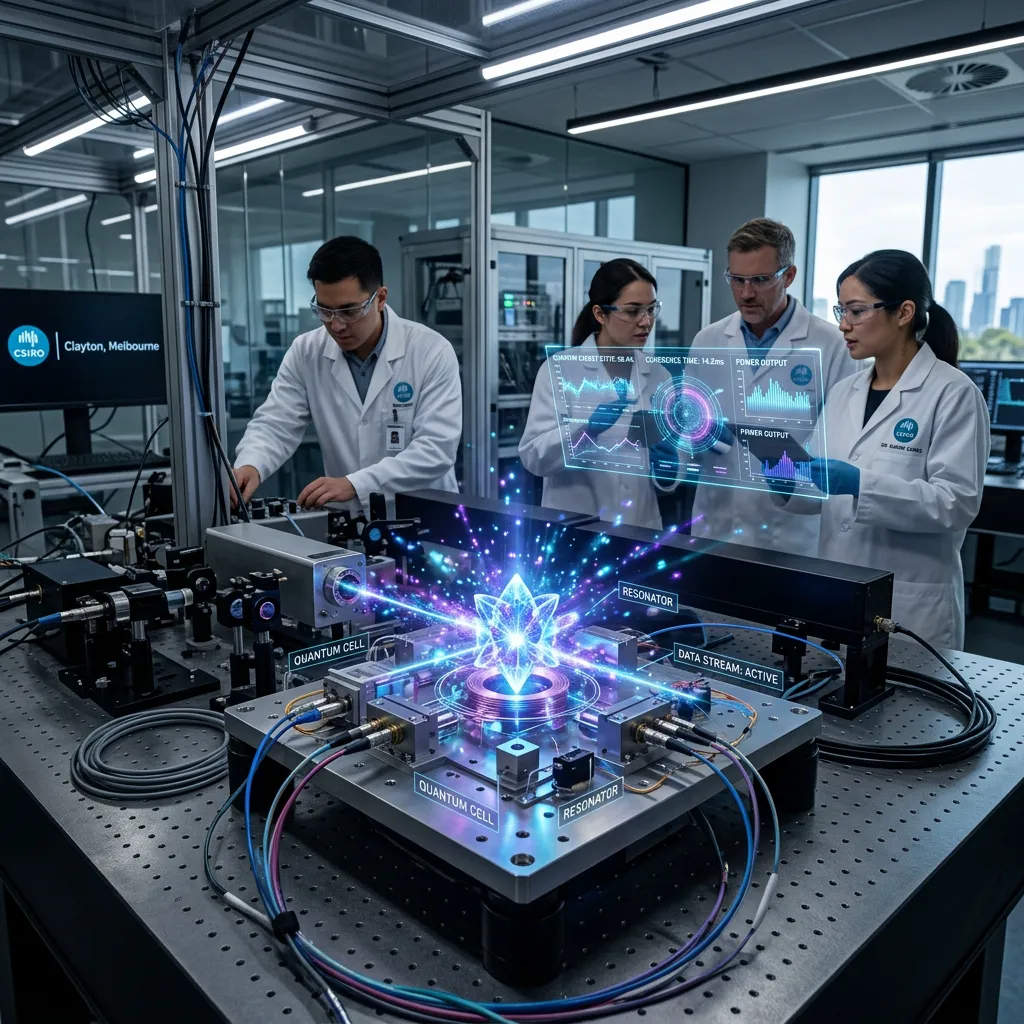
In a climate-controlled laboratory at CSIRO (Commonwealth Scientific and Industrial Research Organisation) in Melbourne, a team of 14 physicists has just accomplished something that, until a few months ago, existed only in theoretical physics equations and the most optimistic fantasies of energy engineering: building the world's first functional quantum battery — a device that not only stores and releases energy using principles of quantum mechanics, but possesses a property so counter-intuitive it seems to defy logic: the bigger the battery, the faster it charges.
Read that sentence again. In the world of conventional batteries — lithium-ion, sodium-ion, solid-state, or any other technology you know — the rule is simple and immutable: bigger batteries take longer to charge. A smartphone charges in 1 hour. A laptop in 2. An electric car in 30 minutes in the best-case scenario with a supercharger. An electric truck might take all night. Capacity increases; charging time follows suit.
The quantum battery completely inverts this equation. And that changes everything.
What Exactly Is a Quantum Battery
To understand why this breakthrough is so revolutionary, we first need to separate what a quantum battery is from what it is not. It is not a smaller or improved version of a lithium battery. It is not an incremental evolution of existing technology. It is a fundamentally different category of energy storage device that operates under the laws of quantum mechanics — the set of rules governing the behavior of subatomic particles like electrons, photons, and atoms.
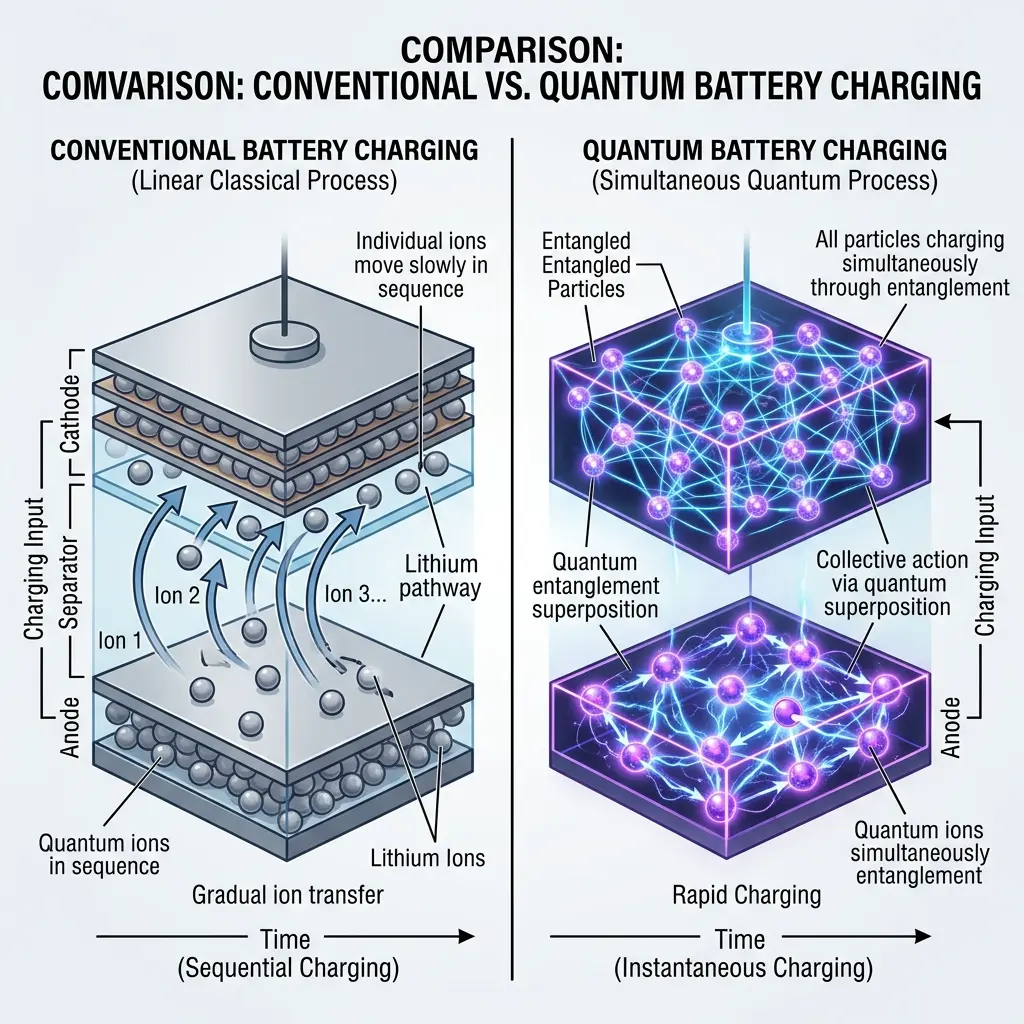
In a conventional battery, energy is stored through electrochemical reactions: lithium (or sodium, or zinc) ions move between two electrodes, creating a potential difference that can be used as electrical current. It's a fundamentally classical process — each ion moves independently, and charging time is proportional to the number of ions that need to be moved.
A quantum battery, on the other hand, stores energy in quantum states of particles. Instead of moving ions back and forth, it directly manipulates the energy levels of qubits (quantum bits) — which can exist in superposition of states simultaneously. This creates what physicists call super-extensive charging or global quantum advantage in the charging process.
Conventional batteries vs. quantum battery:
| Characteristic | Conventional Battery (Li-ion) | Quantum Battery |
|---|---|---|
| Mechanism | Electrochemical reaction | Quantum states of particles |
| Charging speed | Proportional to size | Inversely proportional to size |
| Operation | Classical (each ion independent) | Coherent (entangled particles) |
| Temperature | Ambient | Near absolute zero (current prototype) |
| Current scale | Commercial | Proof of concept |
| Theoretical efficiency | 85-95% | Up to 99.9% (theoretical) |
| Degradation | ~500-1000 cycles | No chemical degradation |
The key point is quantum entanglement — the phenomenon where two or more particles become correlated in such a way that the state of one instantaneously affects the state of the others, regardless of distance. When particles in a quantum battery are entangled, they can be charged collectively rather than individually. It's like the difference between filling a football stadium one seat at a time versus opening all gates simultaneously.
How CSIRO Did It: The Experiment That Changed Applied Physics
Professor James Quach, leader of the CSIRO research team and former researcher at the University of Adelaide, had been developing theoretical models of quantum batteries since 2018. But the barrier was always the same: maintaining quantum coherence — the state of superposition and entanglement — long enough for the battery to be useful. Under normal conditions, quantum coherence breaks down in fractions of a microsecond, a phenomenon called decoherence.
The solution came from a combination of three converging technical advances:
1. Ultra-high-quality optical microcavities
The team developed optical cavities with a quality factor of Q = 10^12 — an unprecedented value that allows trapping photons for periods thousands of times longer than was possible in 2024. These cavities function as "perfect mirror walls" that keep photons bouncing in coherence long enough for the charge and discharge process.
2. Bodipy organic molecules as active medium
Instead of using cold atoms or trapped ions (traditional approaches in quantum computing), the team used organic molecules from the Bodipy family — boron-based fluorescent compounds that exhibit exceptionally stable quantum properties at relatively high temperatures. These molecules absorb and emit photons on timescales compatible with usable charge-discharge cycles.
3. Collective absorption charging protocol
This is the most important conceptual leap. The team experimentally demonstrated that when N Bodipy molecules are coupled within the microcavity, the charging time does not scale as N (as in the classical case), but as √N — the square root of the number of units. In practical terms:
| Charging units (N) | Classical time | Quantum time |
|---|---|---|
| 1 | 1 unit | 1 unit |
| 4 | 4 units | 2 units |
| 100 | 100 units | 10 units |
| 10,000 | 10,000 units | 100 units |
| 1,000,000 | 1,000,000 units | 1,000 units |
"When I first saw the data, I asked the team to repeat the measurement four times," Professor Quach told the Australian Financial Review. "The √N scaling was exactly what theory predicted, but seeing it in actual experimental data... you spend 8 years working on something and still can't believe it when it works."
What This Means for the Real World
CSIRO's current prototype is, obviously, far from replacing your phone battery or the Tesla in your garage. The device operates at nanoscale, stores a minuscule amount of energy (compared to practical applications), and requires controlled laboratory conditions. But the importance lies not in what it does now — it's in what it proves is possible.
Future application scenarios (5-15 year horizon):
Electric cars with seconds-long recharging: If the √N scaling can be maintained in macroscopic-scale batteries, an electric car with a 100 kWh battery (which currently takes 20-45 minutes to charge on a Tesla Supercharger) could be charged in less than 1 minute. Range anxiety — the main barrier to electric vehicle adoption — would disappear overnight.
Long-range wireless devices: The ability to transfer quantum energy coherently opens the possibility of wireless charging at distances of meters, not centimeters. Imagining a world where your smartphone never needs to be plugged into a cable because it absorbs quantum energy from the environment is no longer science fiction — it's long-term engineering.
Renewable energy storage: The biggest problem with solar and wind energy is storage. Solar panels produce energy when the sun shines, but peak demand is at night. Quantum batteries with near-100% efficiency and no chemical degradation could solve this problem permanently.
Quantum energy grid: On an even more ambitious scale, an electrical grid based on quantum batteries could transfer and store energy with near-zero losses, fundamentally transforming global energy infrastructure. The International Energy Agency estimates that between 8% and 15% of all electricity generated worldwide is lost in transmission — quantum batteries could reduce this to fractions of 1%.
The Challenges That Remain: The Distance Between the Lab and the Power Outlet
It's tempting — and journalistically irresponsible — to paint this breakthrough as if electric cars will charge in seconds tomorrow. The reality is that formidable obstacles separate CSIRO's prototype from any commercial application:
1. Scale
The current prototype operates with dozens of molecules. A smartphone battery would need to operate with billions of them, maintaining quantum coherence in each one simultaneously and without degradation over billions of charge-discharge cycles. Scaling quantum systems is the same central challenge that limits quantum computing — and in that field, even with billions of dollars of investment from Google, IBM, and Microsoft (which have collectively spent over US$ 50 billion on quantum research since 2019), practical quantum computers are still limited to hundreds of qubits. Achieving macroscopic-scale quantum coherence is arguably the most difficult engineering challenge in the history of physics.
2. Temperature
Quantum coherence is easiest to maintain at cryogenic temperatures (near absolute zero, -273°C). The use of Bodipy molecules allowed CSIRO to operate at significantly higher temperatures than other quantum systems, but "higher" still means well below zero in practical application terms. For use in consumer devices, the battery would need to function at room temperature — a challenge that may take decades to solve.
3. Energy extraction
Demonstrating that energy can be stored quantumly is one thing. Extracting that energy in a controlled manner and converting it to usable electrical current is something completely different. The prototype demonstrates the principles, but extraction engineering is in its embryonic stage.
4. Cost
Ultra-high-quality optical microcavities are extraordinarily expensive to manufacture. Each cavity in the prototype costs more than an economy car. For commercial application, the cost would need to drop by a factor of millions — something that historically happens with revolutionary technologies (transistors, LEDs, solar cells), but takes decades.
The Global Context: The Race for the Battery of the Future
CSIRO's announcement doesn't happen in a technological vacuum. It's part of a frantic global race for the next energy storage paradigm, where trillions of dollars are at stake:
Competitors on the 2026-2030 battery horizon:
| Technology | Company/Country | Status | Advantage |
|---|---|---|---|
| Sodium-ion | CATL, BYD (China) | Production at scale | 3x cheaper than lithium |
| Solid-state | Toyota, Samsung SDI | Advanced prototype | Safer, higher density |
| Lithium-sulfur | Oxis Energy (UK) | Pilot test | 5x more energy per kg |
| Flow battery | ESS Inc. (USA) | Commercial (niche) | 25+ year lifespan |
| Quantum battery | CSIRO (Australia) | Proof of concept | √N charging, no degradation |
China massively dominates lithium and sodium-ion battery production (75% of global production), making the development of alternative technologies a matter of national energy security for the US, Europe, and Australia. The Australian government announced an additional AU$ 340 million investment in quantum research following CSIRO's result, signaling that it sees the technology as a strategic competitive advantage.

The Verdict: Silent Revolution or Laboratory Curiosity?
The honest answer is: it depends. The history of science is full of laboratory demonstrations that never became products (cold nuclear fusion, large-scale memristors, DNA computing). But it's also full of demonstrations that seemed equally improbable and that, in 15-20 years, revolutionized the world (transistor in 1947 → microprocessor in 1971, blue LED in 1992 → global LED lighting in 2015).
What Professor Quach and his team accomplished was not inventing the battery of the future. It was proving that it's physically possible. In science, the distance between "impossible" and "possible but difficult" is infinitely greater than the distance between "possible but difficult" and "on the market."
The parallel with solar cells is revealing:
In 1954, Bell Laboratories created the first silicon solar cell with 6% efficiency — so expensive and inefficient that the only practical use was powering satellites, where cost was deemed irrelevant compared to mission success. Critics at the time called it "a laboratory curiosity with no terrestrial application." In 1973, the price of one watt of solar energy was US$ 76. In 2024, it's US$ 0.20 — a 99.7% drop in 50 years. Solar cells now cover rooftops on every continent and represent the fastest-growing energy source on the planet.
The quantum battery is, right now, exactly where the solar cell was in 1954. The physics works. The engineering is prohibitive. The cost is absurd. But the fundamental law has been demonstrated — and that's what matters.
There's another factor many analysts overlook: technological convergence. Quantum computing, which faces nearly identical challenges of decoherence and scale, is receiving investments exceeding US$ 35 billion annually from governments and corporations. Any advance in quantum state stabilization for computers automatically benefits quantum batteries — and vice versa. They're not independent fields; they're technological siblings that feed each other.
As Quach himself said: "The transistor in 1947 was a germanium point of contact that fit in the palm of your hand and could barely amplify a radio signal. 25 years later, we put a man on the Moon with it. The scale changes. The physics doesn't."
FAQ — Frequently Asked Questions
When will quantum batteries be commercially available?
The most optimistic estimates point to niche applications (medical sensors, military devices) in 7-10 years, and broad consumer applications in 15-25 years. However, unexpected advances in materials or cryogenic engineering could significantly accelerate this timeline.
How can a battery charge faster by being bigger?
Due to the quantum phenomenon of entanglement: entangled particles can be charged collectively instead of individually. Charging time scales as √N (square root of the number of units), not as N. Thus, doubling the size doesn't double the time — it increases by only 41%.
Can the quantum battery replace lithium in phones?
Not on the current horizon. CSIRO's prototype operates at nanoscale under laboratory conditions. For consumer device application, challenges of scale, temperature, and energy extraction would need to be resolved, which could take decades.
What are the risks of the technology?
The main risks are decoherence (loss of quantum properties), the need for extremely low temperatures, and the prohibitive cost of current manufacturing. There are no known safety risks like those occurring with lithium batteries (explosions, fires).
Sources and References
- CSIRO Research Report: "Proof-of-Concept Quantum Battery Using Organic Microcavities" — March 2026
- Australian Financial Review: "CSIRO's Quantum Battery Breakthrough Could Rewrite Energy Storage" — March 2026
- Nature Physics: "Superextensive Charging in Organic Polariton Systems" — March 2026
- International Energy Agency: World Energy Outlook — March 2026 Update
- Professor James Quach, CSIRO Quantum Technology Division
- Bloomberg NEF: Battery Technology Forecast 2026-2040


