
Artemis II: The Rocket That Will Take Humans Back to the Moon Is Now on the Launch Pad
March 20, 2026. Under a pink sunrise sky over Florida, the largest rocket ever built by humanity began its final journey. NASA's Space Launch System (SLS) — a 322-foot-tall tower of steel, aluminum, and propellant — was slowly transported from the Vehicle Assembly Building (VAB) to Launch Complex 39B at Kennedy Space Center, Cape Canaveral.
The 4.2-mile trek took approximately 11 hours, at an average walking-tortoise speed of just 1 mph. Perched atop the rocket, the Orion capsule gleamed under spotlights, carrying the promise of something humanity hasn't seen in over half a century: astronauts heading to the Moon.
The last time human beings traveled to deep space was in December 1972, on the Apollo 17 mission. That's 54 years ago. Now, Artemis II is poised to break that drought.
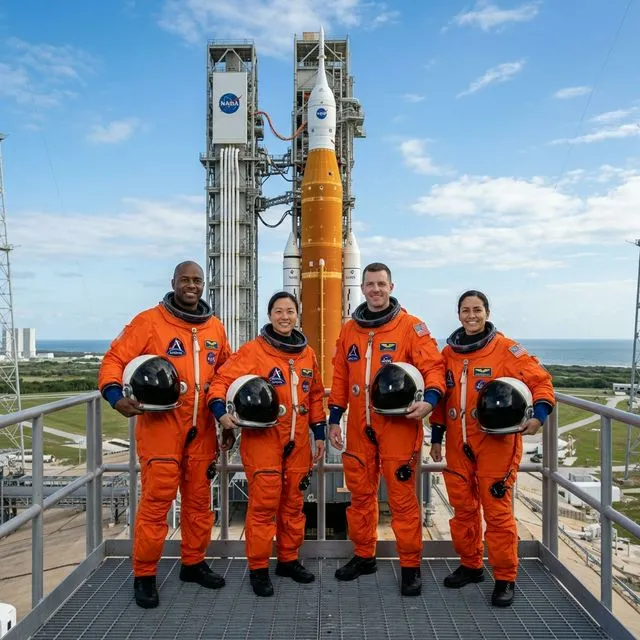
The Mission: What Will Artemis II Do?
The Flight Plan
Artemis II is a lunar flyby mission — all four astronauts will loop around the Moon without landing on its surface. The complete flight will last approximately 10 days and follow a free-return trajectory, similar to the early Apollo missions.
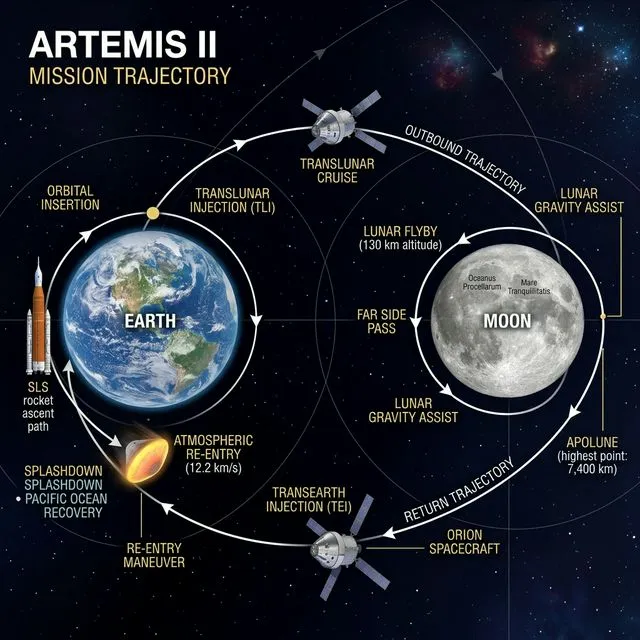
The mission will be divided into several phases:
Day 1 — Launch: The SLS will blast off from Pad 39B and place Orion into low Earth orbit. The astronauts will orbit Earth for about 90 minutes, verifying all systems.
Day 2 — Trans-Lunar Injection (TLI): The upper stage ICPS will be reignited to accelerate Orion to 24,500 mph, escaping Earth's gravity and putting it on a collision course with the Moon.
Days 3-5 — Translunar Cruise: For three days, the capsule will travel through the void between Earth and the Moon — approximately 238,855 miles of distance. The astronauts will conduct system tests, communications checks, and contingency exercises.
Day 6 — Lunar Flyby: Orion will pass within just 4,600 miles of the lunar surface — allowing astronauts to see crater details, mountains, and maria with their own eyes. The Moon's gravity will act as a gravitational slingshot to redirect the capsule back to Earth.
Days 7-9 — Return: The capsule will travel back to Earth, again crossing 238,855 miles of empty space.
Day 10 — Splashdown: Orion will enter Earth's atmosphere at 24,850 mph — the fastest speed any human has ever experienced — and land in the Pacific Ocean using a parachute system.
Primary Objectives
- Test the life support systems of the Orion capsule for long-duration deep space flights
- Validate the thermal protection of the heat shield during high-speed reentry
- Test long-distance communications and deep space navigation
- Verify emergency procedures in case of failures during cislunar flight
- Gather biomedical data on the effects of cosmic radiation on astronauts outside Earth's magnetic field protection
The Crew: Who Are the Chosen Four?
Commander Reid Wiseman
A veteran of the International Space Station (ISS), Wiseman will lead the crew. He's a Navy test pilot and engineer with over 3,000 hours of flight time in military jets.
Pilot Victor Glover
The first Black astronaut to travel to deep space. Glover, a Navy fighter pilot, already has ISS experience and will be responsible for Orion's propulsion and navigation systems.
Mission Specialist Christina Koch
Holder of the women's record for continuous time in space (328 days on the ISS), Koch will be responsible for scientific experiments and life support system monitoring.
Mission Specialist Jeremy Hansen
The first Canadian to travel to the Moon. Hansen, a Canadian Air Force fighter pilot and geologist, represents the Canadian Space Agency's (CSA) contribution to the Artemis program.
The SLS: The Most Powerful Rocket Ever Built
Numbers That Impress
| Specification | Detail |
|---|---|
| Total height | 322 feet (the height of a 32-story building) |
| Launch weight | 5.75 million pounds |
| Liftoff thrust | 8.8 million pounds of thrust |
| Core stage engines | 4 RS-25 engines (reused from the Space Shuttle program) |
| Maximum velocity | 24,500 mph (Mach 32) |
| Cryogenic fuel | Liquid hydrogen (-423°F) and liquid oxygen (-297°F) |
| Cost per launch | ~$2.2 billion |
Comparison with Other Rockets
- Saturn V (Apollo): 7.5 million lbs of thrust — the SLS generates 15% more
- SpaceX Falcon Heavy: 5 million lbs — the SLS has nearly double
- SpaceX Starship: When fully operational, will have more thrust than the SLS — but hasn't yet completed a crewed orbital mission
The Orion Capsule: Your Home in Deep Space
The Orion capsule is the vehicle carrying astronauts from Earth orbit to the Moon and back. Designed by Lockheed Martin, it's significantly more advanced than the Apollo capsules:
- Habitable volume: 316 cubic feet (60% larger than Apollo)
- Capacity: 4 astronauts (Apollo carried 3)
- Maximum duration: 21 days in deep space
- Heat shield: 16.5 feet in diameter, the largest ever built, capable of withstanding temperatures of 5,000°F during reentry
- European Service Module (ESM): Built by ESA, provides propulsion, solar power, and life support
The Artemis Program: From the Moon to Mars
The Long-Term Vision
- Artemis I (2022): Uncrewed flight — tested SLS and Orion in lunar flyby. ✅ Completed successfully.
- Artemis II (April 2026): Crewed flight without landing — loop around the Moon and return. 🚀 On the launch pad.
- Artemis III (2027-2028): First crewed lunar landing since 1972 — including the first woman and first person of color to walk on the Moon.
- Artemis IV-V (2029-2030): Missions with the SpaceX Starship HLS (Human Landing System) and construction of the Lunar Gateway — an orbital space station around the Moon.
- Mars Exploration (2030s): The Artemis program is ultimately a rehearsal for crewed Mars missions.
The Challenges: What Could Go Wrong
1. Cosmic Radiation
Outside Earth's magnetic field protection, astronauts will be exposed to significantly higher levels of cosmic radiation and solar particles. Orion has radiation shielding, but an intense solar flare could pose a real risk.
2. Communication Delays
At a distance of 238,855 miles, communications with Earth will have a delay of approximately 1.3 seconds each way. That doesn't sound like much, but in an emergency, every second counts.
3. Mechanical Complexity
The SLS is, in many respects, the most complex rocket ever built. Millions of components must function perfectly. A failure in any of them could compromise the mission.
4. The Heat Shield
During Artemis I (uncrewed), anomalies were found in the heat shield — it suffered more erosion than expected in certain areas. NASA has conducted extensive testing and modifications, but Artemis II's reentry will be the first time astronauts trust their lives to it.
Historical Context: 54 Years of Waiting
On December 14, 1972, Eugene Cernan and Harrison Schmitt left the lunar surface on Apollo 17. Before climbing the ladder of the lunar module, Cernan said: "We leave as we came and, God willing, as we shall return: with peace and hope for all mankind."
It took 54 years for that promise to begin being fulfilled.
Why Did It Take So Long?
After Apollo 17, the US redirected the space budget to the Space Shuttle program and then to the ISS. The Moon stopped being a priority:
- Costs: Apollo missions were extraordinarily expensive — about $250 billion in today's dollars
- Political will: After "winning" the space race against the USSR, political momentum waned
- Competition: China's plans for a permanent lunar base by 2030 reignited American interest in the Moon
The Future Is Now
When the SLS lifts off from Pad 39B — the same pad from which the Apollo missions departed — it will be more than a rocket launch. It will be a symbol that humanity hasn't given up on exploration. That despite wars, pandemics, and economic crises, we still have the ability — and the will — to look at the sky and say: "We're going there."
The Moon awaits. And for the first time in 54 years, we have a ticket.
FAQ — Frequently Asked Questions
When will Artemis II launch?
The launch is scheduled for early April 2026, from Kennedy Space Center in Florida, USA.
Will the astronauts land on the Moon?
No. Artemis II is a flyby mission — the Orion capsule will loop around the Moon at about 4,600 miles without landing. The first landing is planned for Artemis III.
How many astronauts are going?
Four: Reid Wiseman (commander), Victor Glover (pilot), Christina Koch and Jeremy Hansen (mission specialists).
What's the difference between Artemis and Apollo?
Apollo used the Saturn V rocket and carried 3 astronauts. Artemis uses the SLS (more powerful) and the Orion capsule (more advanced), carrying 4 astronauts. Artemis is also a multinational program with 40+ participating countries.
How much does the Artemis II mission cost?
The estimated cost per SLS launch is approximately $2.2 billion. The total Artemis program has a projected budget of over $93 billion.
Sources: NASA, ESA, CBS News, The New York Times, Reuters, Space.com


