
For decades, ARM Holdings was the invisible architect powering the mobile revolution. Its processor designs are inside 99% of smartphones on the planet — from every iPhone to every Galaxy, from every Pixel to every budget Android device sold in India. But ARM never manufactured a single chip. It merely licensed its architectures for others — Qualcomm, Apple, Samsung, MediaTek — to turn into silicon.
That changed on March 24, 2026.
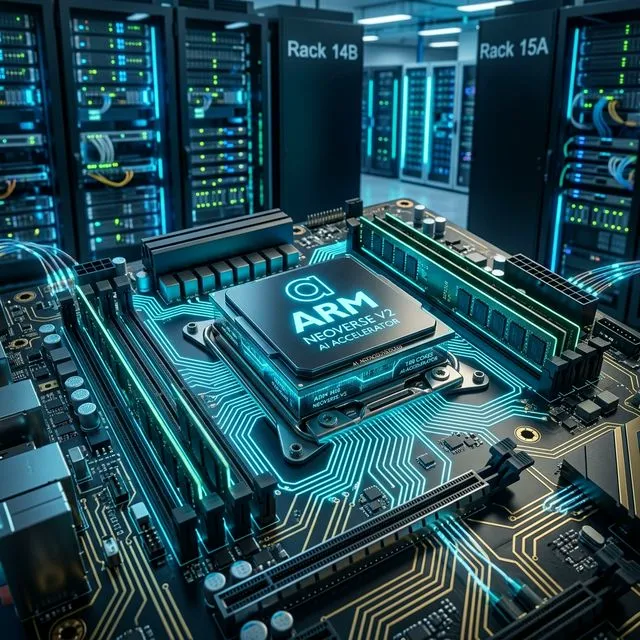
In an announcement that shook the semiconductor industry, ARM revealed the ARM Compute Platform — its first line of self-produced silicon products, starting with the ARM AGI CPU, a processor designed specifically for data centers running agentic artificial intelligence workloads and foundational AGI (Artificial General Intelligence) models.
Why This Is an Industry Earthquake
To understand this announcement's magnitude, you need to understand how ARM worked for the past 34 years. Since its founding in 1990, ARM operated exclusively as an intellectual property (IP) design company. Its business model was elegant in its simplicity: ARM designs processor architectures, chip companies license those designs, foundries produce the chips, and ARM collects royalties per chip sold.
This model generated over 280 billion ARM chips since 1991 — more processors than any other architecture in computing history. But it also meant ARM never controlled the final product.
| Before | Now |
|---|---|
| ARM designs, others manufacture | ARM designs AND offers its own products |
| Mobile focus (low power) | Data center focus (high-performance AI) |
| Revenue per royalty (~$0.10/chip) | Revenue per product (~$5,000+/chip) |
| Dependent on licensees' decisions | Full optimization control |
The ARM AGI CPU
Built on the new Neoverse V3 microarchitecture, manufactured on TSMC's 3nm process (N3E), the ARM AGI CPU targets agentic AI — systems that don't just respond to commands but act autonomously in the real world.
Technical Specifications:
| Spec | Value |
|---|---|
| Process | TSMC N3E (3nm) |
| Cores | 192 Neoverse V3 cores |
| Frequency | Up to 3.8 GHz |
| L3 Cache | 384 MB shared |
| Memory | DDR5-6400 / HBM3E (up to 128 GB) |
| TDP | 350W (configurable) |
| AI on-chip | SVE2 + SME2 (Scalable Matrix Extension) |
ARM claims the AGI CPU delivers 2.3x more inferences per watt than Intel Xeon Granite Rapids and 1.4x more than AMD EPYC Turin for LLM agent workloads.

Who's Worried (and Rightly So)
ARM's entry into silicon production puts the company on a direct collision course with several of its biggest clients and partners. Intel shares dropped 6.2% on the announcement day, while AMD retreated 3.8%. Qualcomm responded by signaling it may accelerate investments in RISC-V.
The RISC-V open-source architecture — royalty-free — represents the strategic paradox: by seeking higher margins selling its own chips, ARM risks pushing customers toward a free alternative.

The AI Infrastructure Market
The timing isn't coincidental. AI infrastructure is expected to reach $420 billion in 2026, growing 78% from 2025. 95% of current AI workloads are inference, not training — and inference favors ARM's strengths: high energy efficiency, many lightweight cores, and low per-thread latency.
ARM projects its processor can reduce the cost per inference in AI data centers by up to 40% compared to equivalent x86 solutions. For a hyperscaler like Microsoft, that could represent billions of dollars in annual savings.
First samples are planned for Q3 2026, with volume production in Q1 2027. The estimated price is $5,000-$8,000 per unit.
FAQ
Will ARM stop licensing its designs?
No. The licensing model continues. The ARM Compute Platform is an addition, not a replacement.
Does the ARM AGI CPU compete with NVIDIA GPUs?
Not directly. The ARM AGI CPU is optimized for agentic inference (CPUs), while NVIDIA GPUs dominate model training. They're complementary.
When will the ARM AGI CPU be available?
Samples in Q3 2026, volume production in Q1 2027.
Sources and References
- ARM Holdings plc — Press Release: ARM Compute Platform (March 24, 2026)
- IDC — Worldwide AI Infrastructure Forecast 2026-2030
- Moorhead, P. (2026). "ARM's Silicon Gambit." Moor Insights & Strategy
- Financial Times — "ARM shares surge 12% on data center push" (March 24, 2026)


