
Apple + Google Gemini in Siri: The Rivalry Became a Partnership — And Your iPhone's AI Will Never Be the Same
Few alliances in tech history are as surprising as this one: Apple and Google — rivals for over 15 years in the smartphone war — announced the integration of Gemini, Google's most advanced generative AI, directly into Siri. Apple's assistant, historically criticized as "the dumbest AI among the major ones," just received an intelligence transfusion that promises to transform it from a tool that "opens Wikipedia and prays" into something that actually understands what you want, when you want it, and how you want it. But why did Apple — the world's most valuable company at $3.4 trillion — need to ask Google for help instead of building its own AI? And what does this mean for the 2.2 billion active iPhones worldwide?
What Changes: Siri + Gemini
From Dumb Assistant to Contextual AI
| Capability | Old Siri | Siri + Gemini |
|---|---|---|
| Complex questions | "I found something on the web" | Elaborated, contextual response |
| Screen context | Didn't understand screen content | Analyzes and interacts with on-screen content |
| Command chaining | Each command was independent | Maintains context between commands |
| Images and documents | Couldn't process | Analyzes photos, PDFs, charts |
| Tone and personality | Robotic responses | Natural and adaptive responses |
| App integration | Limited to native apps | Interacts with third-party apps via App Intents |
Why Apple Didn't Build Its Own AI
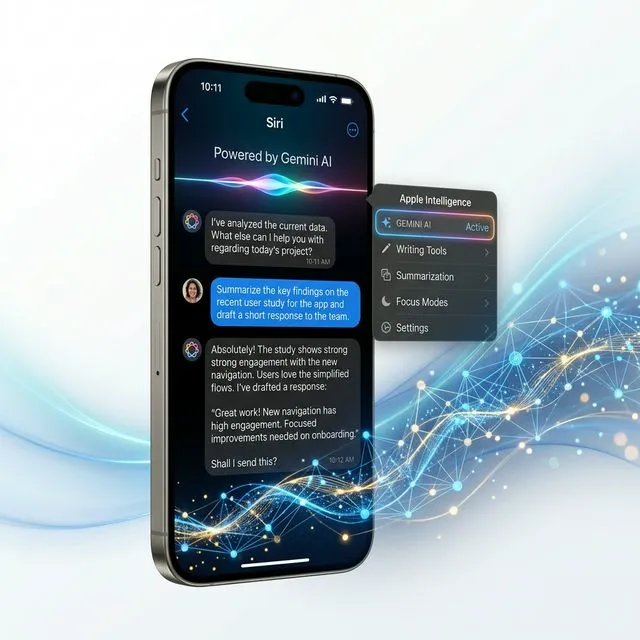
The Privacy-First Paradox
Apple built its brand on privacy. This positioning created a fundamental dilemma: advanced language models need massive data for training, and Apple refused for years to collect user data at the scale Google, Meta, and OpenAI collect.
The result: Apple fell 3-4 years behind in the generative AI race. The Apple Intelligence, launched in 2024, was competent for on-device tasks but nowhere near ChatGPT, Gemini, or Claude in conversational capability.
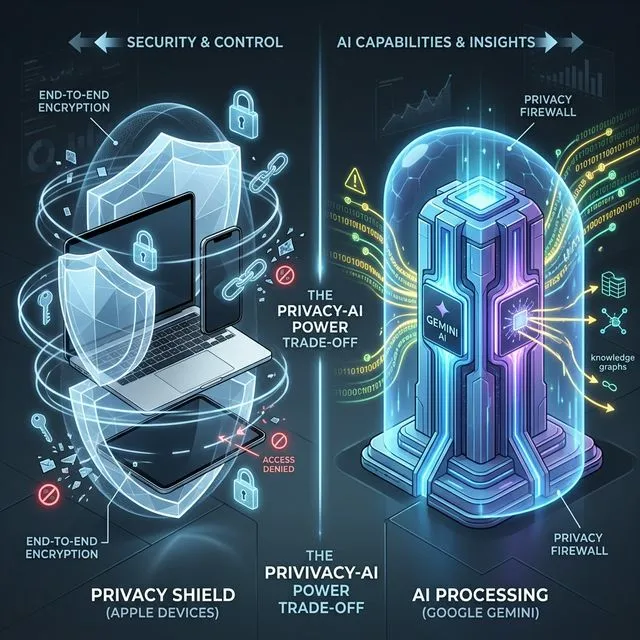
The partnership solves this without compromising privacy (in theory): simple tasks processed locally by Apple Intelligence, complex tasks sent to Gemini via API with ephemeral processing, and explicit opt-in required.
NVIDIA Vera Rubin: The Hardware Powering the Revolution
NVIDIA's Vera Rubin platform promises 40% reduction in training costs, 3x greater energy efficiency than Blackwell, and 288 GB HBM4 memory per chip.
Competitor Reactions
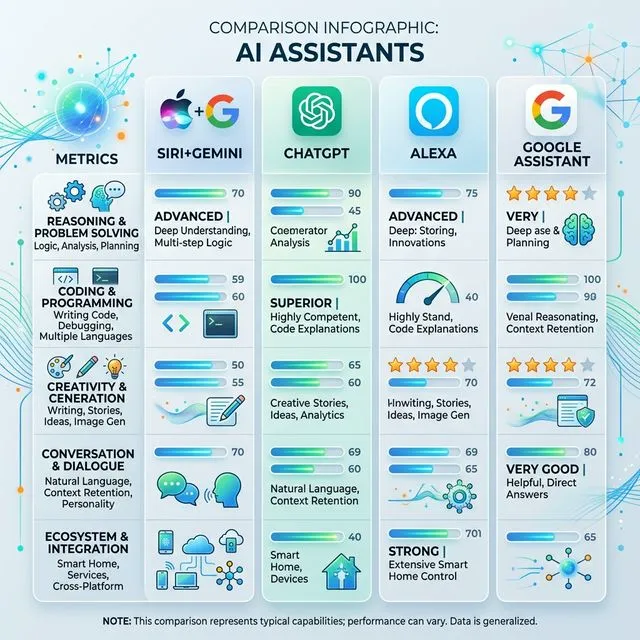
- Microsoft + OpenAI: Argues it pioneered this integration with Copilot, but Windows has 1.4 billion installations vs iPhone's 2.2 billion
- Samsung + Galaxy AI: Positions as the on-device option — more private, faster for simple tasks, but less powerful for complex ones
- Meta + Llama: Offers open-source alternative. Zuckerberg argues open-source AI is safer and more democratic
What This Means for You
If You Have an iPhone
Update via iOS 19.4 (expected April 2026). Compatible: iPhone 16 Pro/Pro Max and later. Older iPhones will have limited cloud functionality.
If You Have Android
Gemini is already available as default assistant on Pixel and Samsung Galaxy AI devices.
Privacy
Apple promises ephemeral processing sessions — no storage, no training, no Google account association. But for the first time, Siri queries can leave Apple's ecosystem.
The Economics Behind the Partnership
Google already pays Apple an estimated $20 billion annually to be Safari's default search engine. For the Gemini integration, analysts estimate Google will pay an additional $5-15 billion per year. In return, Google gains access to the world's largest premium smartphone ecosystem.
The big loser: OpenAI, which loses the exclusive deal it had with Apple since 2024.
Impact on the Digital Job Market
If Siri with Gemini can answer complex questions, analyze documents, and perform contextual research in real time, professions dependent on search and information processing will be affected. However, as with previous tech revolutions, routine job destruction tends to be offset by new professional categories.
The Brazilian Market and the New Siri
Brazil is one of the largest iPhone markets outside the US and Europe. Siri with Gemini in Brazilian Portuguese will be a crucial test — Brazilian Portuguese has nuances, regionalisms, and slang that challenge even the best language models.
Brazil's AI Bill (PL 2338/2023) may impact how Brazilian data is processed by foreign AI systems. ANPD has signaled interest in examining how Siri with Gemini treats personal data under LGPD.
Frequently Asked Questions (FAQ)
Do I need to pay extra for Gemini in Siri?
Basic functionality will be free with iOS 19.4. Apple may offer advanced features as paid subscription.
Will my iPhone 15 get the update?
Partially. Full on-device processing requires A18 Pro chip. iPhone 15 Pro will have limited cloud access.
Will Google have access to my iPhone data?
Apple says no. Queries are processed in "ephemeral sessions" without permanent storage. The feature can be disabled.
Does this mean Apple "gave up" on creating its own AI?
Not exactly. Apple continues developing Apple Intelligence internally for privacy-critical on-device tasks. The partnership is pragmatic for complex tasks requiring enormous models.
Conclusion
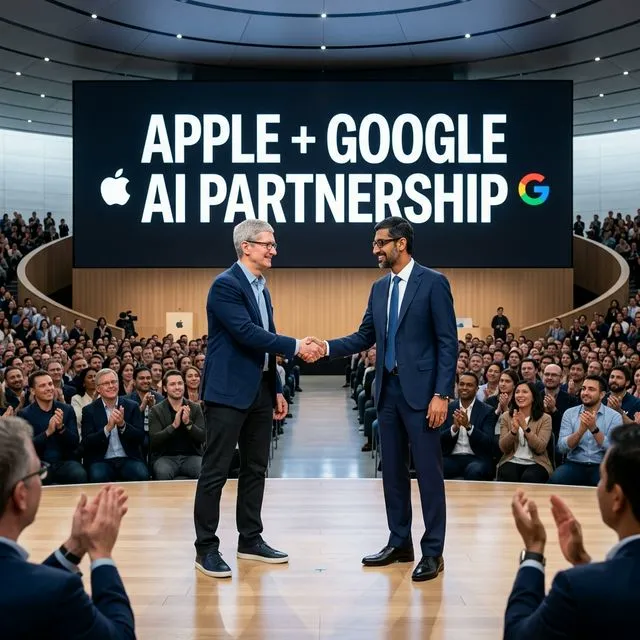
The Apple + Google Gemini partnership is one of those rare moments in tech that redefine entire categories. For the 2.2 billion iPhone users, including tens of millions of Brazilians, the device in your pocket just got significantly smarter overnight.
Perhaps the deepest lesson is this: in the AI race, even Apple — the company that invented the walled garden concept — needed to ask for help. If that doesn't demonstrate how transformative the AI revolution truly is, nothing does.


