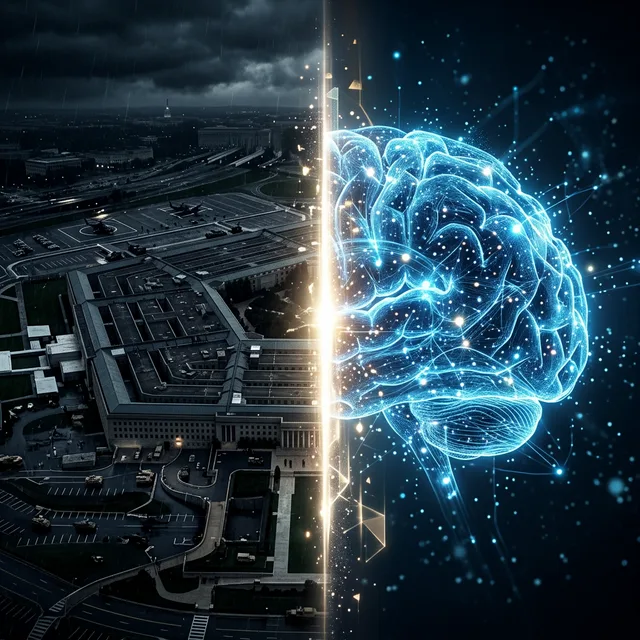
Anthropic’s formal decision to reject a landmark multi-billion-dollar contract with the United States Department of Defense has established a major ethical boundary line across the global artificial intelligence landscape. In February 2026, the creator of the Claude foundation model family publicly refused participation in the Pentagon’s expanded Joint Enterprise Defense Infrastructure initiative (JEDI-2). While key industry competitors, including OpenAI, Google, Microsoft, and Palantir, actively pursue national security procurements, Anthropic chose to draw an uncompromising line against the militarization of its frontier cognitive architectures, triggering the most significant defense ethics debate since the advent of weaponized unmanned aerial systems.
The decision sent immediate shockwaves through national security circles and Silicon Valley boardrooms. By walking away from an estimated ten billion dollars in potential defense revenue distributed over a decade, Anthropic demonstrated that safety-first public benefit corporation principles could override lucrative defense-industrial incentives. The move highlighted a critical technological reality: as generative artificial intelligence systems evolve toward autonomous multi-step reasoning, separating benign logistical analytics from lethal kinetic targeting becomes technically and operationally unmanageable.
Defense analysts and civil rights advocates view this corporate stance as a watershed moment for high-tech governance. By declining to deploy Claude within classified tactical operations, Anthropic directly challenged the prevailing orthodoxy that Western technology firms must subordinate alignment research to geopolitical defense imperatives. The development forces governments, military leaders, and commercial enterprise clients to confront whether artificial intelligence systems should ever participate in automated command-and-control operations during active armed conflict.
The Washington Announcement: Anatomy of a Billion-Dollar Rejection
On February 19, 2026, Anthropic Chief Executive Officer Dario Amodei issued an extensive corporate memorandum detailing the institutional rationale behind bypassing the JEDI-2 procurement cycle. The program represents the Pentagon’s foundational initiative to integrate frontier foundation models into military logistics, strategic intelligence synthesis, threat assessment modeling, and tactical decision-support networks.
The corporate statement addressed the core philosophical dilemma directly:
"Anthropic was established with the explicit objective of developing safe, steerable, and socially beneficial artificial intelligence. Following months of exhaustive internal evaluation, we determined that we cannot guarantee that our technology, once embedded in military operational pipelines, would remain within our mandatory safety parameters. The operational demands of wartime environments inevitably degrade civilian safety constraints. Consequently, we have declined to submit bids for classified defense combat integration."
Inside the company, the decision culminated after weeks of intense internal deliberations. Research teams specializing in constitutional alignment, red-teaming, and mechanistic interpretability overwhelmingly opposed defense deployment, warning that military performance pressure would inevitably force compromises on safety testing. While commercial development executives and certain minority investors noted the competitive risks of forfeiting defense procurement funds, the board of directors and co-founding executives maintained that long-term safety credibility required an absolute separation from military operations.
The Modern Reality of Military Artificial Intelligence
To appreciate the gravity of Anthropic’s position, observers must examine the operational reality of military artificial intelligence in 2026. Autonomous algorithms are no longer theoretical concepts confined to scientific white papers; they represent the decisive competitive edge in modern warfare across Eastern Europe, the Middle East, and the Asia-Pacific theater.
Militaries worldwide deploy machine learning systems across multiple tactical domains:
- Loitering Munitions and Autonomous Drones: Systems like Russia’s Lancet-3 and Israel’s Harop employ edge-computed computer vision to lock onto radar signatures and vehicular shapes without continuous operator control.
- Air Defense Autonomy: Automated missile interception complexes, including modernized Iron Dome batteries and David’s Sling, utilize algorithmic trajectory modeling to neutralize incoming supersonic threats within milliseconds.
- Sensor-to-Shooter Acceleration: The United States military’s Project Maven utilizes deep learning models to ingest petabytes of satellite, drone, and radar surveillance imagery, flagging potential human and equipment targets for military analysts.
- Unmanned Combat Aviation: Platforms like the Air Force Skyborg program and Boeing’s Loyal Wingman test autonomous fighter jet piloting algorithms designed to conduct electronic warfare and air-to-air maneuvers alongside human-crewed aircraft.
Within this operational environment, the ethical dilemma centers on algorithmic drift and accountability. Even when defense procurement contracts stipulate that foundation models will only assist with administrative scheduling or logistical routing, the underlying software libraries can be rapidly repurposed for automated targeting. Once advanced neural networks interface with military command nodes, preserving meaningful human control over lethal engagements becomes exceedingly precarious.
Market Realignment: Tech Giants Competing for Defense Dominance
While Anthropic opted out, major technology corporations have moved aggressively to secure lucrative national security contracts, creating a clear division in Silicon Valley’s corporate strategy.
The comparative table below outlines the commercial positioning, defense contract portfolios, and ethical policy frameworks of the leading artificial intelligence developers operating in 2026:
| Technology Corporation | Military AI Procurement Stance | Major Defense Engagements | Annual Defense Revenue (Est.) | Ethical Safeguard Governance |
|---|---|---|---|---|
| Anthropic | Comprehensive Refusal | None (Zero military combat contracts) | bash | Constitutional AI strictly for civilian use |
| OpenAI | Commercial Partnership | Project Maven II, DARPA Defense LLM | 50M+ | Internal review board with military exceptions |
| Google / DeepMind | Active Defense Vendor | Pentagon Joint Warfighting Cloud, Maven 2 | .4B+ | Principles updated to support democratic defense |
| Microsoft | Foundational Prime Contractor | IVAS HoloLens combat systems, Azure Secret | .2B+ | Dedicated government cloud compliance units |
| Palantir Technologies | Core Defense Business | Maven Smart System, Tactical Data Mesh | .8B+ | Defense-first mission architecture |
| Meta Platforms | Indirect Government Licensing | Llama open-weight defense integration | Indirect licensing | Dual-use open licenses without kinetic liability |
OpenAI’s transformation has been particularly noteworthy. Having historically prohibited military use in its published terms of service, the company revised its usage policies in early 2024 to permit defense applications supporting national security goals. OpenAI subsequently secured contracts to deploy custom models for cybersecurity resilience, medical logistics, and maritime threat assessment under DARPA supervision.
Google underwent a similar strategic evolution. In 2018, widespread internal protests led leadership to cancel its involvement in Project Maven. However, escalating geopolitical competition between the United States and technological rivals prompted management to re-enter defense procurement, asserting that supplying democratic institutions with advanced software represents a civic responsibility.
Microsoft has long maintained deep institutional relationships with defense agencies, deploying sovereign cloud environments through Azure Government and engineering augmented reality targeting headsets. Palantir continues to expand its defense data architectures, ensuring that enterprise artificial intelligence models integrate directly into joint military command nodes across NATO member states.
The Ethical Debate: Competing Visions for Silicon Valley
The divide over military artificial intelligence reflects fundamentally divergent ethical philosophies regarding the role of private technology companies in global security.
Proponents of military collaboration argue:
- Geopolitical Deterrence: Authoritarian states, particularly China and Russia, invest heavily in algorithmic warfare without independent ethical oversight. Western democracies must maintain technological superiority to preserve international stability.
- Precision and Collateral Damage Reduction: Highly accurate algorithmic targeting can minimize civilian casualties by eliminating human calculation errors and cognitive fatigue during high-stress combat operations.
- Institutional Stewardship: Technology leaders contend that ethical software companies must participate in defense programs to ensure that modern weapons systems adhere to international humanitarian law.
Conversely, critics and alignment researchers emphasize severe systemic risks:
- Algorithmic Opacity and Hallucination: Deep neural networks operate as probabilistic systems prone to unpredictable errors, confabulations, and data poisoning, making them hazardous foundations for life-or-death decisions.
- Erosion of Moral Accountability: Delegating targeting recommendations to automated systems disperses legal responsibility among software engineers, procurement officers, and commanding generals, obscuring war crimes liability.
- Accelerated Arms Escalation: Algorithmic speed compresses strategic decision windows, creating unstable tactical dynamics where autonomous systems could trigger unintended international escalation within minutes.
Commercial and Regulatory Fallout of Anthropic's Stand
Anthropic’s refusal has established significant commercial and regulatory ripples that extend beyond lost defense contracts. In the enterprise sector, the company has positioned Claude as the premier ethical AI solution for healthcare providers, financial institutions, and academic researchers seeking alignment integrity. The decision has strengthened recruitment efforts, attracting senior research scientists from competing firms who prefer working in an environment dedicated exclusively to civilian applications.
On the regulatory stage, lawmakers in the European Union and the United Nations have cited Anthropic’s policy as a model for responsible corporate governance under the EU Artificial Intelligence Act. Diplomats advocating for international prohibitions on Lethal Autonomous Weapons Systems point to Anthropic’s stance as evidence that technical safety and military targeting are fundamentally incompatible.
The refusal to work with the Pentagon has established a permanent benchmark in the artificial intelligence sector. By demonstrating that a leading frontier lab can achieve commercial viability while refusing military contracts, Anthropic proved that technological development does not require subservience to defense establishments. As artificial intelligence reshapes human society, the question of whether cognitive technologies should be deployed as weapons will remain the central moral inquiry of the digital era.
Institutional Sources and Official References
- Anthropic Corporate Communications — Official corporate statements on alignment principles and safe commercial deployment.
- United States Department of Defense — Joint Enterprise Defense Infrastructure and algorithmic warfare modernization briefs.
- Congressional Research Service (CRS) — Reports on Artificial Intelligence and National Security Governance.
- Defense One — Reporting on Silicon Valley procurement trends and military software integration.
- Campaign to Stop Killer Robots — Global coalition documentation on autonomous weapons governance.