Why Do Some Animals Glow in the Dark? The Science of Bioluminescence 🌟🐙
In the depths of the Pacific Ocean, at 3,000 meters below the surface — where sunlight never reaches — there is more light than on many city streets at night. But this light doesn't come from the Sun. It comes from the animals themselves.
It's estimated that 76% of deep ocean organisms are bioluminescent. In other words, in the largest habitat on planet Earth, the dominant form of communication, hunting, and defense is light itself. It's not the exception — it's the rule.
Bioluminescence is one of evolution's most spectacular adaptations, having arisen independently at least 40-50 times in completely different lineages — from bacteria to sharks, from fungi to squid. When evolution reinvents the same solution dozens of times, it's because it works exceptionally well.
🔬 The Chemistry: How Organisms Manufacture Light
All bioluminescence depends on two molecules:
- Luciferin — the substrate that emits light (there are at least 11 different types in nature)
- Luciferase — the enzyme that catalyzes the reaction
When luciferase oxidizes luciferin (in the presence of oxygen), energy is released in the form of photons — particles of visible light. The reaction is extraordinarily efficient: it converts nearly 100% of energy into light, without generating heat.
For perspective: an incandescent bulb converts only 10% of energy into light (the other 90% becomes heat). A modern LED reaches 40-50%. Nature reaches nearly 100%. In terms of luminous engineering, life solved the problem better than any human technology.
Some organisms produce their own luciferin. Others obtain it from their diet — they eat bioluminescent prey and recycle their luminous molecules. And others, like the anglerfish, don't even produce the light: they host bioluminescent bacteria that do the work for them, in a symbiotic partnership.
🌊 The Most Fascinating Bioluminescent Animals
1. 🔥 Firefly (Lampyridae) — The Luminous Poet
The most familiar example of bioluminescence is also one of the most sophisticated. There are more than 2,000 species of fireflies, each with a unique flashing pattern — like a visual Morse code in the dark.
The courtship process works like this: males fly emitting flashes in species-specific sequences. A receptive female on the ground responds with her own flashes, at equally specific intervals. It's a luminous dialogue: he flashes 3 times in 2 seconds, she responds with 1 flash after 0.5 seconds. If the timing is wrong, there's no match.
But nature has its villains. The female of the genus Photuris learned to mimic the flash patterns of other species to attract unsuspecting males. When the male approaches, expecting to find a mate, she devours him. And the reason isn't just hunger: by eating males of other species, she acquires toxic chemical compounds that protect her from predators. It's chemical theft via luminous trap.
In Brazil, Emas National Park (Goiás) offers one of the most surprising spectacles: firefly larvae (Pyrearinus termitilluminans) colonize termite mounds, creating entire fields of mounds glowing green in the darkness — it looks like a starry sky on the ground.
2. 🪼 Crystal Jellyfish (Aequorea victoria) — The Nobel Prize
This translucent jellyfish from the North Pacific seems modest, but it revolutionized modern science. It produces a protein called GFP (Green Fluorescent Protein) — a molecule that glows green when exposed to ultraviolet light.
In 1962, Japanese scientist Osamu Shimomura isolated GFP for the first time. Decades later, researchers discovered they could fuse the GFP gene to any protein of interest, creating a luminous marker that allows tracking biological processes in real time.
Want to see a cancer cell spreading? Attach GFP to it and observe under a fluorescent microscope. Want to track a specific protein in the brain? Fuse it with GFP. Want to follow an infection developing? GFP marks the path.
The discovery earned the 2008 Nobel Prize in Chemistry for Shimomura, Martin Chalfie, and Roger Tsien. Since then, modified versions of GFP produce light in blue, yellow, red, and dozens of other colors — the so-called "biological rainbow" that transformed molecular biology. A jellyfish protein became one of the most used tools in the history of science.
3. 🎣 Anglerfish (Lophiiformes) — The Deep-Sea Trap
In the ocean depths (1,000-4,000 m), where pressure is crushing and darkness is total, the anglerfish developed nature's most macabre hunting strategy.
The female (males are tiny and parasitic) possesses a modified stalk on her head — the illicium — that functions like a fishing rod. At the tip of this stalk, a bulb contains symbiotic bioluminescent bacteria that produce an oscillating bluish light.
Curious prey approach the light — in the total darkness of the deep ocean, any point of light could mean food — and are swallowed by the anglerfish's disproportionately enormous mouth. The mouth can open to accommodate prey larger than the predator itself, thanks to an extremely elastic stomach and jaws that distend.
Males have a particularly bizarre fate: upon finding a female, the male physically fuses to her body, sharing the bloodstream and degenerating until becoming essentially a pair of gonads attached to the female. It's one of the most extreme cases of sexual dimorphism in nature.
4. 🧛 Vampire Squid (Vampyroteuthis infernalis) — The Curtain of Light
Despite the terrifying name ("vampire squid from hell"), the vampire squid is a small (up to 30 cm), gentle, and harmless animal that inhabits the minimum oxygen zone of the ocean — between 600 and 1,200 meters, where practically no other predator can survive.
Its defense is brilliant: when threatened, instead of ejecting dark ink (like most cephalopods), it fires a bioluminescent mucus that explodes into thousands of points of bluish light. In the total darkness of the deep ocean, a dark cloud would be invisible — but a cloud of light is a perfect distraction, confusing predators while the squid escapes.
The vampire squid also possesses photophores at the tips of its arms that can be "turned on" and "turned off" individually, creating light patterns that disorient predators — like a defensive light show.
5. ✨ Dinoflagellates — The Beaches That Glow
These microscopic single-celled organisms are responsible for one of the most magical natural phenomena on the planet: bioluminescent beaches. When disturbed by waves, swimmers, paddles, or boats, dinoflagellates emit flashes of electric-blue light, transforming the water into luminous liquid.
Beaches famous for this spectacle include Mosquito Bay in Vieques (Puerto Rico), the Maldives, the coast of Tasmania, and bays in Jamaica.
The bioluminescence of dinoflagellates is a defense strategy called the "burglar alarm": the flash of light doesn't directly scare the predator eating the dinoflagellates, but attracts larger predators that eat whoever was eating the dinoflagellates. It's a luminous "distress call" that summons reinforcements.
6. 💡 Lanternfish (Myctophidae) — The Most Abundant
Lanternfish are possibly the most abundant vertebrates on the planet — billions of individuals forming massive schools. They possess dozens of photophores (light organs) distributed across their bodies in species-specific patterns.
These patterns function as species identification: in the dark, a lanternfish "reads" the photophore arrangement of another to determine if they're the same species. It's the marine equivalent of facial recognition — but with light.
The second function is counter-illumination: photophores on the belly emit light that matches the faint luminosity coming from the surface. Viewed from below, the fish's silhouette disappears against the luminous background — perfect camouflage against predators that hunt by looking upward.
7. 🍄 Bioluminescent Fungi (Mycena chlorophos)
Not all bioluminescent organisms are animals. More than 80 species of fungi emit light — usually a ghostly green that illuminates the floor of tropical forests at night.
Mycena chlorophos, found in forests of Southeast Asia, Japan, and Brazil, glows with enough intensity to be photographed without flash. In Brazil, biogeographer Cassius Stevani (USP) is one of the world's leading experts on bioluminescent fungi, having discovered several new species.
The function? The most accepted theory is that the light attracts insects that help disperse spores — a nocturnal version of the colorful flowers that attract pollinators during the day.
8. 🦈 Bioluminescent Sharks — Luminous Giants
In 2021, scientists discovered that the kitefin shark (Dalatias licha), measuring up to 1.8 meters, is the largest known bioluminescent vertebrate. The shark's entire belly emits a soft, greenish light.
The function is counter-illumination: the shark hunts at depths of 200-600 meters and, viewed from below by prey or predators, its silhouette would blend with the faint light from the surface. It's active camouflage — the animal becomes invisible by eliminating its own shadow.
Several other deep-water sharks are also bioluminescent, including the elegant Etmopterus spinax (lantern shark), which has photophore patterns that may serve as communication between individuals.
🧬 Bioluminescence and Human Technology
Revolutionary Medicine
GFP and its variants have transformed biomedicine:
- Tumor tracking: Cancer cells marked with fluorescent proteins allow surgeons to see exactly where the cancer is during operations
- Neuroscience: The Brainbow project marks different neurons with distinct colors, creating colorful maps of the brain
- Vaccines: Fluorescent markers track the immune response in real time
- Infectious diseases: Pathogenic bacteria marked with GFP allow tracking infections live
Environmental Sensors
Genetically modified bioluminescent bacteria function as pollution sensors: they glow normally in clean water, but stop glowing when exposed to contaminants. It's real-time biomonitoring, more sensitive than many laboratory instruments.
The Future: Plants That Light Up Streets
In 2020, MIT researchers managed to incorporate bioluminescence genes into plants, creating seedlings that emit enough light to read a book in the dark. Although still in the experimental stage, the vision of bioluminescent trees lighting streets without electricity is increasingly close to reality.
Technological and Medical Applications
Bioluminescence inspires revolutionary technological innovations. Researchers at Cambridge University developed plants that glow in the dark by inserting firefly genes, aiming to create sustainable urban lighting without electricity. While still experimental, these bioluminescent plants could eventually illuminate streets and parks.
In medicine, bioluminescence is used to track cancer cells in real time. Scientists tag tumors with luciferase genes, allowing visualization of cancer growth and metastasis in animal models without invasive surgery. This technique has accelerated the development of new oncological treatments and drug screening processes.
Bioluminescent sensors detect environmental contaminants, food pathogens, and disease biomarkers with extraordinary sensitivity. Companies like Glowee in France are developing bioluminescent urban signage using genetically modified bacteria, offering a sustainable alternative to conventional electric lighting. The potential applications extend to military camouflage, underwater communication systems, and even bioluminescent art installations.
Deep Ocean Bioluminescence: The Hidden Light Show
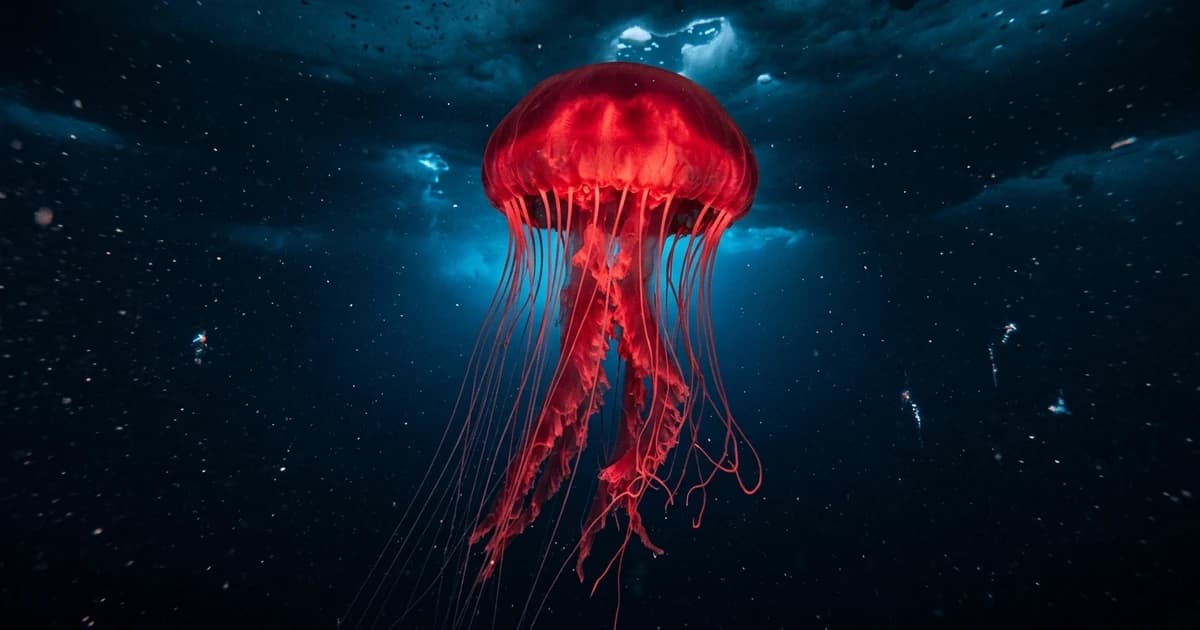
The deep ocean is the planet's greatest bioluminescence stage. Below 200 meters depth, where sunlight cannot penetrate, an estimated 76% to 90% of all organisms produce their own light. The anglerfish uses a bioluminescent lure to attract prey, while vampire squid expel glowing mucus clouds to confuse predators. Deep-sea jellyfish create cascading light displays that ripple through the water column, and certain shrimp species spray bioluminescent fluid at attackers like underwater pepper spray.
The diversity of light production strategies in the deep ocean is staggering. Some organisms use symbiotic bacteria housed in specialized light organs, while others produce light through their own biochemistry. Colors range from blue and green (which travel farthest in water) to rare red light produced by dragonfish, which is invisible to most deep-sea creatures, giving dragonfish a secret spotlight for hunting.
Terrestrial Bioluminescence: Fireflies and Fungi
Fireflies are the most well-known terrestrial bioluminescent organisms, with over 2,000 species distributed across every continent except Antarctica. Each species has a unique flash pattern that serves as a communication code for finding mates. Some predatory species, like those in the genus Photuris, mimic the patterns of other species to lure and devour unsuspecting males in a deadly deception known as femme fatale signaling.
Bioluminescent fungi represent another fascinating phenomenon. More than 80 species of fungi glow in the dark, primarily in humid tropical forests. The Mycena chlorophos of Asia emits a spectral green light that illuminates the forest floor at night. Scientists believe this light attracts insects that help disperse the fungus's spores, similar to how colorful flowers attract pollinators. The ghost fungus of Australia and the jack-o'-lantern mushroom of North America are among the most striking examples, creating eerie glowing displays that have inspired folklore and ghost stories for centuries.
New Zealand's Waitomo Caves showcase one of the most spectacular bioluminescent displays on Earth. Thousands of Arachnocampa luminosa glowworms cover the cave ceiling, creating a living starscape that attracts hundreds of thousands of tourists annually. These larvae produce bioluminescent silk threads that hang like fishing lines, attracting flying insects toward their sticky, glowing traps.
Conservation and Threats to Bioluminescent Species
Light pollution poses a significant threat to bioluminescent organisms worldwide. Firefly populations have declined dramatically in recent decades as artificial lighting disrupts their mating signals. Urban expansion, pesticide use, and habitat destruction compound the problem. Conservation efforts include creating dark sky reserves, reducing light pollution in critical habitats, and establishing breeding programs for endangered firefly species.
Climate change also affects bioluminescent ecosystems. Rising ocean temperatures alter the distribution of bioluminescent plankton, while ocean acidification threatens the chemistry of light-producing reactions. Scientists use bioluminescent organisms as bioindicators of ecosystem health, monitoring changes in their populations to track environmental degradation. The preservation of these remarkable creatures is not just about protecting biodiversity — it's about maintaining the natural wonder that has inspired human curiosity for millennia.
The Future of Bioluminescence Research
Research into bioluminescence continues to yield surprising discoveries. In 2025, scientists identified new bioluminescent species in the Mariana Trench, the deepest point on Earth. These organisms produce light using previously unknown chemical pathways, opening new avenues for biotechnology applications. The intersection of bioluminescence research with synthetic biology promises to create entirely new categories of living light sources.
Frequently Asked Questions
Is bioluminescence dangerous to humans?
No. The light produced by bioluminescent organisms is completely harmless. You can swim in waters with bioluminescent plankton without any risk.
Why is most bioluminescence blue or green?
Because blue light (~475 nm) travels farther in water than any other color. Marine organisms evolved to emit in the wavelength range that reaches the greatest distance in their environment.
Do humans glow?
Technically, yes. The human body emits biophotons — a tiny amount of light that is 1,000 times weaker than our eyes can detect. This was confirmed by ultrasensitive cameras in 2009 by Japanese researchers. But it's not bioluminescence in the functional sense.
How many bioluminescent species exist?
More than 10,000 known species, but the real number may be much higher. The deep ocean — Earth's largest habitat — is only ~5% explored. Every deep-sea expedition discovers new luminous species.
Sources: Haddock, S.H.D. et al. "Bioluminescence in the Sea" (Annual Review of Marine Science) | Shimomura, O. "Bioluminescence" (World Scientific) | MBARI (Monterey Bay Aquarium Research Institute). Updated January 2026.
Read also: