
In 2025, wildfires consumed 12.4 million hectares in North America alone — an area larger than all of Austria. In Greece, Portugal, Spain, and southern France, the fire season destroyed entire communities and killed dozens of people. In Australia, the trauma of the 2019-2020 mega-fires (when 18.6 million hectares turned to ash) remains vivid in collective memory. And with the planet shattering consecutive temperature records — 2025 was officially the hottest year ever recorded according to the WMO — the outlook for the coming decades is clear: wildfires will be more frequent, more intense, and more destructive.
Firefighting technology, however, has remained essentially the same for decades. Tanker aircraft dump water or retardant "in the general area" — with accuracy measured in tens of meters at best. Helicopters communicate with ground teams via analog radio, without a unified view of the terrain. Surveillance drones collect data that takes hours to process. And the time between detecting a hotspot and the first water drop can exceed 45 minutes — a period during which a wildfire under strong wind conditions can expand from one hectare to fifty.
Airbus, the European aviation giant, has just demonstrated that this can change radically. In tests conducted at the Istres air base in southern France, the company successfully completed trials of an integrated digital wildfire combat system that connects all response assets — tanker aircraft, helicopters, reconnaissance drones, and ground teams — in a unified real-time data network, achieving water drop precision of 5 meters and a 70% reduction in time between detection and first attack on the fire.
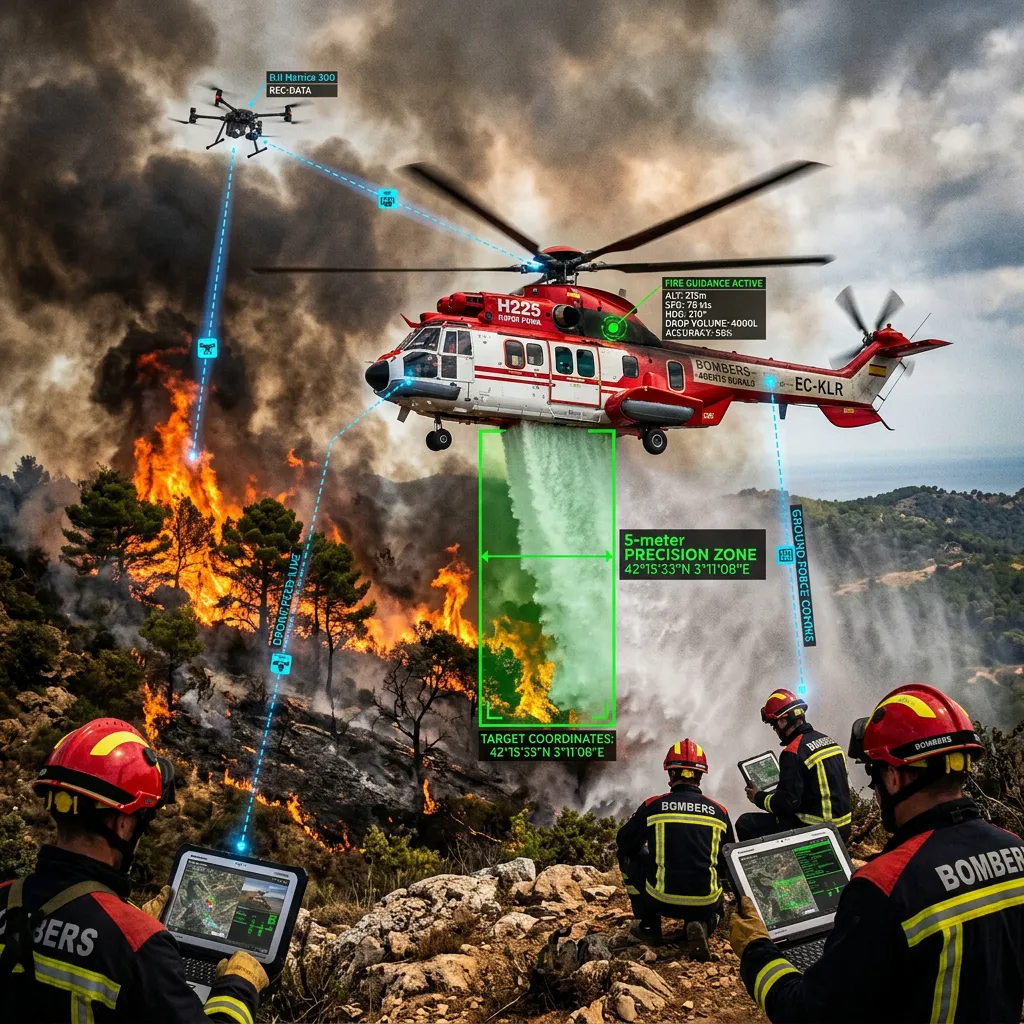
How It Works: The Neural Network of Future Firefighters
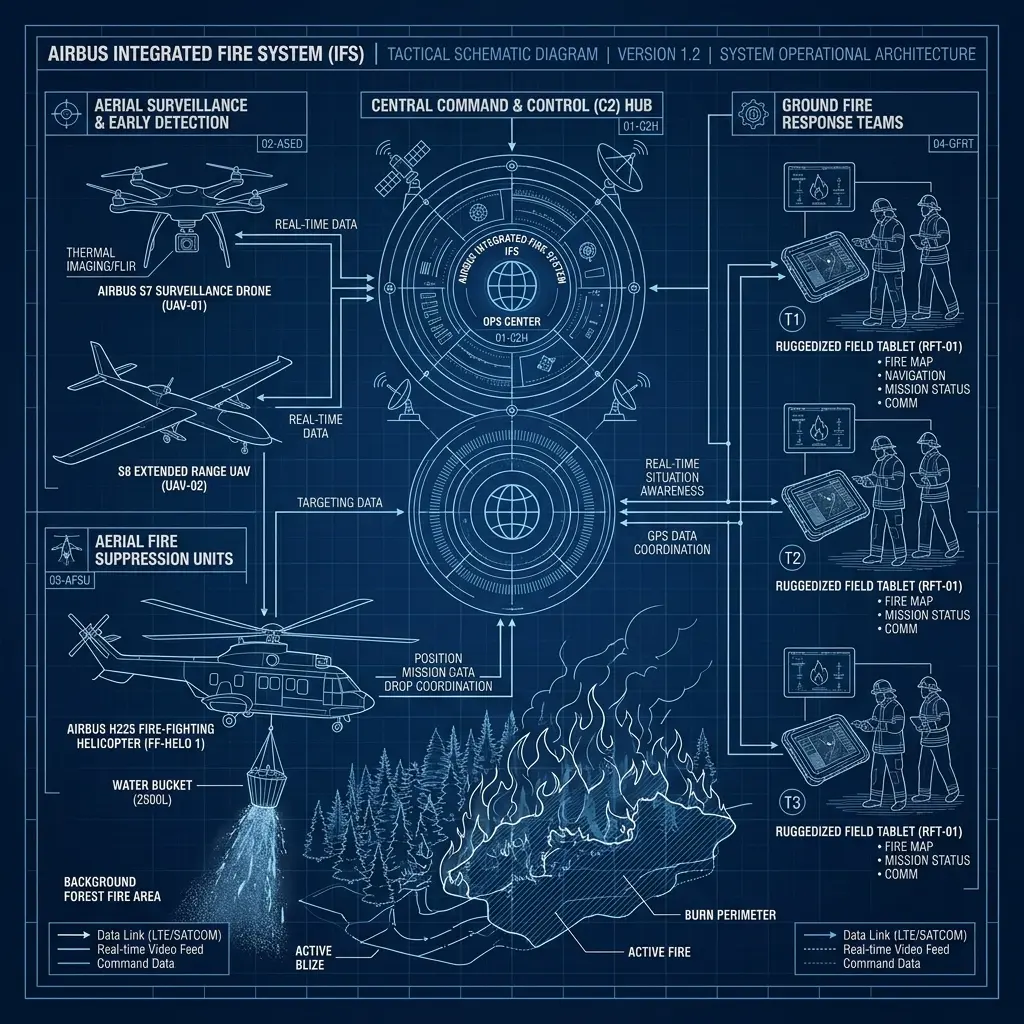
The Airbus system — internally named IFS (Integrated Fire System) — is not a single product or device. It's a network architecture that transforms multiple independent assets into a coordinated organism. Imagine the difference between an orchestra where each musician plays looking only at their own sheet music versus one where everyone sees the same score, knows what each colleague is playing, and a conductor coordinates everything in real time.
IFS Components:
| Component | Function | Innovation |
|---|---|---|
| Aliaca Drones (reconnaissance) | Fly over fire area transmitting 4K video and thermal data in real time | 4h endurance, 100 km range, encrypted transmission |
| C2 Hub (command center) | Processes data from all assets, generates 3D map updated every 2 seconds | AI that predicts fire spread direction and speed |
| Digital Bombsight | Calculates optimal drop point considering wind, speed, altitude, and terrain | 5m accuracy (vs. 30-50m manual) |
| Tactical Radio Link (communication) | Connects aircraft, drones, and ground teams in redundant mesh network | No dead zones, no latency |
| Ground Tablets (field teams) | Ground firefighters see 3D map with positions of all aircraft and danger zones | Prevents friendly fire (firefighters hit by water/retardant) |
The most important conceptual leap is the Digital Bombsight. In conventional operations, the pilot of a tanker aircraft (such as the Canadian CL-415 or adapted C-130) visually estimates the drop point — accounting for aircraft speed, altitude, crosswind, and topography. It's an artisanal skill executed by extraordinarily talented pilots, but inherently imprecise. A margin of error of 30-50 meters means some water falls on areas not burning — or, worse, misses the fire front where it's most needed.
The Digital Bombsight automatically calculates the optimal release point using real-time data from differential GPS (centimeter-level precision), onboard anemometers, radar altimeter, and 3D terrain model updated by drones. The pilot doesn't need to "aim" — the system indicates the exact moment of release, and the result is a drop with a margin of error of 5 meters. It's the difference between throwing a basketball at the hoop and throwing a bowling ball at the hoop.
The Tests: Numbers That Impressed Veteran Firefighters
The trials at Istres, conducted between January and March 2026, involved:
Test configuration:
- 2 H225M helicopters equipped with 3,000-liter bambi buckets
- 1 C295 demonstrator aircraft configured as tanker
- 4 Aliaca drones for long-range reconnaissance
- 1 mobile C2 Hub in operational container
- 23 ground teams with tablets connected to the system
- 48 controlled burns of different types (Mediterranean forest, dry brush, rugged terrain)
Documented results:
| Metric | Conventional Method | Airbus IFS System | Improvement |
|---|---|---|---|
| Detection → first attack time | 35-50 minutes | 8-12 minutes | 70-76% |
| Water drop accuracy | 30-50 meters | 5 meters | 85-90% |
| Area burned before containment | 15-40 hectares (average) | 2-8 hectares | 75-80% |
| Flight time between reloads | 25 min (return to base) | 18 min (advanced reload point guided by drone) | 28% |
| "Friendly fire" incidents (water hitting firefighters) | 3-5 per major operation | Zero across 48 tests | 100% |
| Water use efficiency | ~45% (water on target) | 88% (water on target) | 96% |
The most impactful number is the area burned before containment: from 15-40 hectares to 2-8 hectares. In practical terms, this means fires that previously would destroy areas the size of dozens of football fields before being contained can now be suppressed when they're still the size of a few city blocks.
Colonel Jean-Philippe Hédé, director of the Istres air base and military observer of the tests, commented: "I've seen 30 years of wildfire combat. What Airbus demonstrated at Istres fundamentally changes our capability. It's not incremental. It's like comparing a paper map with GPS — same information, completely different use."
The Problem Technology Solves: The "Golden Hour" of Wildfires
Wildfire combat specialists speak of the "Golden Hour" concept — the first 60 minutes after ignition, when a fire can be controlled with relatively modest resources. After that period, dynamics change: the fire creates its own microclimate (convection, updrafts, ember showers) and becomes exponentially harder — and more expensive — to fight.
The exponential rule of wildfires:
| Time after ignition | Typical size | Resources needed | Combat cost |
|---|---|---|---|
| 0-15 min | <1 hectare | 1-2 ground teams | ~€5,000 |
| 15-60 min | 1-10 hectares | Ground teams + 1-2 aircraft | ~€50,000 |
| 1-3 hours | 10-100 hectares | Multiple aircraft + dozens of teams | ~€500,000 |
| 3-12 hours | 100-1,000 hectares | Full regional mobilization | ~€5,000,000 |
| 12-48 hours | 1,000+ hectares | International aid, evacuations | ~€50,000,000+ |
The Airbus system directly targets the Golden Hour: by reducing detection → first attack time from 35-50 to 8-12 minutes, it keeps the fight within the window where the fire is controllable. It's damage prevention, not just damage response.
The medical analogy is perfect: it's like the difference between treating a stroke within the first 90 minutes (when thrombolysis can reverse damage) versus hours later (when brain damage is permanent). The faster the response, exponentially less the damage.
Who's Buying: The Countries That Burn the Most
Airbus isn't developing the IFS as an academic exercise. The company is already in contract negotiations with multiple governments:
Commercial status:
| Country | Status | Motivation |
|---|---|---|
| France | Pilot contract signed (€180M, 3 years) | Record fires in Gironde (2022) and Var (2024) |
| Greece | Advanced negotiations | Annual losses estimated at €2B from wildfires |
| Portugal | Letter of intent | Pedrógão Grande fires (2017) killed 124 people |
| Spain | Evaluation phase | 2025 season was worst in 30 years |
| Australia | Interest expressed | Black Summer (2019-20) cost AU$ 100B |
| Canada | Technical briefing scheduled | 2023 was worst wildfire year in Canadian history |
| Chile | Preliminary talks | Viña del Mar fires (2024) killed 131 people |
France, as Airbus's home country and having suffered devastating fires in recent years, is the first operational customer: a €180 million contract for a 3-year pilot system that will equip the Sécurité Civile (France's emergency services for natural risks) with the complete IFS infrastructure, including 12 Aliaca drones, 2 mobile C2 Hubs, and Digital Bombsight retrofit on 8 EC-225 helicopters.
The Limitations: Technology Doesn't Extinguish Causes
Perspective is essential: as impressive as Airbus's system is, firefighting technology is, by definition, reactive. It responds to fires that have already started. The root causes — climate change making forests drier, urban expansion into wildland-urban interface areas, decades of fire suppression that accumulated fuel in forests, and human causes (90% of wildfires have anthropogenic origin) — remain unchanged.
Dr. Cristina Santín, wildfire researcher at Spain's CSIC (Superior Council of Scientific Investigations), warns: "Do we need better firefighting technology? Absolutely. But as long as we spend €180 million on drones and digital bombsights and €18 million on prevention and forest management, we'll keep chasing fires instead of preventing them. The question isn't 'how do we extinguish better?' — it's 'why are we burning more?'"
The numbers support the researcher: data from the European Forest Fire Information System (EFFIS) shows that area burned annually in Europe has tripled since 2000, and projections for 2050 — considering moderate warming scenarios (2-3°C above pre-industrial) — indicate that fires could affect areas previously considered "safe," including forests in northern Germany, the UK, and Scandinavia.
The UN's own report confirming the last decade as the hottest in history adds urgency to the problem. Each fraction of a degree of additional warming makes vegetation drier, fire seasons longer, and extreme events more likely. Airbus's technology is a crucial tool — but it's a fire extinguisher on a warming planet.
The Future: Autonomous Firefighters?
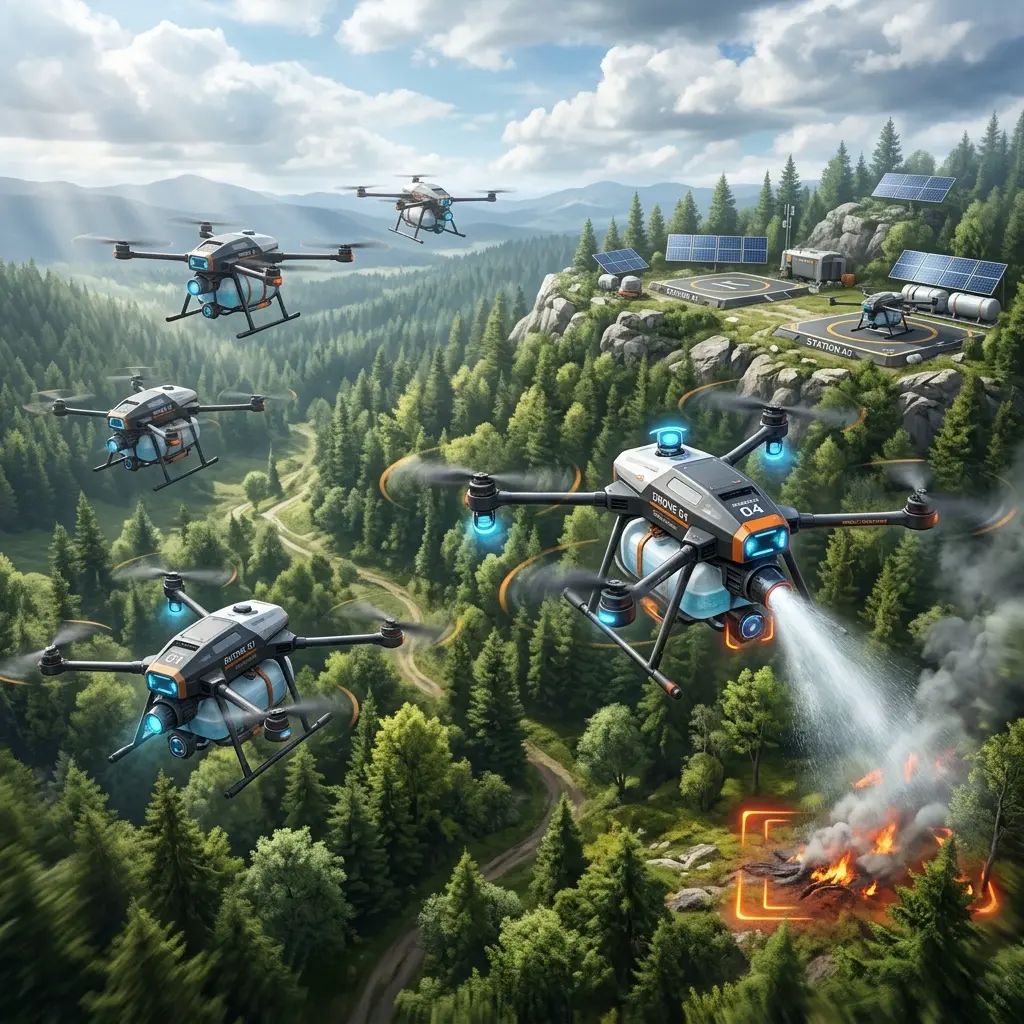
Airbus doesn't hide that the IFS is a first step toward a more ambitious future: autonomous wildfire combat, where unmanned cargo drones detect, assess, and attack fire hotspots without human intervention in the critical first stages.
The company's technology roadmap envisions:
| Phase | Horizon | Capability |
|---|---|---|
| IFS 1.0 (current) | 2026-2028 | Human pilot with AI-assisted targeting |
| IFS 2.0 | 2028-2030 | Cargo drones dropping water semi-autonomously |
| IFS 3.0 | 2030-2035 | Fully autonomous detection and response for initial hotspots |
| IFS 4.0 | 2035+ | Permanent drone surveillance + response network with solar recharging |
Phase 3.0, where autonomous cargo drones would detect a hotspot via thermal sensor and drop 500-1,000 liters of water in less than 3 minutes without any human intervention, would represent a revolution comparable to automated external defibrillators in public health — devices that detect cardiac arrest and deliver a shock without needing a doctor, saving thousands of lives annually precisely due to their response speed.
The Calculation That Justifies Everything: The Mathematics of Prevention
The economic argument in favor of the IFS is brutally simple. In 2025, global costs of wildfire destruction were estimated at US$ 347 billion — including destroyed properties, health costs (respiratory illnesses from smoke), agricultural losses, tourism impact, and reconstruction costs. Combat costs (aircraft, personnel, logistics) added another US$ 42 billion.
Total: nearly US$ 400 billion per year spent on wildfires globally.
The French IFS contract costs €180 million over 3 years — €60 million per year. France spent €1.2 billion on post-fire combat and reconstruction in 2022 and 2023 combined alone. If the IFS reduces burned area by 50% (a result consistent with the Istres tests), the savings would be hundreds of millions of euros per year — a return on investment of more than 10:1.
It's the same principle as seismographs and tsunami warning systems: the device itself is expensive, but the cost of not having it is incomparably greater. The difference with wildfires is that, while earthquakes and tsunamis are inevitable, the intensity of wildfires is directly amplified by human choices — primarily the burning of fossil fuels that heats the planet. The irony of using advanced technology to combat a problem caused by previous technology is not lost on researchers in the field.
FAQ — Frequently Asked Questions
When will the system be operational?
France has already signed a pilot contract for deployment starting in 2027. Other European countries are in negotiations. Broad availability is expected by 2028-2030.
How much does implementing the IFS cost?
The French contract is €180 million for 3 years (12 drones, 2 command centers, retrofit of 8 helicopters). For smaller countries, reduced configurations could cost €50-80 million.
Does the technology work on any type of terrain?
Tests were conducted on Mediterranean terrain (pine forest, dry brush, rugged terrain). Airbus plans additional tests in boreal forests (Canada), savanna (Australia), and Atlantic forest to validate necessary adaptations.
Can autonomous drones really extinguish fires on their own?
In the projected future (IFS 3.0, 2030-2035), cargo drones carrying 500-1,000 liters could autonomously attack initial hotspots. For large wildfires, human coordination will remain essential. Automation doesn't replace firefighters — it frees them for tasks requiring human judgment.
Could this technology be used in tropical regions?
Yes. Countries suffering devastating fires in tropical forests and savannas could potentially benefit. However, the scale of these regions (millions of hectares) is much larger than the European Mediterranean, requiring significant adaptations to the system architecture — especially in drone flight endurance and communication infrastructure in remote areas.
Sources and References
- Airbus Defence & Space: "Integrated Fire System Trial Results — Istres 2026" — March 2026
- Sécurité Civile (France): IFS Contract Announcement — March 2026
- European Forest Fire Information System (EFFIS): Annual Report 2025
- WMO (World Meteorological Organization): "2025 Confirmed as Hottest Year on Record" — January 2026
- CSIC: Dr. Cristina Santín — Analysis published in Nature Climate Change
- Colonel Jean-Philippe Hédé, Istres Air Base — Official testimony
- Canadian Interagency Forest Fire Centre: 2023 Wildfire Season Report


