
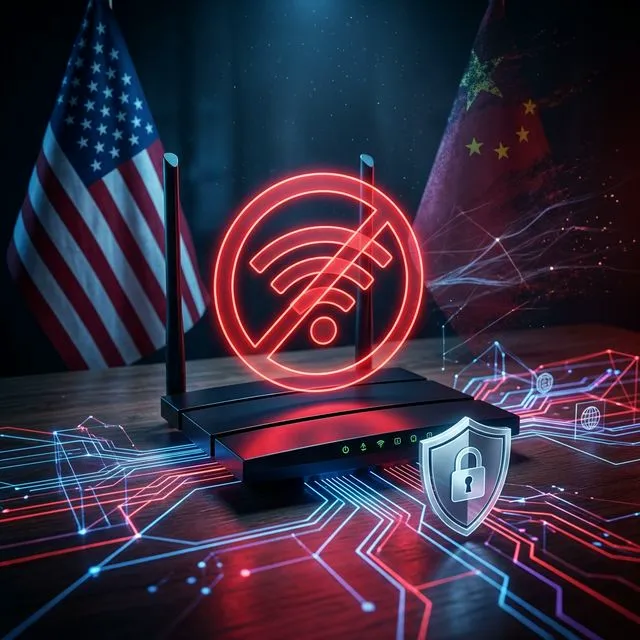
On Monday, March 24, 2026, the US Department of Commerce published an executive order that, with a stroke of a pen, shook the global networking equipment market: starting July 1, 2026, the import, sale, and installation of foreign-manufactured routers on American soil is prohibited. The measure directly targets Chinese manufacturers like TP-Link, Huawei, and ZTE, but also affects European and other Asian companies.
The official justification cites "confirmed supply chain vulnerabilities" and "unacceptable risks to critical telecommunications infrastructure." President Donald Trump was more direct on Truth Social: "Chinese routers in American homes = Chinese backdoors in American data. It's over."
What Triggered the Decision
Three events in the past 18 months created the groundwork:
1. The TP-Link case (October 2025): CISA investigators discovered undocumented firmware in TP-Link routers sold in the US, capable of mirroring traffic to Beijing servers and creating a latent botnet. TP-Link — the world's largest router seller with 65% of the US home market — denied the allegations.
2. The power grid attack (December 2025): A sophisticated cyberattack hit the electrical grid of three states (Texas, Louisiana, Mississippi), causing partial blackouts during a cold wave that killed 17 people. The NSA attributed the attack to Volt Typhoon, linked to the Chinese government, which used compromised home routers as entry points.
3. The classified FBI report (January 2026): The FBI estimated that over 12 million routers in American homes and offices contained exploitable vulnerabilities. About 70% were Chinese-manufactured.
What the Order Prohibits
| What's banned | Details |
|---|---|
| New router imports | From any manufacturer without NIST certification |
| Retail sales | Retailers have 6 months to remove non-certified products |
| Critical infrastructure | Immediate ban (no transition period) |
| ISP routers | Providers must replace foreign equipment in 18 months |
What's NOT banned: keeping already-installed foreign routers; equipment from "whitelist" countries (US, Canada, Japan, South Korea, Australia, EU); enterprise routers already meeting NIST standards.

Consumer Impact
| Category | Current price (with TP-Link) | Estimated (without TP-Link) | Increase |
|---|---|---|---|
| Basic router | $30-50 | $80-120 | +100-140% |
| Wi-Fi 6E router | $60-100 | $150-250 | +100-150% |
| Mesh system | $150-250 | $300-500 | +100% |
The Consumer Technology Association estimates the measure will cost American families an average of $100-200 extra per household over the next 3 years.
International Reaction
China: called the measure "flagrant protectionism disguised as security" and threatened "proportional countermeasures." Europe: expressed concern about the measure's "extraterritorial scope." US Industry: divided — Cisco and Netgear support it; Amazon and Walmart worry about stock and consumer impact.

Real Security or Security Theater?
The central question: does the ban genuinely make Americans safer, or is it primarily a trade war tool? Security analyst Bruce Schneier notes: "The threat is real, but the solution is calibrated to benefit domestic commercial interests. The correct approach would be to require mandatory security standards for ALL routers — American or not — instead of banning by country of origin."
FAQ
Do I need to replace my TP-Link router?
Not for now. The order doesn't require consumers to replace already-installed equipment.
Does this affect Brazil?
Indirectly. Brazil isn't on either list. Domestically, Brazil doesn't plan similar measures.
Do Chinese routers really spy?
The FBI and CISA presented evidence of undocumented firmware in specific TP-Link models. This doesn't mean all Chinese routers spy, but the risk was deemed unacceptable.
Sources and References
- U.S. Department of Commerce — Executive Order (March 24, 2026)
- CISA — "TP-Link Firmware Analysis Report" (October 2025)
- FBI — Testimony to Senate Intelligence Committee (January 2026)
- Consumer Technology Association — Impact Assessment (March 2026)


