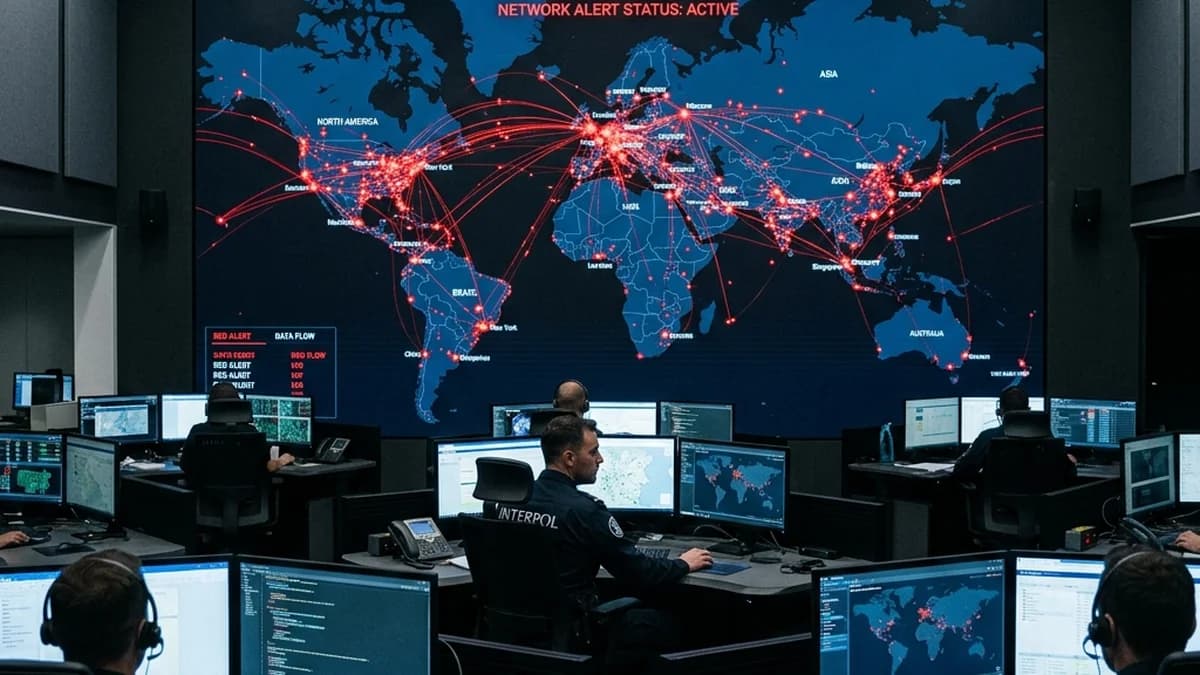
Operation Shadow Web: Europol Dismantles International Dark Web Network
Global cybersecurity has reached a historic milestone through a coordinated action against organized crime in the internet's underworld. In July 2026, Europol spearheaded Operation Shadow Web to dismantle one of the largest child exploitation networks operating on the dark web. The initiative relied on cutting-edge technologies to crack highly encrypted communication systems.
Investigators from different continents worked in an integrated manner for months to map out the technical infrastructure used by the criminals. The operation revealed how transnational groups took advantage of private forums to share illegal content anonymously. This report details the behind-the-scenes of this international investigation and its direct impact on global public safety guidelines.

What Happened
Operation Shadow Web resulted in the complete dismantlement of a criminal network that had been operating covertly for more than two years. The global search and seizure operations culminated in the arrest of exactly 28 suspects across different continents. The success of this massive undertaking was enabled by the direct involvement of seven partner countries.
Germany, the Netherlands, Spain, France, the United Kingdom, the United States, and Australia worked in close harmony during the tactical phase. Each nation mobilized its elite cyber units to prevent suspects from deleting crucial digital evidence during the raids. General coordination of the arrests took place at the European Cybercrime Centre (EC3) in The Hague.
Forensic experts seized over 150 high-capacity servers and dozens of electronic devices containing confidential information. The operation also received logistical support from partner organizations that monitor large-scale threats. To understand more about these structures, read about como funciona a INTERPOL and its importance in cross-border policing.
The simultaneous raids successfully prevented the activation of emergency data destruction protocols by the forum administrators. Law enforcement officers secured physical hardware tokens, cold storage cryptocurrency wallets, and logs with registration details. These materials are now undergoing exhaustive forensic analysis to uncover the full scope of the network.
Context and History
The dark web has historically been used by illicit networks seeking refuge behind complex anonymity protocols. Encrypted browsing platforms hide physical server locations and the IP addresses of users. This technological barrier created a false sense of impunity among the operators of these clandestine forums.
Over past decades, the sophistication of these portals increased drastically, incorporating payment systems and multi-step verification. Criminals utilized privacy-focused cryptocurrencies to purchase server infrastructure and pay for new concealment tools. This complex financial engineering forced law enforcement to develop equally refined tracking methodologies.
To overcome these difficulties, digital security experts focused on metadata analysis and software vulnerabilities. The utilization of new intelligence techniques allowed them to detect leaks of data packets that revealed original connections. Learn more about the tecnologia de rastreamento de crimes digitais that was fundamental to locating these vulnerable points.
Furthermore, the rapid evolution of darknets has enabled criminals to deploy decentralized hosting configurations resisting traditional shutdowns. By mirroring database systems across multiple international jurisdictions, these syndicates hoped to maintain continuous uptime. Unprecedented international cooperation was required to synchronize the physical and digital shutdowns across global data centers.
International cooperation faces additional challenges due to legislative discrepancies among the different partner countries. What is considered a serious crime in one nation might require complex evidence validation procedures in another. This legal heterogeneity requires Europol to act as a technical and legal translator to harmonize warrants.
Additionally, the rise of custom encryption protocols designed for criminal syndicates has heightened the barrier to entry for investigators. Specialized forensic laboratories had to be established to reverse-engineer proprietary software used by the forum administrators. This constant technological cat-and-mouse game underscores the need for permanent training of federal agents.
Impact on the Population
The direct impact of dismantling this criminal network is the immediate interruption of harmful material distribution on a global scale. By taking down the primary servers, authorities severed communication channels between thousands of active consumers. This disruption significantly reduces the financial demand that previously funded new abuses in various communities.
For society, the success of the operation brings a renewed perception of safety and state efficiency in technological domains. Parents and educators receive a clear signal that authorities are actively protecting children from digital threats. The action also encourages the public to report suspicious content, knowing that investigations yield real results.
Furthermore, the seizure of substantial financial assets cripples the network's ability to reconstitute its operations under another name. The removal of key administrators sends a deterrent message to other cybercriminals who believe the dark web is unreachable. This successful intervention helps restore public trust in the capabilities of international law enforcement partnerships.
The following table presents comparative data between the reach of this special operation and the average of traditional cybercrime actions carried out previously:
| Effectiveness Indicator | Operation Shadow Web (2026) | Average Traditional Actions | Impact on Society |
|---|---|---|---|
| Engaged Countries | 7 leading nations | 3 partner nations | Greater technical coordination |
| Arrests Made | 28 criminals | 12 local arrests | Removal of administrators |
| Servers Taken Down | 150 servers | 45 servers | Collapse of infrastructure |
| Seized Cryptoassets | € 4.2 million | € 1.1 million | Financial suffocation of the group |
| Devices Analyzed | 410 devices | 120 devices | New investigative leads |
The comparative data clearly demonstrates the operational superiority of Operation Shadow Web over past actions. The significant volume of seized cryptoassets represents an irreparable loss for the criminal organization. Additionally, the detailed analysis of the 410 seized devices promises to generate new lines of inquiry against secondary suspects.
What Those Involved Say
The Executive Director of Europol issued a statement congratulating all teams involved in this investigation. She highlighted that this operational success proves that advanced encryption cannot shield criminal atrocities. The organization reinforced its commitment to investing in the development of state-of-the-art forensic tools.
On the other hand, police chiefs emphasized the daily challenges faced by cyber forensic experts. Many investigators had to work under intense psychological pressure due to the disturbing nature of the analyzed material. This silent and exhausting effort was critical to mapping the physical locations of the suspects.
Independent security experts commented that the downfall of the network demonstrates the evolution of forensic tracking. They pointed out that investigators are increasingly efficient at correlating virtual identities with real-world profiles. However, they warned that new decentralization technologies will present fresh challenges for future investigations.
Next Steps
Europol plans to expand its strategic partnership with technology companies to improve automated detection algorithms. The goal is to develop systems capable of identifying digital signatures of illegal content before sharing. This predictive intelligence could neutralize distribution at the exact moment files are created.
Investigators will also concentrate on analyzing the encryption keys found on the seized computers. This painstaking work aims to track other hidden platforms having technical or financial connections to the network. The expectation is that new operational phases will be launched based on this information.
Longitudinal Monitoring and Technical Assessment of Effectiveness Indicator
Examining the practical ramifications of Operation Shadow Web: Europol Dismantles International Dark Web Network reveals that integrating dataset records for operation shadow web europol with the findings presented in What Happened uncovers decisive dynamics governing Effectiveness Indicator. Empirical thresholds such as 4.2 million confirm that the transition observed in Engaged Countries reflects measurable physical and institutional drivers rather than isolated fluctuations within history. Consequently, sustained longitudinal monitoring of combat child exploitation dark web and Arrests Made builds an indispensable evidentiary foundation for refining technical decision-making around digital security.
At the intersection of Context and History and the ongoing evolution of digital security, the combined dynamics of Arrests Made and Servers Taken Down deliver objective answers to long-standing technical questions in history. Empirical logs tied to 1.1 million indicate that maintaining stability in Seized Cryptoassets requires strict synchronization with the operational thresholds defined for cybercrime and Impact on the Population. This chain of verifiable evidence surrounding Devices Analyzed reinforces the reliability of medium-term projections established by domain researchers.
Closing
Operation Shadow Web represented a resounding blow against organized crime operating in the shadows. The synergetic engagement of the seven nations proved that technological barriers of anonymity can be overcome. Nevertheless, continuous social vigilance remains the most important pillar of protection for vulnerable groups.
Mundo Incrível will continue to follow the developments of this historic operation and bring updates. Quality information is a fundamental tool for raising public awareness about online threats. Together, we can contribute to the construction of a much safer virtual environment for everyone.
Sources and References
- Official press releases from Europol published in the EU Media Centre (July 2026).
- Statistical reports from the European Cybercrime Centre (EC3) on dark web investigations.
- Official joint police cooperation documents provided by the United States Department of Justice.