
Operation Epic Fury: The US-Iran Military Crisis That Could Change the Global Balance of Power
Date: March 13, 2026
Reading time: 30 minutes
Emoji: ⚔️
In February 2026, the United States launched the largest military mobilization in the Persian Gulf since the invasion of Iraq in 2003. Under the codename "Operation Epic Fury," the offensive combined precision airstrikes against Iranian nuclear facilities, an unprecedented cyber warfare campaign against the country's infrastructure, and the deployment of three carrier strike groups to the Strait of Hormuz — the most strategic chokepoint for global oil transportation. Iran's response was equally dramatic: partial closure of the Strait, activation of proxy cells in Lebanon, Iraq, and Yemen, and a massive cyber retaliation that struck Western financial systems. The crisis, still unfolding in March 2026, represents the most dangerous confrontation between the two nations in over four decades — and its consequences are already reshaping global geopolitics, energy markets, and international alliances in potentially irreversible ways.
Context: The Escalation That Led to Epic Fury
The Iranian Nuclear Program — The Last Straw
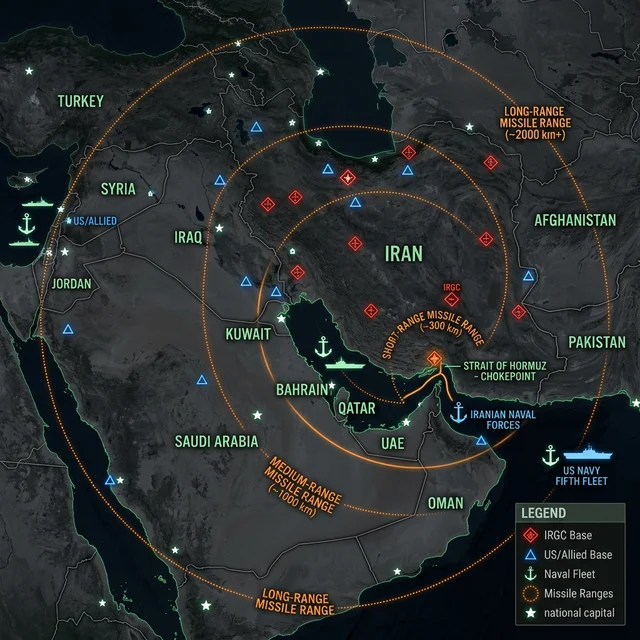
The tension between Washington and Tehran didn't appear from nowhere. The escalation had deep roots in a series of events that accumulated throughout 2024 and 2025:
JCPOA Collapse (2024): After years of failed negotiations to revive the 2015 nuclear deal, Iran formally announced its withdrawal from the JCPOA (Joint Comprehensive Plan of Action) in August 2024, declaring it no longer felt bound by any limitations on uranium enrichment.
90% Enrichment (September 2025): The International Atomic Energy Agency (IAEA) confirmed that Iran had achieved 90% uranium enrichment — the threshold for nuclear weapons. IAEA inspectors were expelled from the Fordow and Natanz facilities, triggering an emergency session of the UN Security Council.
Escalated Proxy Attacks (October-December 2025): The Iran-backed Houthis in Yemen intensified attacks against commercial shipping in the Red Sea. Hezbollah conducted drone strikes against Israeli targets. Iraqi militias attacked American bases in Syria and Iraq with increasing frequency — culminating in an attack that killed 3 American soldiers in December 2025.
Nuclear "breakout" intelligence (January 2026): The Israeli Mossad and the CIA shared converging assessments indicating Iran was 3-6 months from assembling a nuclear device. The American president convened a National Security Council meeting and ordered operational planning for what would become Epic Fury.
| Timeline | Event |
|---|---|
| Aug 2024 | Iran formally withdraws from JCPOA |
| Sep 2025 | IAEA confirms 90% enrichment |
| Oct-Dec 2025 | Escalation of proxy attacks in Red Sea and Middle East |
| Dec 2025 | 3 American soldiers killed in militia attack in Iraq |
| Jan 2026 | Intelligence indicates nuclear "breakout" in 3-6 months |
| Feb 2026 | Launch of Operation Epic Fury |
Operation Epic Fury: Three Simultaneous Fronts
Front 1: Precision Airstrikes
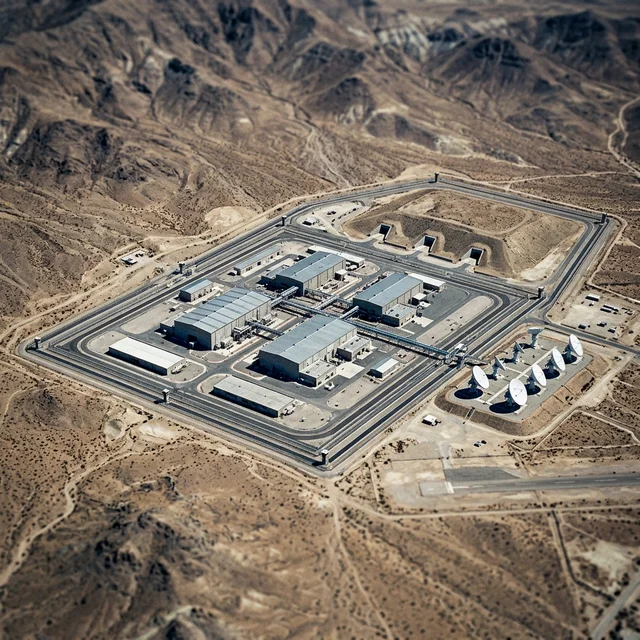
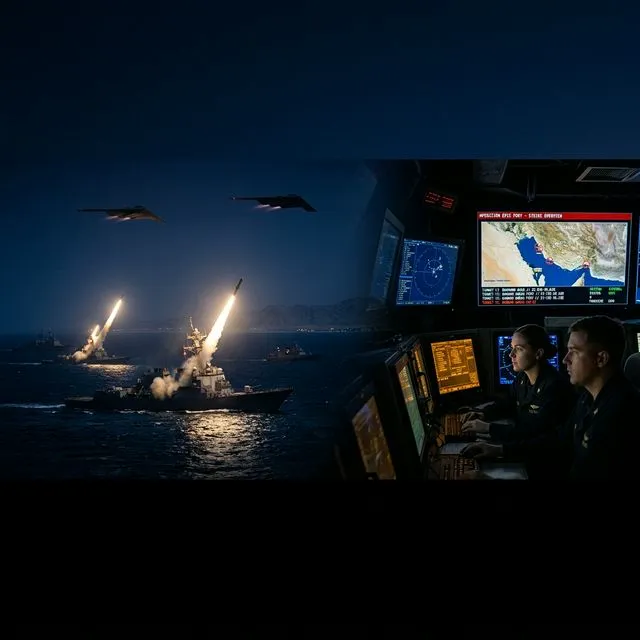
The first phase consisted of precision airstrikes against Iranian nuclear and air defense infrastructure. Operations were conducted by B-2 Spirit bombers and F-35A fighters from bases in the Gulf region, complemented by salvos of Tomahawk cruise missiles launched from Navy cruisers and destroyers positioned in the Arabian Sea and the Persian Gulf.
Primary targets included the uranium enrichment facilities at Fordow (buried under a mountain near Qom) and Natanz, the Arak research center, and multiple ballistic missile storage installations. The Pentagon deployed GBU-57 Massive Ordnance Penetrators (MOPs) — 30,000-pound bombs specifically designed to penetrate hardened underground targets — against Fordow's buried facilities.
The US employed an unprecedented combination of firepower and technology:
- B-2 Spirit: Stealth bombers flew 36-hour missions directly from Whiteman AFB, Missouri, with multiple aerial refueling over the Atlantic and Indian Oceans
- F-35A Lightning II: Dozens of fighters operating from bases in Qatar, Bahrain, and UAE, conducting Suppression of Enemy Air Defenses (SEAD) and precision strikes
- Tomahawk Block V: Hundreds of cruise missiles launched from Navy vessels, with in-flight route replanning capability and integrated defense penetration
- GBU-57 MOP: The largest conventional bombs in the American arsenal, capable of penetrating 200+ feet of earth and concrete before detonating
Front 2: Cyber Warfare
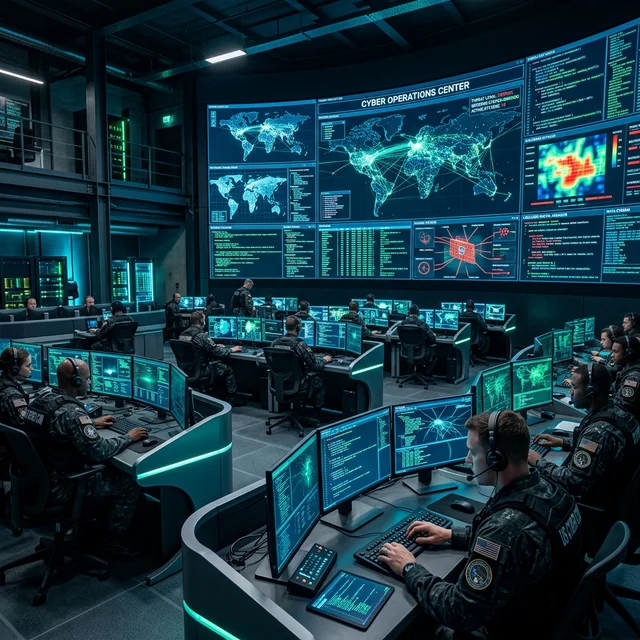
The second front — and perhaps the most revolutionary — was a cyber warfare campaign coordinated by US Cyber Command (USCYBERCOM) and the NSA. This campaign represented the first time in history that offensive cyber operations were integrated in real-time with a large-scale kinetic campaign against a sovereign state.
Cyber attacks targeted multiple layers of Iranian infrastructure simultaneously:
- Power grid: Sophisticated malware penetrated SCADA systems of Iranian power plants, causing partial blackouts in Tehran, Isfahan, and Shiraz to degrade military response capability
- IRGC military communications: The encrypted communication systems of the Islamic Revolutionary Guard Corps were compromised, including command-and-control networks for ballistic missile launches. American operators managed to intercept and, in some cases, block launch orders in real-time
- Banking system: Massive DDoS attacks against Iran's Central Bank and major commercial banks paralyzed financial transactions for 72 hours
- Propaganda and disinformation: USCYBERCOM hackers temporarily hijacked the IRIB state broadcast, transmitting messages in Farsi directed at the Iranian public
Iran responded with significant cyber retaliation: attacks on financial systems in Bahrain, UAE, and Qatar, attempted compromises of American critical infrastructure, and massive social media disinformation campaigns in multiple languages.
Front 3: Naval Blockade and the Strait of Hormuz
The Strait of Hormuz is, without exaggeration, the most strategic point on the planet in terms of global energy security. Approximately 21 million barrels of oil pass through it daily — roughly 20% of world consumption. The strait is only 21 miles wide, with shipping lanes even narrower at just 2 miles in each direction.
Iran's immediate response was what analysts feared most: partial closure of the Strait. The IRGC Navy deployed naval mines, launched swarms of fast attack boats armed with missiles, and positioned Noor and Ghader anti-ship cruise missiles on mountain slopes overlooking the strait.
The US responded with the largest naval concentration in the region since 2003: three carrier battle groups (USS Gerald Ford, USS Dwight Eisenhower, and USS Ronald Reagan), accompanied by Aegis destroyers, nuclear submarines, and mine warfare ships.
The economic impact was immediate and devastating:
| Indicator | Before Crisis | During Crisis | Change |
|---|---|---|---|
| Brent Price (barrel) | ~$87 | $142 (peak) | +63% |
| Gas Price (US/gallon) | ~$3.50 | ~$5.80 | +66% |
| Maritime insurance risk premium | Normal | +4,000% | Explosion |
| Ships detained at Strait | 0 | ~120 | — |
| Global oil production affected | 0% | ~15-20% | — |
International Reactions and Alignments
The Epic Fury crisis provoked rapid polarization of the international community:
Supporting the US: Israel (direct intelligence participation, missile defense), United Kingdom (naval deployment, GCHQ intelligence sharing), Saudi Arabia and UAE (provided airbases and regional intelligence), Australia and Japan (diplomatic support and minor logistics).
Opposition/Neutrality: China (condemned strikes, convened emergency UN Security Council session, mediated secret communications between Tehran and Washington), Russia (condemned attacks as "illegal aggression," provided S-400 air defense assistance to Iran but avoided direct military involvement), India (carefully neutral position, calling for "immediate de-escalation").
The Iranian Nuclear Program: What Survived?
The effectiveness of strikes against Iran's nuclear program remains hotly debated. Natanz surface facilities suffered major damage with confirmed destruction of centrifuge cascades, but deeper underground facilities suffered limited damage. Fordow, buried under 90+ meters of mountain rock, saw only its access tunnels destroyed — the status of nuclear equipment inside remains uncertain. The Arak heavy water reactor was effectively destroyed.
Military analysts estimate the strikes delayed Iran's nuclear program by 2-5 years — significant but far from permanent elimination. Iran's technical and scientific knowledge remains intact, and the country possesses dispersed enriched uranium resources that may not have been hit.
Global Economic Impact: The 2026 Oil Shock
The Strait of Hormuz crisis triggered the third major oil shock in history, after 1973 and 1979. Brent crude surged to $142 per barrel at the crisis peak before partially retreating as the US Strategic Petroleum Reserve and emergency OPEC+ agreements kicked in. Global stock indices fell 8-15% in the first two weeks, with the S&P 500 losing over $3 trillion in market value. Supply chain costs for Asian importers increased 40-80%.
Future Scenarios for Coming Months
Scenario 1: Negotiated De-escalation
Chinese mediation leads to indirect negotiations through Oman or Qatar. An informal ceasefire is established, with Iran agreeing to resume IAEA inspections in exchange for partial sanctions relief.
Scenario 2: Prolonged Attrition
The conflict transforms into a prolonged low-intensity war with continuous cyber attacks, naval confrontations, and intermittent proxy activation. Oil stabilizes at $100-120/barrel.
Scenario 3: Regional Escalation
The conflict expands to directly involve Israel (Iranian ballistic missile attacks), Hezbollah (war in Lebanon), and Iraqi militias. The region enters a multi-front conflict lasting months.
Conclusion: The Most Dangerous Moment Since the Cold War
Operation Epic Fury represents far more than a military campaign against Iran's nuclear program. It is an inflection point in the post-Cold War international order — the moment when accumulated tensions between global, regional, and non-state powers converged in a conflict that tested the limits of the international system. The consequences will be felt for decades.
Sources and References


