The James Webb Space Telescope has detected carbon dioxide ($CO_2$) and hydrogen peroxide ($H_2O_2$) on the frozen surface of Charon, the largest moon of the dwarf planet Pluto, for the first time in history. The discovery, published in the journal Nature Communications by an international research team led by the Southwest Research Institute (SwRI), fundamentally expands the chemical inventory of this distant icy world located in the Kuiper Belt, nearly six billion kilometers from the Sun. The high-resolution spectroscopic observations demonstrate that Charon's crust is not an inert remnant of planetary accretion, but rather an active cryogenic laboratory driven by cosmic radiation and solar winds at temperatures below 40 Kelvin (-233 degrees Celsius).
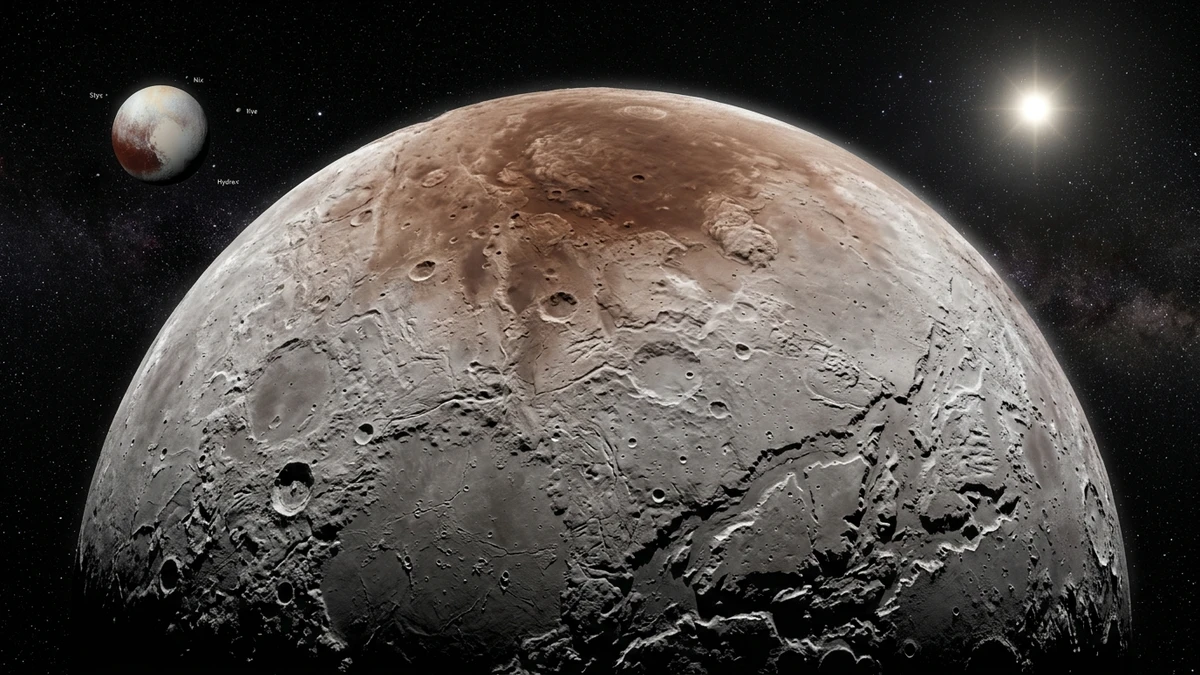
Prior to this landmark investigation conducted by the James Webb observatory, planetary scientists relied almost exclusively on observations from NASA's New Horizons spacecraft, which executed a historic flyby of the Pluto-Charon binary system in July 2015. While New Horizons successfully mapped vast extents of crystalline water ice, massive tectonic chasms, and Charon's distinctive reddish north polar hood named Mordor Macula, its onboard linear etalon imaging spectral array (LEISA) operated only up to wavelengths of 2.5 micrometers. This physical constraint prevented the spacecraft from observing the characteristic diagnostic infrared absorption bands where carbon dioxide and hydrogen peroxide produce their most prominent spectral fingerprints.
Dr. Silvia Protopapa, a senior principal scientist at the Southwest Research Institute and lead author of the study, directed the scientific deployment of the telescope's Near-Infrared Spectrograph (NIRSpec). Operating in its Integral Field Unit (IFU) configuration, the observatory measured reflected sunlight across the continuous wavelength regime from 0.97 to 5.27 micrometers. This expanded infrared window revealed an unambiguous, sharp absorption feature at 4.27 micrometers caused by crystalline carbon dioxide, accompanied by a broad and distinct absorption band centered at 3.5 micrometers corresponding directly to hydrogen peroxide ice.
The detection of carbon dioxide provides crucial insights into the original volatile inventory that condensed in the outer solar nebula during the primordial epochs of planetary formation. Charon has a diameter of roughly 1,214 kilometers and forms a tidally locked, mutual gravitational system with Pluto. While Pluto possesses sufficient surface gravity to maintain a tenuous seasonal atmosphere of nitrogen and methane, Charon's lower escape velocity allowed its volatile surface gases to disperse into space over billions of years. The carbon dioxide observed today represents a stratified veneer overlying the thicker water-ice mantle, indicating that primordial volatiles buried within the moon's interior have been exhumed by successive impacts of Kuiper Belt meteoroids and comets.
Spectroscopic Measurements and Physical Parameters of Charon's Surface
The structured table below details the quantitative measurements, diagnostic absorption wavelengths, and astrophysical interpretations established by the James Webb NIRSpec observations. These metrics illustrate the critical advancement over prior planetary flyby missions and underscore the active photolytic evolution occurring on outer solar system bodies.
| Observational Parameter | Detected / Measured Value | Astrophysical and Geological Significance |
|---|---|---|
| Observation Spectral Range | $0.97,\mu\text{m}$ to $5.27,\mu\text{m}$ | Full NIRSpec IFU coverage, surpassing the previous $2.5,\mu\text{m}$ boundary. |
| Diagnostic $CO_2$ Band | Deep absorption at $4.27,\mu\text{m}$ | Confirms stratified carbon dioxide veneer sitting atop the water-ice crust. |
| Diagnostic $H_2O_2$ Signature | Broad absorption centered at $3.5,\mu\text{m}$ | Unmistakable empirical evidence of active water-ice radiolysis by energetic ions. |
| Mean Surface Temperature | Approximately $40,\text{K}$ ($-233,^\circ\text{C}$) | Extreme cryogenic regime that stabilizes volatile frost and chemical radicals. |
| $CO_2$ Exposure Mechanism | Impact excavation and cratering | Primordial subsurface carbon dioxide unroofed and redistributed by impacts. |
| Primary Radiative Drivers | Solar Lyman-alpha UV and cosmic rays | High-energy photon and ion bombardment driving molecular photolysis of ice. |
The identification of hydrogen peroxide carries profound implications for outer solar system chemistry, serving as undeniable confirmation that Charon undergoes active surface radiolysis. Charon's outer crust consists predominantly of crystalline and amorphous water ice mixed with ammoniated hydrates. When solar wind protons, galactic cosmic ray ions, and solar Lyman-alpha ultraviolet photons relentlessly strike the unprotected cryogenic ice, they cleave the covalent bonds of water molecules through ionizing radiation and photolysis.
In this harsh radiation environment, hydrogen atoms are stripped away and rapidly escape into the surrounding space vacuum, while the remaining hydroxyl radicals ($OH$) recombine within the cold ice lattice to form hydrogen peroxide ($H_2O_2$). While ultra-high vacuum laboratory simulations had long suggested that energetic radiation should generate hydrogen peroxide on exposed water-ice surfaces in space, the Webb observations represent the first direct, unambiguous empirical detection of this process on a classic, mid-sized Trans-Neptunian Object.
Radiative transfer modeling developed by the international team enabled researchers to determine the geometric and physical distribution of the newly identified species across the celestial disk. The spectral modeling indicates that carbon dioxide exists as a thin, patchy superficial coating rather than a uniform, thick volatile slab. This stratified arrangement suggests that seasonal heating across Charon's 248-year orbital period may cause localized thermal migration and sublimation of volatile ices, constantly redistributing trace compounds across contrasting regional topographies.
Furthermore, this groundbreaking chemical census sheds new light on the origin of Mordor Macula, the prominent dark reddish northern polar terrain of Charon. Scientists previously determined that methane gas escaping from Pluto's atmosphere drifts through interplanetary space and freezes onto the ultra-cold polar winter cap of Charon, where solar ultraviolet radiation processes it into complex red-tinted macromolecules known as tholins. The confirmed presence of native carbon dioxide and active peroxide synthesis indicates that the organic synthesis pathway on Charon possesses an abundant local supply of oxygen and carbon, drastically diversifying the potential prebiotic chemical complexity occurring in the Kuiper Belt.
By unraveling the compositional stratification of Pluto's primary satellite, the James Webb Space Telescope reinforces its status as an unparalleled vanguard of modern astrophysics and planetary exploration. Extending infrared observations to long wavelengths with unprecedented sensitivity allows scientists to probe the chemical frontiers of ancient planetary remnants without requiring in situ orbiters. These observational milestones establish a vital scientific baseline for future robotic missions seeking to navigate the distant frontiers of our solar system.
Frequently Asked Questions About the Discovery on Charon
What did the James Webb Space Telescope detect on Charon and why is it a scientific breakthrough?
The James Webb Space Telescope detected carbon dioxide and hydrogen peroxide on the frozen surface of Charon, Pluto's largest companion. Although NASA's New Horizons spacecraft mapped Charon during its 2015 flyby, its onboard infrared instruments could not record spectral signatures beyond two and a half micrometers. By operating across an extended wavelength range up to five micrometers, Webb identified clear absorption features of carbon dioxide and hydrogen peroxide, proving that this remote world is chemically active rather than geologically dead.
How does hydrogen peroxide form on a frozen moon billions of kilometers from the Sun?
Hydrogen peroxide forms through an ongoing physical process known as water radiolysis under extreme cryogenic conditions. High-energy particles from the solar wind, energetic galactic cosmic rays, and solar ultraviolet radiation continuously strike Charon's exposed water-ice crust. This ionizing radiation breaks the molecular bonds of water, driving off light hydrogen atoms and allowing the leftover hydroxyl radicals to recombine into stable hydrogen peroxide molecules that remain trapped within the ice at minus two hundred and thirty-three degrees Celsius.
Why is the discovery of carbon dioxide on Charon important for understanding the early Solar System?
The presence of carbon dioxide on Charon serves as an ancient chemical record of the primordial protoplanetary disk from which planets and Kuiper Belt objects condensed over four billion years ago. Because Charon possesses modest gravitational pull and lacks a protective dense atmosphere, primordial carbon dioxide was buried beneath an outer mantle of water ice during its formation. Successive impacts by comets and micrometeoroids excavated this deep carbon dioxide, exposing it to the surface as an intact cryogenic time capsule.\n