
Iran Threatens to Attack Google, Apple and Meta: IRGC Declares Big Techs 'Legitimate Military Targets'
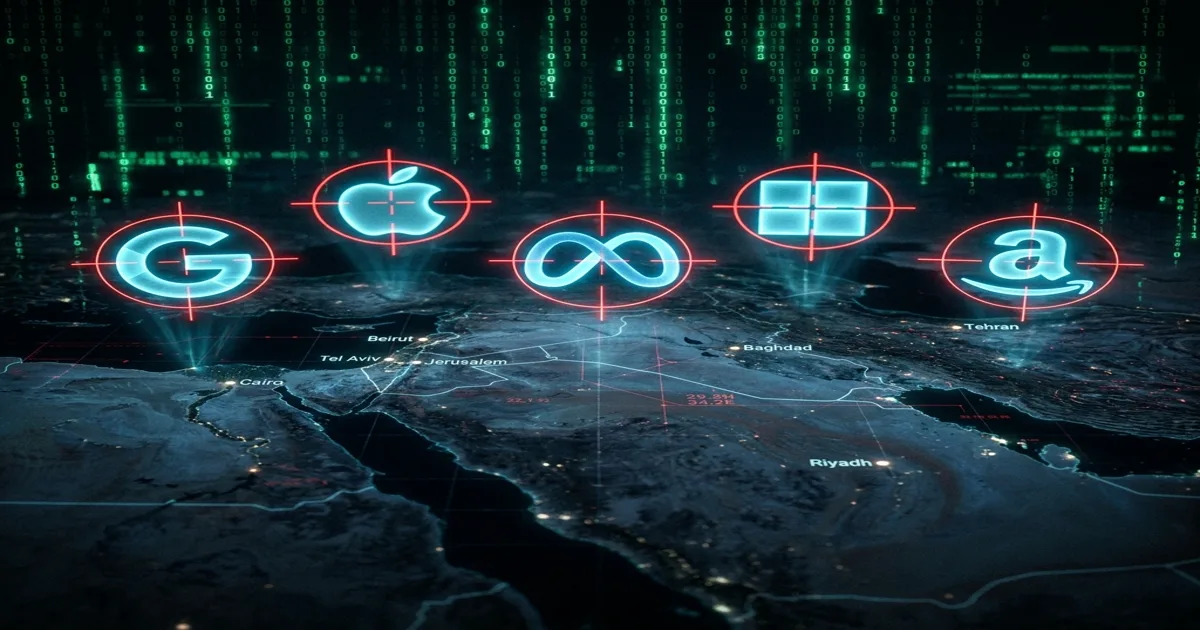
In an escalation that merges geopolitics, technology and cyberwar in an unprecedented manner, Iran's Islamic Revolutionary Guard Corps (IRGC) declared on March 31, 2026 that American technology companies — specifically Google, Apple and Meta — are now considered "legitimate military targets" by the Iranian regime.
The statement, published through the IRGC's official communication channel and reproduced by agencies IRNA and Tasnim, accused the three companies of "active collaboration with intelligence services of the Zionist entity [Israel] and the US Department of Defense" in surveillance and data collection operations targeting Iranian citizens, military officials and nuclear infrastructure.
What the IRGC Said
The statement was specific and detailed, accusing the companies of:
- Google: Providing satellite imagery from Google Maps and Google Earth that was allegedly used to plan attacks on Iranian military installations. The accusation also includes Google Cloud providing computing infrastructure for intelligence analysis
- Apple: "Deliberately inserting surveillance backdoors" in iOS devices used by Iranian government officials, allegedly at the request of the NSA
- Meta (Facebook/Instagram/WhatsApp): Using its platforms to "psychologically manipulate the Iranian population" and coordinate opposition movements during the 2022-2023 protests
The Exact Words
The IRGC statement included the following passage (translated from Farsi):
"Any entity — corporate, governmental or individual — that provides material, technological or intelligence support for aggression against the Islamic Republic of Iran is considered a legitimate military target. This explicitly includes the technology companies based in the United States known as Google, Apple and Meta, which have demonstrated direct and active cooperation with the intelligence apparatus."
Context: Why Now?
The declaration doesn't emerge from a vacuum. It occurs in a highly volatile geopolitical context:
The Israel-Iran Escalation
Since the beginning of 2026, tensions between Israel and Iran have reached levels not seen since the 1979 Islamic Revolution. In February 2026, Israel allegedly conducted a cyberattack on the Natanz nuclear enrichment facility, temporarily disabling 40% of centrifuge capacity. Iran attributed the attack to a joint US-Israeli operation and vowed retaliation.
Sanctions and Technological Isolation
Iran has been under progressively tighter Western sanctions since 2018, when the US withdrew from the JCPOA nuclear deal. In 2025, the European Union expanded sanctions to include Iranian access to cloud computing platforms, citing national security concerns. This effectively cut Iranian government agencies off from AWS, Google Cloud and Azure — which Iran interpreted as "technological warfare."
The Role of Technology in Iranian Domestic Politics
During the Mahsa Amini protests (2022-2023), the Iranian government blamed social media platforms — particularly Instagram and WhatsApp (both Meta products) — for coordinating and amplifying protests that led to the death of more than 500 people. The government responded by implementing intermittent internet shutdowns that lasted months and caused billions in economic damage.
The Cyber Threat: What Could Iran Actually Do?
Iran is no cyber superpower, but it's not a pushover either. The country has invested heavily in offensive cyber capabilities since 2010, when the Stuxnet virus (attributed to the US and Israel) destroyed centrifuges at the Natanz facility.
Iran's Cyber Arsenal
| Capability | Level | Notable Examples |
|---|---|---|
| DDoS attacks | Advanced | 2012 attacks on US banks |
| Ransomware | Moderate | Attacks on healthcare systems |
| Infrastructure disruption | Advanced | 2019 Saudi Aramco operations |
| Social engineering | High | State-sponsored phishing campaigns |
| Wiper malware | Advanced | Shamoon variants |
What an Attack on Big Tech Would Look Like
Cybersecurity experts consulted by international publications outlined several scenarios:
- DDoS attacks on Google, Apple and Meta's consumer-facing services — disruptive but temporary
- Supply chain attacks targeting subcontractors and partners of the three companies in the Middle East
- Data exfiltration targeting employee accounts of the three companies
- Physical attacks on data centers or submarine cables — extremely unlikely but mentioned in the IRGC statement's language about "all forms of response"
The Companies' Response
Google released a brief statement: "We take seriously any threats against our infrastructure, employees and users. We maintain robust security protocols and work closely with relevant government agencies." The company did not directly address the IRGC's specific accusations.
Apple
Apple declined to comment publicly on the IRGC statement. Privately, sources told Bloomberg that Apple's security team had already been on "elevated alert" since the Natanz incident in February.
Meta
Meta's Head of Global Affairs issued a statement calling the IRGC declaration "deeply concerning" and noting that the company "does not cooperate with any intelligence agencies in conducting surveillance."
Expert Analysis
"Unprecedented but Not Unexpected"
Dr. James Lewis, Senior Vice President at the Center for Strategic and International Studies (CSIS), told Reuters: "This is the first time a state actor has explicitly declared civilian technology companies to be military targets. It's unprecedented in the language used, but not unexpected given the trajectory of US-Iran relations."
CISO Reactions
Chief Information Security Officers at major technology companies were briefed by the Cybersecurity and Infrastructure Security Agency (CISA) within hours of the IRGC statement. CISA issued a Shield Advisory recommending that all US technology companies "review and enhance access controls, incident response plans, and supply chain security postures."
Global Implications
The IRGC's declaration creates several dangerous precedents:
- Legitimizing attacks on civilian companies: If tech companies can be declared "military targets," what about banks that process sanctions? Airlines that refuse Iranian routes? The category becomes infinitely expandable
- Corporate security budgets: Major tech companies may need to invest even more in physical and cyber security, costs that ultimately get passed to consumers
- Employee safety: Thousands of Google, Apple and Meta employees travel internationally. The IRGC declaration effectively makes them potential targets
- Digital sovereignty acceleration: The incident strengthens arguments for "digital sovereignty" — the idea that countries should control their own technology infrastructure to avoid geopolitical vulnerabilities
FAQ
Can Iran really attack Google, Apple or Meta?
While a full-scale cyberattack that takes down Google, Apple or Meta entirely is extremely unlikely — these companies have among the most sophisticated cybersecurity infrastructures in the world — Iran has the capability to cause significant disruption through targeted attacks on specific services, employees, or supply chain partners. The greater risk is not a single dramatic attack but a sustained campaign of low-level cyber harassment.
Has Iran attacked technology companies before?
Yes. In 2012, Iranian hackers conducted massive DDoS attacks against major US banks including JPMorgan Chase and Bank of America. In 2014, Iranian hackers infiltrated the Sands Casino network. More recently, in 2023-2024, Iranian state-sponsored groups were linked to phishing campaigns targeting technology sector employees.
What does this mean for regular users?
For ordinary users of Google, Apple and Meta services, the immediate risk is minimal. These companies invest billions annually in cybersecurity and have robust defenses. However, users in the Middle East region, particularly those with connections to Iranian opposition groups, should exercise heightened security awareness.
Is this related to the nuclear deal?
Indirectly, yes. The collapse of the JCPOA nuclear deal in 2018, the subsequent reimposition of sanctions, and the ongoing Israeli-Iranian shadow war have all contributed to an environment where Iran sees Western technology companies as extensions of the geopolitical apparatus working against it.
Sources and References
- IRNA — Islamic Republic News Agency. IRGC official statement, March 31, 2026
- Reuters — "Iran's IRGC declares Google, Apple, Meta military targets" — March 31, 2026
- Bloomberg — "Big Tech on alert after Iranian military threat" — April 1, 2026
- CSIS — Center for Strategic and International Studies. Expert analysis
- CISA — Cybersecurity and Infrastructure Security Agency. Shield Advisory 2026-003


