
US-Israel-Iran War 2026: The Attacks That Redrew the Middle East in March
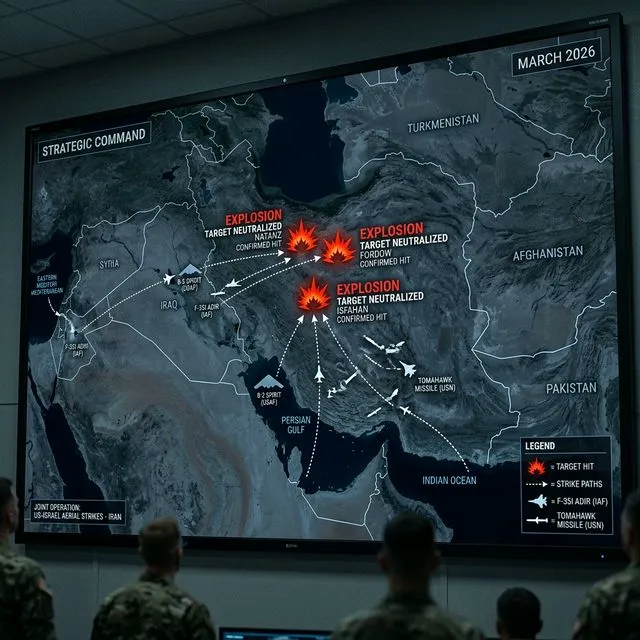
March 5, 2026, 02:47 local time in Tehran. The sky above the Iranian capital lit up with white streaks of Tomahawk missiles and satellite-guided bombs. In 47 minutes, more than 200 targets were hit simultaneously across 6 provinces — nuclear facilities, military bases, Revolutionary Guard command centers, and air defense infrastructure.
It was not a surgical strike. It was a war.
Chronology of Escalation: January to March 2026
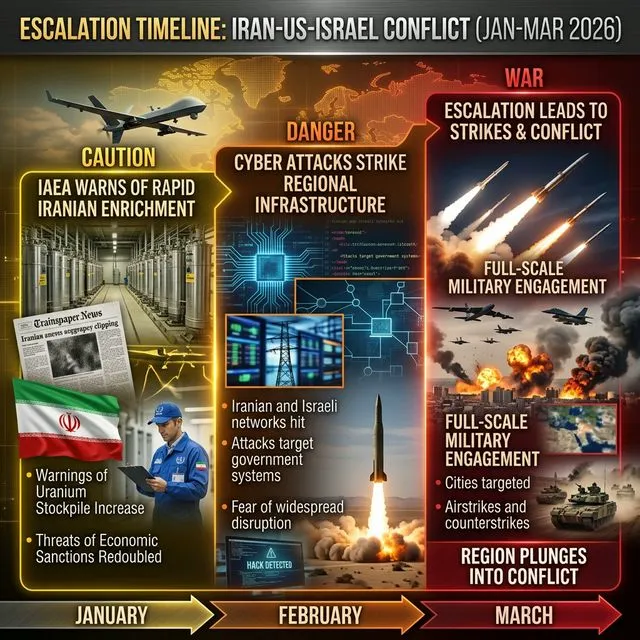
The war didn't begin in March. It was built over months of provocations, miscalculations, and crossed red lines.
January 2026: The Ignition Point
| Date | Event | Consequence |
|---|---|---|
| Jan 8 | Iran announces 84% uranium enrichment | UN Security Council emergency session |
| Jan 12 | Israel launches cyberattack on Natanz centrifuges | Iran accuses "act of war" |
| Jan 18 | IAEA confirms traces of 90% uranium at Fordow | US sends second carrier to Persian Gulf |
| Jan 24 | Houthis in Yemen attack American ship in Red Sea | 2 sailors killed — first US casualty |
| Jan 31 | Iran expels IAEA inspectors from 3 facilities | New START expires without renewal |
February 2026: The Spiral
- Feb 3: Israel assassinates Iranian nuclear scientist Mohsen Rezaei in Vienna. Iran promises "devastating revenge."
- Feb 10: Hezbollah fires 300 rockets at northern Israel. 12 civilians killed. IDF responds with strikes on Beirut.
- Feb 17: US imposes "maximum level" sanctions on Iran's central bank. Oil jumps to $97/barrel.
- Feb 22: Iran tests Fattah-2 hypersonic ballistic missile. Estimated range: 1,500 km. Can reach any US base in the Gulf.
- Feb 28: Secret meeting between Netanyahu and the US president at the Pentagon. Topic: preemptive military option.
March 2026: The War
March 5 — "Operation Dawn of Cyrus"
At 02:47, the US and Israel launch the largest joint aerial operation since the Gulf War:
- B-2 Spirits take off from Diego Garcia and Missouri
- F-35I Adir Israeli jets penetrate Iranian airspace from Iraq
- Tomahawks fired from 4 destroyers in the Persian Gulf and submarines in the Sea of Oman
- JASSM-ER missiles launched from B-1B Lancers 1,000 km away
First night results:
- 214 targets hit
- Natanz, Fordow, and Isfahan facilities "severely damaged"
- Iranian S-300 air defense system 80% destroyed
- Estimated 340 Iranian military killed
- 47 civilians killed in adjacent areas (Red Cross confirmed)
March 7 — Iranian Retaliation
Iran didn't need nuclear weapons to respond. It used what it had in abundance: ballistic missiles and proxies.
- 127 ballistic missiles launched against Israel (Fattah-1, Emad, Shahab-3)
- Iron Dome intercepted 89 (70% rate) — 38 remaining hit targets
- Tel Aviv: 3 missiles hit the metropolitan area. 23 killed, 167 wounded
- Nevatim Air Base: 2 missiles hit runways. 4 F-35Is damaged on the ground
- Hezbollah launched 450 rockets at Haifa. 8 killed.
- Houthis fired Samad-4 drone at USS Eisenhower — intercepted at 15 km
The Strait of Hormuz: The World's Chokepoint
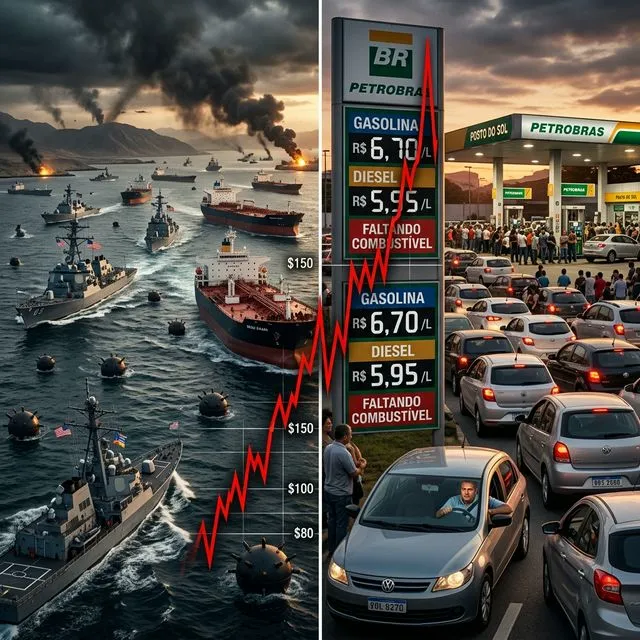
On March 8, Iran did what everyone feared: partially blocked the Strait of Hormuz.
Why Hormuz Changes Everything
- 20% of the world's oil passes through this 33-km-wide strait
- 21 million barrels per day transit through Hormuz
- If completely blocked, oil prices could reach $200/barrel in weeks
What Iran Did
- Naval mines: the Iranian Navy seeded mines in 3 shipping corridors
- Fast boats: Revolutionary Guard boat swarms harassed tankers
- Anti-ship missiles: Noor and Ghader batteries positioned along the coast
- 3 tankers seized: Iran confiscated 3 vessels — 2 Greek and 1 Indian
Price Impact
| Date | Oil (Brent) | Change |
|---|---|---|
| Mar 4 (pre-war) | $89.40 | — |
| Mar 6 | $97.20 | +8.7% |
| Mar 8 (Hormuz) | $109.30 | +22.3% |
| Mar 12 | $104.50 | +16.9% |
| Mar 19 (today) | $101.80 | +13.9% |
The Invisible Victims
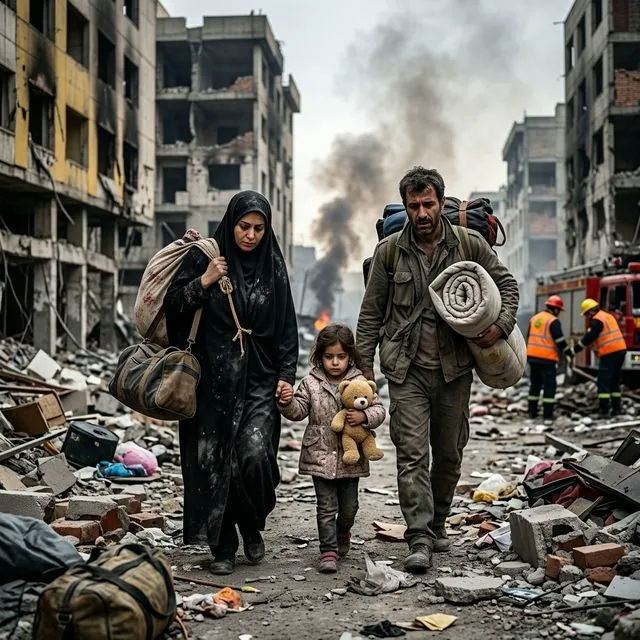
While generals discuss strategy and politicians give speeches, people die.
Numbers as of March 19, 2026
| Iran | Israel | Lebanon | Yemen | |
|---|---|---|---|---|
| Military killed | 1,420+ | 47 | 89 | 210+ |
| Civilians killed | 380+ | 34 | 156 | 45+ |
| Wounded | 3,200+ | 890 | 2,100+ | 300+ |
| Displaced | 1.2M+ | 300K | 800K+ | — |
| Infrastructure destroyed | 67% air defense | 3 air bases | Port of Beirut | 2 ports |
Estimated total: more than 2,400 killed in 14 days of conflict.
And none of them voted for this war.
The Nuclear Shadow
The elephant in the room — that nobody wants to name but everyone thinks about — is the possibility of nuclear escalation.
Where We Stand
Iran's nuclear program was damaged but not destroyed. Analysts estimate Iran retained enough capability to enrich uranium to 90% within 3-6 months if centrifuges are rebuilt.
Israel possesses approximately 90 nuclear warheads (not officially confirmed). The "Samson Option" doctrine — using nuclear weapons as a last resort if the state's existence is threatened — has never been abandoned.
The US positioned 2 Ohio-class nuclear submarines in the Persian Gulf. Each carries 20 Trident D5 missiles with up to 8 MIRV warheads each. Total: 320 nuclear warheads within 20 minutes of Tehran.
The question everyone asks — and nobody wants to answer — is: what happens if Iran manages to build a bomb before the war ends?
The World Reacts: Who Supports Whom
| Country/Bloc | Position | Actions |
|---|---|---|
| 🇺🇸 USA | Co-belligerent | Airstrikes, naval, intelligence |
| 🇮🇱 Israel | Co-belligerent | Airstrikes, special operations |
| 🇷🇺 Russia | Pro-Iran (verbal) | Condemned attacks, sold S-400 to Iran in 2025 |
| 🇨🇳 China | Neutral-concerned | Called for ceasefire, buys 40% of Iranian oil |
| 🇪🇺 EU | Neutral-critical | Called for "restraint," concerned about energy |
| 🇸🇦 Saudi Arabia | Calculated silence | Didn't criticize, didn't support. Increased oil production |
| 🇮🇳 India | Neutral-concerned | 2 ships detained in Hormuz. Requested release |
| 🇧🇷 Brazil | Neutral | Foreign ministry issued note calling for dialogue |
| 🇹🇷 Turkey | Critical of attacks | Erdogan called operation "state terrorism" |
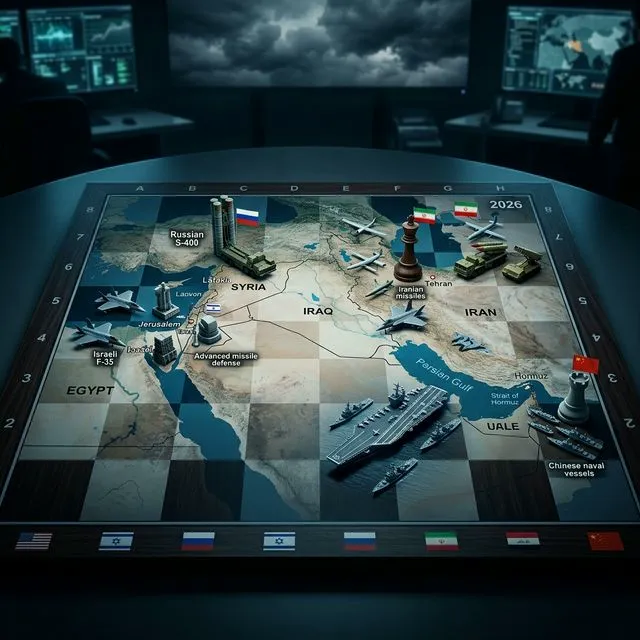
Scenarios: Where Are We Headed?
IISS (International Institute for Strategic Studies) analysts outline 3 scenarios for the coming weeks:
Scenario 1: Negotiated ceasefire (30% probability)
China and Russia mediate negotiations. Iran agrees to halt enrichment in exchange for sanctions suspension. US and Israel declare "objectives achieved." Hormuz reopens. Oil drops to $90. Optimistic scenario, but unlikely with current positions.
Scenario 2: Prolonged low-intensity conflict (50% probability)
Airstrikes decrease, but proxies (Hezbollah, Houthis) continue operating. Hormuz partially reopened with naval escort. Oil stabilizes between $95-105. A war of attrition that could last months. The most likely scenario.
Scenario 3: Catastrophic escalation (20% probability)
Iran announces emergency nuclear capability. Israel threatens preemptive nuclear strike. US faces impossible dilemma. China and Russia mobilize forces. The scenario nobody wants to think about, but history shows is possible.
The Invisible War: Cyber Attacks and Digital Warfare
While bombs fall in the physical world, another war rages in the digital realm — and this one may be even more dangerous.
The Cyber Front
Since the first airstrikes, Iran's cyber capabilities have been fully deployed:
- March 6: The American electrical grid in the Northeast suffered a coordinated attack attributed to APT33 (Iranian hacker group linked to the IRGC). 3.2 million homes lost power for 38 minutes — a demonstration of capability rather than an attempt to cause permanent damage.
- March 8: Israel's Mossad intelligence website was defaced with anti-Zionist propaganda. Simultaneously, a DDoS attack took down Israel's traffic management system for 4 hours in Tel Aviv, causing urban chaos.
- March 11: Iranian state TV suffered counter-attack attributed to Unit 8200 (Israeli cyber intelligence). The broadcast was replaced for 15 minutes with footage of Iranian anti-regime protests.
- March 14: A sophisticated worm (dubbed "Stuxnet 2.0" by analysts) was detected in Iranian nuclear control systems. Iran attributed it to the CIA. If confirmed, it would be the most advanced offensive cyber weapon ever deployed.
The Numbers of Digital Warfare
| Indicator | Iran-attributed | US/Israel-attributed |
|---|---|---|
| Confirmed cyberattacks (Mar 2026) | 847 | 312 |
| Critical infrastructure targeted | 23 | 8 |
| Data exfiltration operations | 156 | 89 |
| Disinformation campaigns detected | 2,400+ social media operations | 800+ social media operations |
| Estimated cost of damage | $2.1 billion | $890 million |
Cybersecurity expert Bruce Schneier warns: "This is the first true cyber war between nation-states. And the world is realizing, terrified, that the rules of physical warfare do not apply to the digital world. A power grid attack doesn't distinguish between military bases and hospitals."
The Information War: Narratives in Dispute
Each side tells a radically different story — and the truth depends on who you ask.
Media Narratives by Region
American media (CNN, Fox, NYT): Frame the operation as a "preventive defense against the Iranian nuclear threat." Emphasis on precision of strikes and minimization of civilian casualties. Iran portrayed as the aggressor for its nuclear program.
Arabic media (Al Jazeera, Al Arabiya): Frame the attacks as "American-Israeli aggression against a sovereign nation." Emphasis on civilian casualties, hospital footage, and displacement. Iran portrayed as a victim defending itself.
Chinese media (CGTN, Xinhua): Frame the conflict as "proof of American imperialism in decline." Analysis focused on economic impacts and opportunities for Chinese expansion in the Middle East.
European media (BBC, Le Monde, DW): Attempt to maintain neutrality with analysis of "both sides." Concerns about energy, refugees, and impact on the European economy. Growing editorial criticism of the operation's legality under international law.
The TikTok War
For the first time in a major conflict, TikTok has become the primary news source for young people (18-30):
- #IranWar accumulated 12.7 billion views in the first two weeks
- 78% of videos are from non-verified sources — mixing real footage, old videos from other conflicts, and outright fabrication
- AI-generated deepfake videos showing fictional war scenes were viewed over 340 million times before being flagged
- Iranian and American government accounts on TikTok engaged in direct propaganda wars, each producing 50+ daily posts
The result is an unprecedented epistemological crisis: for the first time in history, the majority of the global population literally cannot distinguish between real and fake war footage.
FAQ
Does Iran have nuclear weapons?
Officially no. Iran's nuclear program was damaged by the March attacks, but analysts estimate Iran retained enough knowledge and materials to rebuild within 3-6 months. Iran never confirmed enrichment above 84%, but traces of 90% were found by the IAEA in January.
Can this become World War III?
It's the least likely scenario (analysts estimate 5-10%), but not impossible. The main concern is the direct entry of Russia or China, which would transform a regional conflict into a global one. For now, both maintain military distance while supporting Iran diplomatically.
Can the Strait of Hormuz be completely closed?
Iran has the capability to severely disrupt navigation, but completely closing it would require confronting the US Navy, which is incomparably superior. The most realistic scenario is partial blockade with mines and harassment, which raises insurance costs and delays deliveries.
How does this affect oil prices for consumers?
The immediate impact is a 25-40% increase in fuel prices at the pump in most countries. European countries dependent on Middle Eastern oil are hit hardest. The US is partially insulated due to domestic shale production, but global price linkages mean Americans still see prices rise by $0.40-0.80/gallon.
What is the humanitarian situation in Iran?
The UN estimates that 2.3 million Iranians have been displaced by the bombings. Hospitals in Tehran and Isfahan are overwhelmed. Iran has restricted international media access, making verification difficult, but satellite imagery confirms extensive damage to civilian infrastructure in at least 12 major cities.
Is there an exit strategy?
Neither the US nor Israel have publicly outlined exit criteria. Defense analysts compare this to the "mission creep" problem seen in Iraq and Afghanistan. The lack of clearly defined victory conditions suggests this could evolve into a prolonged engagement, potentially lasting months or years.
Sources and References
- Reuters — "US-Israel strikes hit 200+ targets across Iran" (March 5, 2026)
- Al Jazeera — "Iran retaliates with 127 ballistic missiles against Israel" (March 7, 2026)
- International Institute for Strategic Studies (IISS) — "Iran Conflict Assessment" (March 2026)
- U.S. Energy Information Administration (EIA) — Oil Price Data March 2026
- International Atomic Energy Agency (IAEA) — Iran Nuclear Program Reports (Jan-Mar 2026)
- Federation of American Scientists — Nuclear Forces Status 2026
- Reuters — "Strait of Hormuz: mining, seizures and the oil shock" (March 9, 2026)
- Bruce Schneier — "The Coming Cyber War" (Schneier on Security, 2025)
- CrowdStrike — Iran Cyber Threat Assessment (March 2026)
- UNHCR — Iran Displacement Crisis Situation Report (March 2026)


