
There exists a point on the world map where the global economy can be strangled in a matter of hours. It's not Wall Street. It's not the Suez Canal. It's not the central server of the internet. It's a waterway just 34 kilometers wide at its narrowest point, squeezed between Iran to the north and Oman to the south, through which 21 million barrels of oil pass daily — approximately 21% of all oil consumed worldwide and one-third of all liquefied natural gas transported by sea.
In March 2026, with the conflict between the United States-Israel and Iran escalating to levels not seen since the Iran-Iraq War (1980-1988), the Iranian provisional government executed what geopolitical analysts had feared for decades: restricting the passage of commercial ships through the Strait of Hormuz. Not a total blockade — which would technically be an act of war against dozens of nations — but a "security inspection zone" where the Iranian Revolutionary Guard Corps (IRGC) detains, inspects, and in some cases redirects oil tankers for up to 72 hours.
The effect was immediate and devastating. The price of Brent crude leaped above US$ 130 for the first time since 2022. Asian stock markets crashed. Lines began forming at gas stations across Europe. And the United Kingdom, dependent on natural gas that transits through the strait, convened an emergency session of Parliament demanding "swift resolution" of the standoff.
The question the world is asking isn't whether the situation can get worse. It's why the entire planet placed 21% of its energy supply in the hands of a 34 km corridor controlled by a nation at war.
What Exactly Is Happening
To understand the crisis, a chronological context is necessary. Since Operation "Roaring Lion" on February 28, 2026 — the coordinated US-Israel strike that hit Iranian nuclear and military installations and resulted in the death of Ayatollah Khamenei — the conflict has followed a predictable but terrifying escalation:
Crisis timeline at the strait:
| Date | Event | Impact |
|---|---|---|
| Feb 28 | Operation "Roaring Lion" — US-Israel strikes on Iran | Death of Khamenei; military infrastructure destroyed |
| Mar 1 | Iranian retaliation — 708 projectiles against Gulf and Israel | Damage to port infrastructure in Kuwait |
| Mar 5 | IRGC declares "maritime security zone" in strait | Tankers begin being detained for inspection |
| Mar 8 | First European tanker detained for 48h | Brent reaches $118/barrel |
| Mar 12 | Iran fires missiles at tankers simulating "exercise" | Lloyd's of London increases insurance premiums by 300% |
| Mar 18 | Two Japanese tankers refuse to transit | Japan activates strategic oil reserve |
| Mar 22 | 17 tankers queued on both sides | Brent surpasses $130/barrel |
| Mar 25 | Trump delays ultimatum on "forced opening" of strait | Markets swing ±4% in one day |
| Mar 26 | G7 meets in emergency session in France | UK demands "resolution in days, not weeks" |
| Mar 27 | Rubio pressured to clarify US strategy | Pakistan offers mediation |
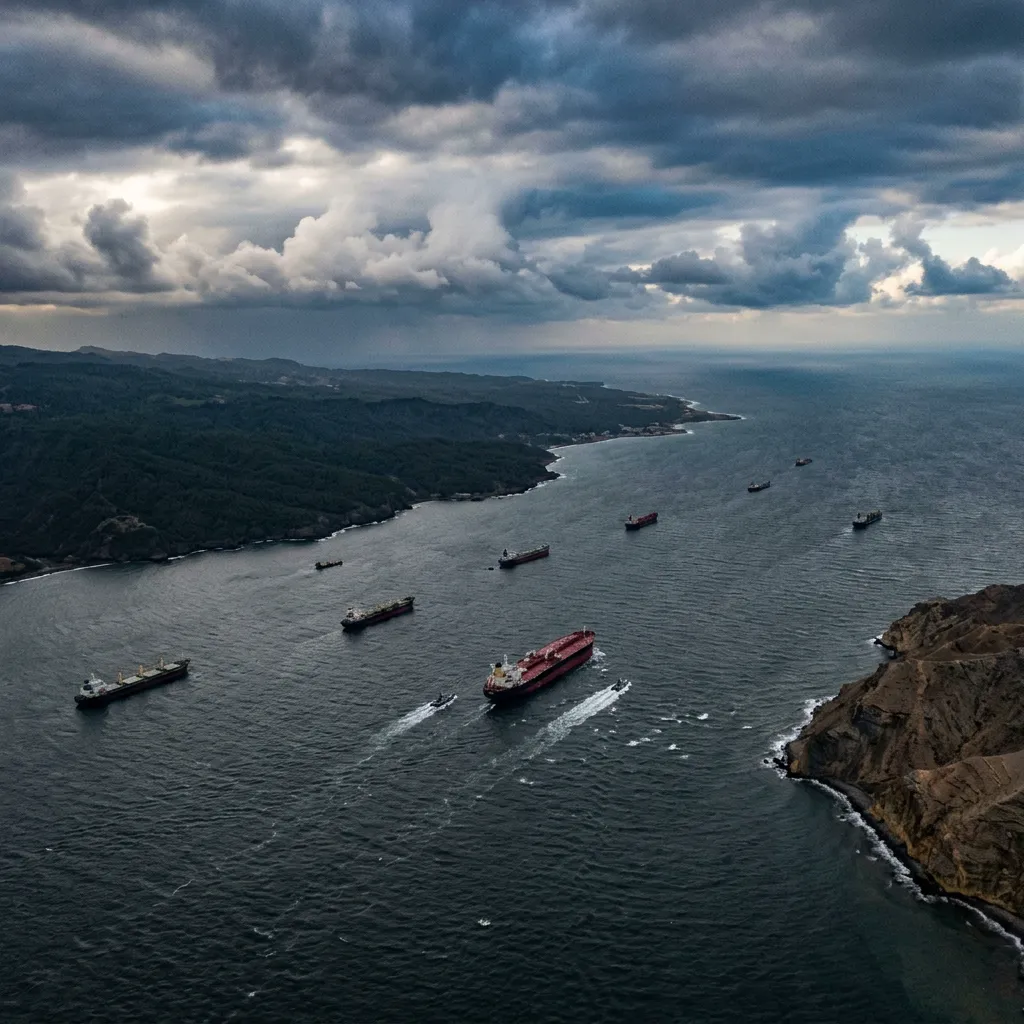
What Iran is doing technically is not a total blockade, which would be an unequivocal casus belli under international maritime law. The strategy is more sophisticated: the IRGC has established what it calls "preventive security inspection" — under the argument that it needs to verify whether ships are carrying weapons or military equipment for the enemy coalition. In practice, each tanker entering the strait is intercepted by IRGC speedboats, subjected to an "inspection" that can last 6 to 72 hours, and only then authorized to proceed.
The result is the maritime equivalent of an artificial traffic jam: the strait isn't closed, but throughput has been reduced to less than 40% of normal capacity. And 40% of 21 million daily barrels is a deficit of 12.6 million barrels per day in global supply — more than the entire output of the US (12.3 million b/d) or Saudi Arabia (10.5 million b/d).
Why the Strait of Hormuz Is So Important
Most people have never heard of the Strait of Hormuz until a crisis throws it into the news. But this waterway is, without any exaggeration, the most vital artery of the world economy — more than any stock exchange, central bank, or tech hub.
Numbers that dimension its importance:
| Data Point | Volume |
|---|---|
| Oil transiting daily | 21 million barrels (~21% of global production) |
| LNG transiting daily | ~25% of world's LNG |
| Navigable width (each channel) | 3.2 km |
| Minimum depth | 60 meters |
| Ships transiting per day | ~80-100 |
| Countries directly dependent | 30+ |
| Daily cargo value | ~US$ 2.1 billion |
The most vulnerable countries are those importing most of their oil through the Persian Gulf — and the list includes the world's largest economies:
Strait of Hormuz dependency by country:
| Country | % of oil imported via Hormuz | Strategic reserve |
|---|---|---|
| Japan | 80% | 175 days |
| South Korea | 75% | 120 days |
| India | 65% | 74 days |
| China | 45% | 90 days |
| Germany | 30% | 90 days |
| France | 25% | 90 days |
| USA | 12% | 400 days |
| Brazil | ~8% | 45 days (limited) |
Japan and South Korea are in particularly vulnerable positions: without viable alternatives for their energy imports, a prolonged disruption of the strait could literally paralyze their economies within weeks. Not coincidentally, both countries activated their strategic oil reserves even before the crisis reached its peak.
The Scenarios: From Bad to Catastrophic
Geopolitical analysts — from the Brookings Institution to the IISS (International Institute for Strategic Studies) in London — are working with three scenarios for how the crisis unfolds:
Scenario 1: Diplomatic resolution (Estimated probability: 35%)
Negotiations mediated by Pakistan (which maintains relations with both sides) and China (Iran's largest oil buyer) produce an agreement: Iran suspends inspections in exchange for guarantees of non-aggression against civilian targets and partial suspension of economic sanctions. Oil retreats to $95-105/barrel within 2-4 weeks.
The G7, meeting in France, is pushing for this solution. The problem is that Trump, under domestic pressure to show "strength," may refuse concessions perceived as "backing down." And Iran's provisional government, internally weakened after Khamenei's death, may lack sufficient authority to negotiate in a unified manner.
Scenario 2: Controlled escalation (Estimated probability: 45%)
The standoff continues for weeks or months. Iran maintains intermittent inspections as a pressure tool. The US increases naval presence in the Gulf but avoids direct confrontation. Oil stabilizes between $120-140/barrel — high enough to cause recession in import-dependent economies, but not high enough to justify direct military action to "open" the strait.
This is the scenario most analysts consider most likely. It's also the most dangerous, because it creates a "chronic crisis" that gradually erodes the global economy without a dramatic event that forces resolution.
Scenario 3: Military confrontation (Estimated probability: 20%)
The US decides that "forced opening" of the strait — using the Navy to escort tankers and neutralize IRGC positions — is necessary. Iran responds with naval mines, anti-ship missiles, and attacks on desalination infrastructure in Arab Gulf states. Oil surpasses $200/barrel. US military spending explodes. Risk of conflict expanding to include Iranian proxies (Houthis, Hezbollah).
What This Means for Your Wallet
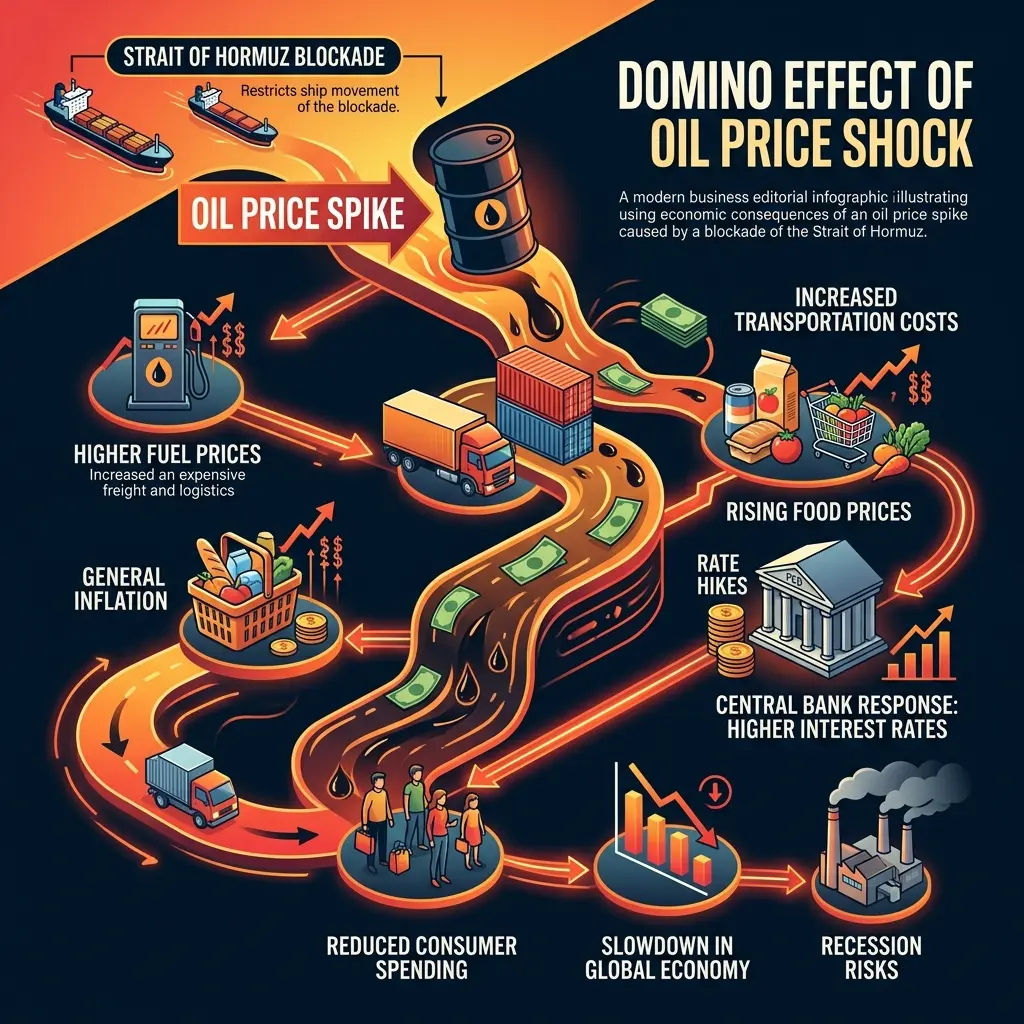
If the Strait of Hormuz seems like a distant problem for someone living in New York, London, or Tokyo, the numbers tell a different story. The price of oil is the domino that knocks everything down:
Impact chain of oil at $130/barrel:
1. Gasoline and diesel: Each $10 increase per barrel of Brent translates to approximately $0.08-0.15 increase per gallon at the pump in the US (with a 2-4 week lag). At $130/barrel, gasoline at $4.50-5.00/gallon is plausible.
2. Transportation and logistics: More expensive diesel raises road freight costs, which in most countries represents the majority of cargo transport. Food, construction materials, industrial products — everything that moves by truck gets more expensive.
3. Food: Agriculture is diesel-intensive (tractors, harvesters, transport) and uses petroleum-derived fertilizers. A sustained oil price increase can generate 3-5% food price inflation in emerging markets.
4. Airline tickets: Aviation fuel (jet fuel) represents 25-40% of an airline's operating cost. Oil at $130 means tickets 15-25% more expensive — or low-cost carriers operating in the red.
5. General inflation: The IMF estimates that each sustained $10/barrel increase in oil prices adds 0.3-0.5 percentage points to global inflation. At $130/barrel, this could push central banks to maintain or raise interest rates during 2026, strangling credit and investment.
Projected impact by region:
| Region | Inflation impact | GDP impact | Recession risk |
|---|---|---|---|
| USA | +0.8-1.2% | -0.5% | Low (enormous reserves) |
| Europe | +1.5-2.0% | -0.8% | Moderate (LNG dependence) |
| Japan | +2.0-2.5% | -1.2% | High (80% dependence) |
| China | +1.0-1.5% | -0.7% | Moderate (Russian diversification) |
| India | +2.5-3.0% | -1.5% | High (65% dependence) |
The Alternative That Was Never Built
The global dependency on the Strait of Hormuz isn't inevitable — it's the result of decades of strategic decisions that prioritized lowest short-term cost over long-term energy security.
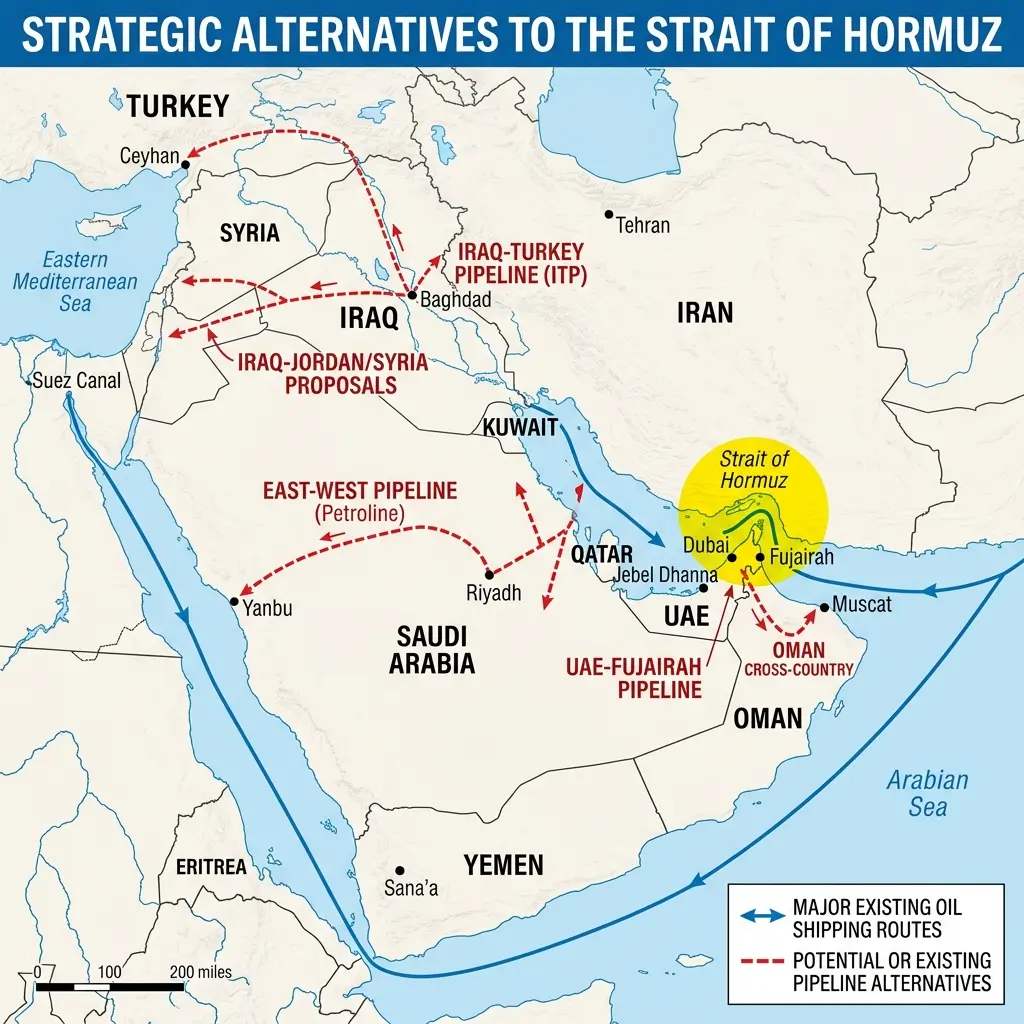
There are land pipelines that could bypass the strait:
Existing alternative pipelines:
| Pipeline | Capacity | Route | Status |
|---|---|---|---|
| East-West Pipeline (Saudi Arabia) | 5 million b/d | Abqaiq → Yanbu (Red Sea) | 3.5M b/d in use |
| ADCOP (UAE) | 1.5 million b/d | Habshan → Fujairah (outside strait) | Operational |
| Iraq-Turkey (Kirkuk-Ceyhan) | 1.6 million b/d | Iraq → Turkey → Mediterranean | Partially closed |
Combined, these pipelines could transport at most 7 million barrels per day without the strait — one-third of what transits through Hormuz. The gap of 14 million barrels simply has no viable alternative.
The reason is economic: building land pipelines costs between $1-5 billion each, crosses multiple borders with their own political risks, and historically was never justifiable because the strait "has always been open." It's the classic infrastructure problem: nobody wants to pay for redundancy until the primary system fails.
The Lesson the World Refuses to Learn
The Strait of Hormuz is the perfect example of a single point of failure in global infrastructure — a concept systems engineers know well, but energy policymakers seem unable to internalize.
Every decade, a crisis at the strait (or the threat of one) generates panic, solemn declarations about "energy diversification," and temporary investments in alternatives. And then, when the crisis passes, everything returns to normal — until the next crisis.
The difference in 2026 is that the context is more complex than ever. The energy transition to renewables is underway, but remains decades away from replacing oil as the foundation of the global economy. Liquefied natural gas — touted as a "transition fuel" — depends on the same strait. And the geopolitical tensions that elevated Hormuz's risk to critical levels show no signs of resolution.
As Admiral James Stavridis, former Supreme Allied Commander Europe for NATO, summarized: "The Strait of Hormuz is not an engineering or logistics problem. It's a problem of imagination. We can't imagine a world where it's closed — until it is."
FAQ — Frequently Asked Questions
Can Iran really close the Strait of Hormuz?
Technically yes, although not indefinitely. Iran possesses naval mines, anti-ship missiles, and IRGC speedboats positioned on the northern coast of the strait. Complete closure would be an act of war, but restricting flow (as currently being done) is strategically more effective and legally ambiguous.
How long would the world's strategic oil reserves last?
If the strait were completely blocked and no alternatives were used, the combined OECD reserves would last approximately 90-120 days. The US has the largest reserve (400 days), while countries like Brazil would have ~45 days.
Is the US directly affected?
The US imports ~12% of its oil through Hormuz and has enormous strategic reserves. However, oil prices are global — even domestically produced oil follows the Brent price. Gasoline, diesel, airline tickets, and food will all become more expensive.
Are there alternatives to the Strait of Hormuz?
Land pipelines in Saudi Arabia and UAE can transport up to 7 million barrels/day, but the strait handles 21 million. The 14-million-barrel gap has no viable short-term substitute.
When might this crisis resolve?
Analysts consider three scenarios: diplomatic resolution (35% probability, potentially achievable within 2-4 weeks through Pakistani and Chinese mediation), controlled escalation (45%, months of tense standoff with intermittent disruptions), or military confrontation (20%, forced resolution with enormous humanitarian and economic risks). The G7 emergency meeting and possible Pakistani mediation currently represent the most promising diplomatic pathways toward de-escalation.
Sources and References
- Energy Information Administration (EIA): "World Oil Transit Chokepoints" — March 2026 Update
- Brookings Institution: "The Strait of Hormuz Crisis: Scenarios and Implications" — March 2026
- International Institute for Strategic Studies (IISS): War Assessment — March 2026
- Lloyd's of London: Maritime Insurance Premium Bulletin — March 2026
- IMF: World Economic Outlook — Special Update March 2026
- Financial Times: "Oil Markets React to Hormuz Restrictions" — March 2026
- Admiral James Stavridis (ret.): Geopolitical Analysis — Bloomberg Opinion


